








Why does the where does coffee grow question matter to Tims China?
Tims, Canada's national coffee brand, entered China in 2019 with a plan to open 1,500 stores in ten years or less, starting in first-tier cities such as Shanghai and targeting office buildings and business districts. Backed by successive financing rounds and partnerships with Metro and Sinopec EasyJoy, it is expanding on a coffee-plus-bakery model priced at 15 to 30 yuan.
By May 2020 Tims had nearly 50 stores in China. After Tencent's investment, expansion accelerated: a second financing round in February 2021 funded store growth, digital infrastructure, and brand building, and reports in August 2021 pointed to a Nasdaq listing through a merger with Silver Crest. Its course still echoes the question of where does coffee grow and how source markets shape strategy.
China's coffee market is fiercely competitive, and Tims, a national brand from Canada, has been making frequent moves since entering the Chinese market in 2019. From its initial goal of 1,500 stores in ten years to securing successive rounds of financing and forming strategic partnerships with Metro and Sinopec EasyJoy, Tims China is accelerating its expansion with a "coffee + bakery" combination and a pricing strategy of 15 to 30 yuan. At the same time, its process of listing in the United States has also attracted much attention. Will Tims ultimately follow Luckin's internet-driven path, or Starbucks' third-space model? This article reviews Tims China's development trajectory and strategic layout, taking you through this young brand's path to breaking through in China's coffee market.
Although repeated outbreaks of the pandemic have dealt a considerable blow to China's catering industry, the Chinese coffee market remains an important growth area contested by domestic and international chain brands. In this highly competitive market, brands are all making their moves, and Tims, Canada's national coffee brand, has recently made remarkable progress.
On February 26, 2019, Tims officially entered the Chinese market. At that time, the CEO of Tims China revealed the brand's ambition in an interview with the media: planning to open 1,500 stores in China within 10 years or even less. Tims started in first-tier cities with relatively mature coffee consumption, such as Shanghai, and locked its store locations onto office buildings, business districts, and other areas with dense coffee-consuming populations, quickly cutting into China's rapidly growing coffee market.
It is not hard to see that Tims, this cup of Canada's national coffee, also harbors the vision of becoming China's national coffee. In May 2020, two years after entering the Chinese market, Tims had nearly 50 stores. After receiving investment from Tencent, Tims' pace of expansion clearly accelerated.
In February 2021, Tims China completed its second round of financing, saying at the time that the funds would be used for store expansion, digital infrastructure construction, and brand building. In August of the same year, reports emerged that Tims China would merge and list on Nasdaq with Silver Crest. After that, Tims China obtained investment again in December 2021 and March 2022 respectively.
Well-known venture investor Xu Xin once said: "Is Starbucks' coffee the best in the world? Then why do you think of Starbucks as soon as you drink coffee? Because you can see it everywhere, so opening stores is a solution!"
Although the words are blunt, they capture the true essence of the coffee chain industry. Although Tims China's U.S. listing has been repeatedly delayed, its pace of accelerated expansion remains high-profile. Obviously, Tims China is trying to seize market share by opening more small stores.
In November 2021, Tims China reached a strategic partnership with Metro China, becoming Metro China's exclusive cooperating coffee brand in the country. Through this cooperation, Tims successfully opened inside Metro supermarkets. Compared with Starbucks, Tims has been in the Chinese market for only more than three years and appears relatively young, but its ambition to secure a place in the coffee market is in no way inferior.
On July 26, 2022, Tims China announced a strategic partnership with EasyJoy Coffee under Sinopec EasyJoy. The two sides will explore opening small Tims coffee shops in some EasyJoy Coffee stores, while jointly developing co-branded ready-to-drink coffee and selling it in EasyJoy convenience stores nationwide.
Sinopec EasyJoy has developed rapidly in the past two years and is the chain convenience store brand with the largest number of stores in China. Sinopec operates more than 30,000 gas stations nationwide, many of which have EasyJoy convenience stores. As of June 30, 2020, the number of EasyJoy convenience stores had reached 28,000.
China's coffee market has enormous opportunities, and competition is extremely fierce across all price ranges from high-end to low-end, with each tier having well-known representative brands. In the high-end market there are Starbucks and Costa, in the mid-range market there are Luckin and Manner, and in the low-end market there are Lucky Cup and convenience store coffee, among others.
Tims once proposed the goal of "opening one offline store every 36 hours," which is quite similar to Manner in the past. In addition, Tims China regards high cost-effectiveness as one of its core competitive advantages. Tims China's chief marketing officer He Bin once said that Tims is positioned in the 15 to 30 yuan price range. At the same time, Tims does not focus only on coffee, but plays the combined card of coffee + bakery, carrying a bit of Nayuki's style. From the menu, it is not hard to find some combinations of coffee with warm food.
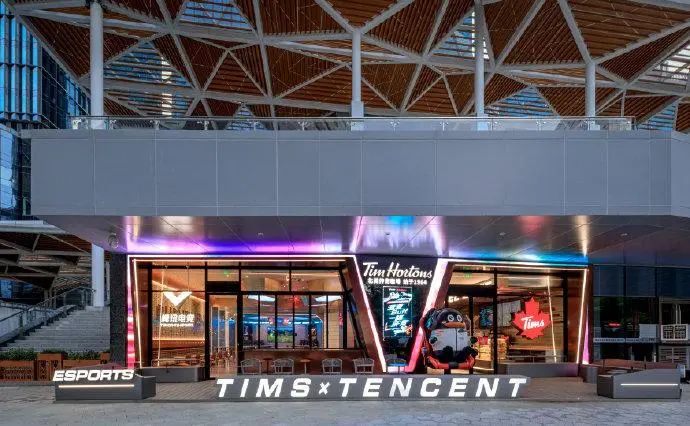
In terms of in-store experience, Tims China practices the concept of a comfortable third space. It is a common scene for consumers to drink coffee while meeting guests and discussing business in the store, which is similar to Starbucks. From the perspective of consumer usage habits, Tims China is a coffee company led by Tencent, and its production, ordering, and service processes are full of internet-based logic, which is similar to Luckin.
Tims China can be regarded as a combined-style coffee company. According to updated news from Silver Crest, the relevant business combination was declared effective by the U.S. Securities and Exchange Commission on July 20, 2022. If Silver Crest obtains approval at its shareholders' meeting on August 18, the two will complete the merger and listing.
After Tims China's business is listed in the United States, it will undoubtedly gain more ample capital support, but smoothly expanding in the market in the future will not be easy.
Image source: Internet
For more coffee bean information, please follow Coffee Workshop (WeChat public account cafe_style) For professional coffee knowledge exchange, please add WeChat ID kaixinguoguo0925
The above content is compiled by CoffeeHunters, a coffee news website.


