







What does the end of the virtual stock campaign mean for coffee marketing?
Nayuki's Tea stopped its virtual stock membership campaign on July 14, hours after launch. Members earned Nayuki coins with purchases and traded virtual shares tied to the real Hong Kong stock price of 02150.HK, with 2x to 10x leverage. After the 16:00 cutoff, virtual shares converted at 1 share to 6 Nayuki coins.
The mechanics track the same formula used to explain production of coffee beans and other commodity pricing: virtual stock price equals the Hong Kong closing price times the HKD-to-RMB exchange rate. Experts say the coins are consumption points, not securities, and no legal line was crossed, but the model is aggressive and hard to copy. Some members received conversion notices hours late.
On July 14, Nayuki's Tea suddenly announced the discontinuation of its virtual stock membership campaign, drawing widespread attention. The campaign allowed users to earn Nayuki coins through purchases and trade virtual stocks linked to real stock prices, even supporting leveraged operations. Within just hours of launch, it sparked continuous controversy, with netizens questioning its legality. Industry experts pointed out that Nayuki coins are essentially consumption points and have not yet crossed legal red lines, but the model is aggressive and not suitable for simple imitation. Meanwhile, Nayuki's frequent food safety issues have also led consumers to question its marketing strategy. This article will sort through the course of events, legal controversies, and hidden brand concerns.
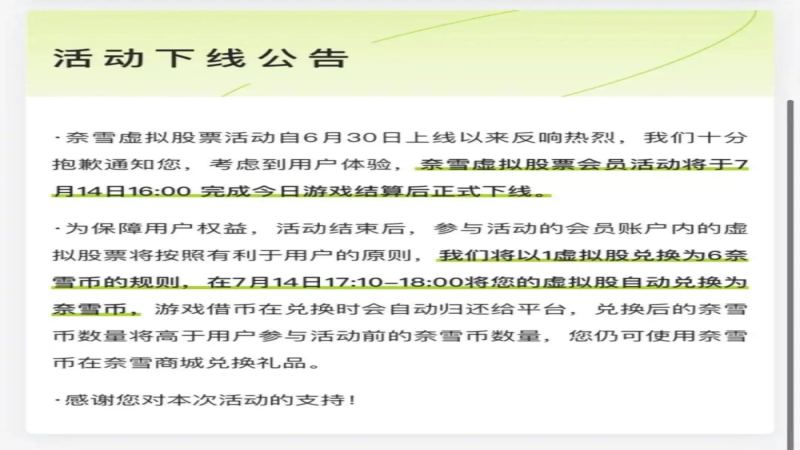
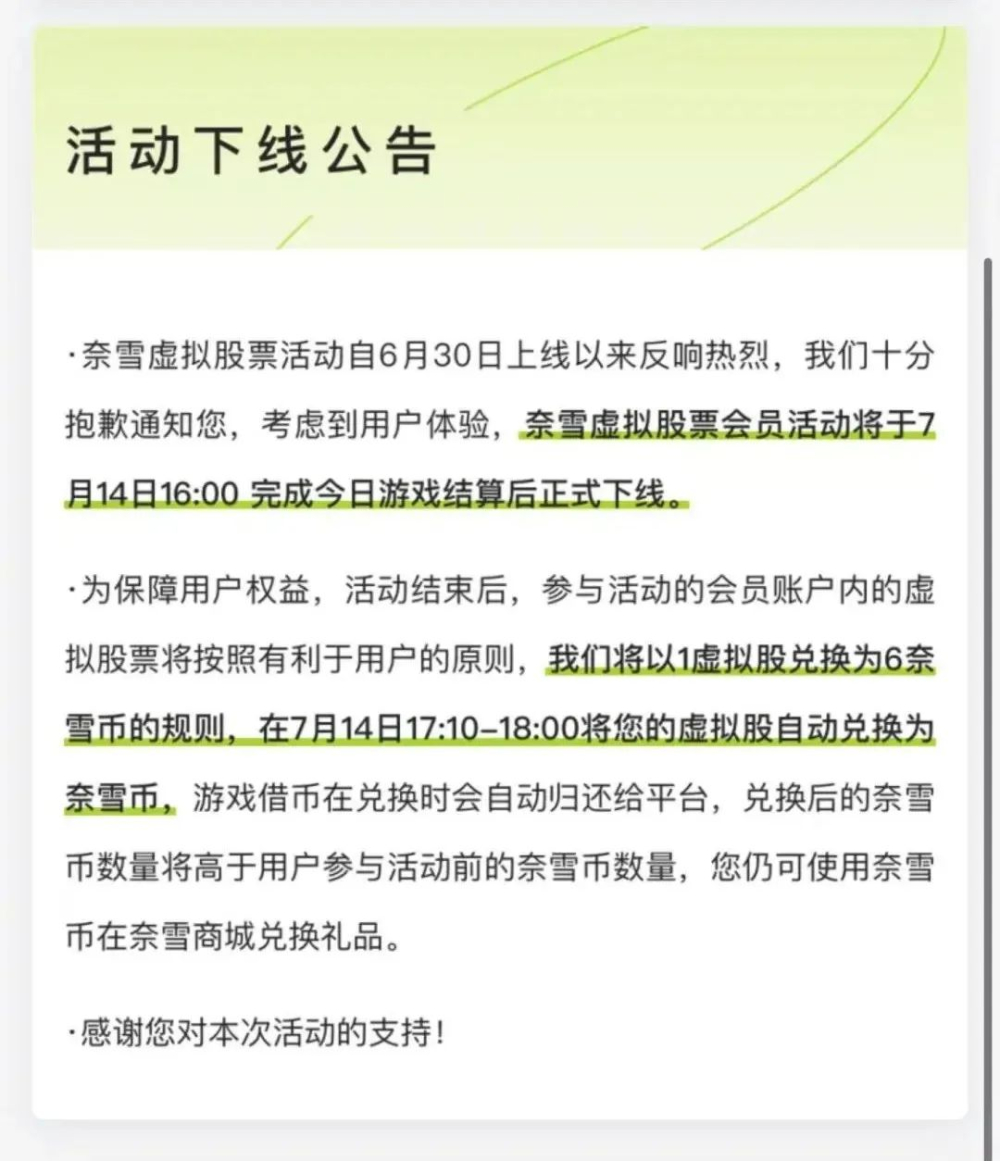
On July 14, Nayuki's Tea posted a notice in its ordering mini-program, stating that the virtual stock membership campaign had received a great deal of attention since its launch and that it had decided to officially stop the feature after the game ended at 16:00 that day.
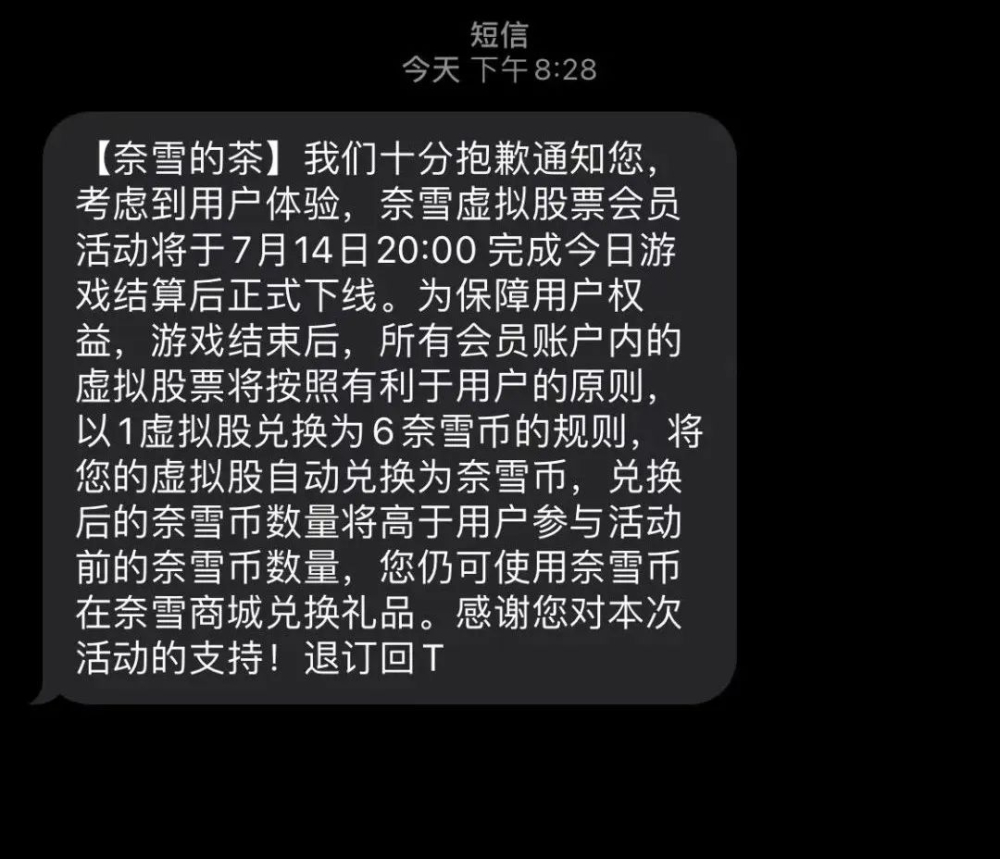
To protect users' interests, after the campaign ended, the virtual stocks held by members would be automatically converted between 17:10 and 18:00 on July 14 at a ratio of 1 virtual share to 6 Nayuki coins, under rules favorable to users. However, some members reported that although the mini-program marked the game end time as 16:00, they did not receive the notification text message until around 8 p.m., and the message showed the end time as 20:00, by which point all virtual stocks had already been converted into Nayuki coins.
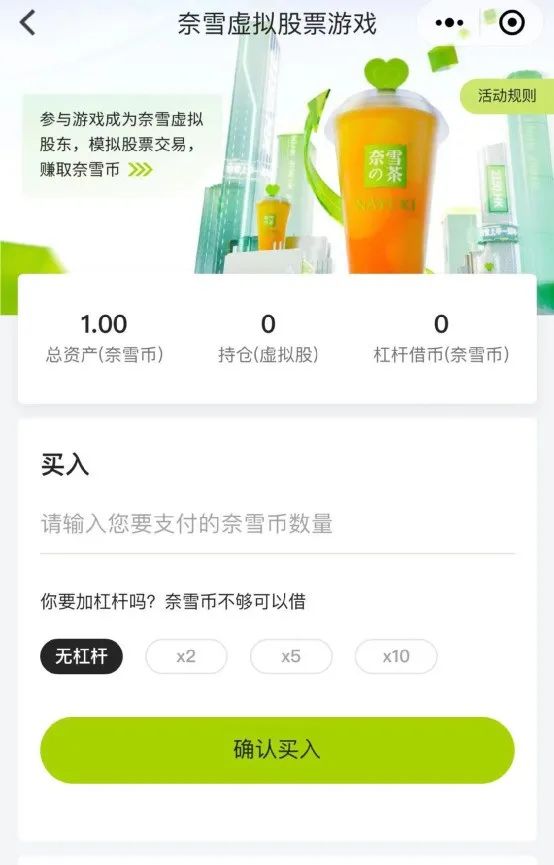
On June 30, Nayuki's Tea announced on its official WeChat account that starting immediately, every 1 yuan spent would earn 1 Nayuki coin, and users could use Nayuki coins to buy and sell virtual stocks and become virtual shareholders. The virtual stock price was linked to the rise and fall of Nayuki's real stock (02150.HK), with the formula: virtual stock price = Nayuki's Hong Kong stock closing price on the trading day × that day's HKD-to-RMB exchange rate. For example, if Nayuki's Hong Kong stock closing price on a trading day was 6 yuan, then buying 1 virtual stock required 6 Nayuki coins, and selling it yielded 6 Nayuki coins. Users could also choose 2x, 5x, or 10x leverage, and if they did not have enough Nayuki coins, they could even borrow coins from the platform.
These borrowed game coins were also reclaimed by the platform during the automatic conversion when the campaign ended on July 14. Nayuki said that after the campaign ended, the number of Nayuki coins held by users would be higher than before participating, and they could still be used in the Nayuki mall to redeem coupons, gifts, and more. After the virtual stock game launched at 11 a.m. on June 30, a large number of negative reviews emerged online within just 7 hours.
As the first milk tea stock, Nayuki has repeatedly pioneered in the metaverse field: the first to launch digital collectibles, the first virtual human, and the first virtual stock. But against the backdrop of Q coins already being regulated and the secondary market for digital collectibles being strictly controlled, such a high-profile linkage to real stock prices while allowing leverage and selling sparked questions online about its legality.
In response to the doubts, several industry insiders in the new-style tea beverage sector said that Nayuki coins are essentially consumption points, and virtual stocks are not real stock trading and will not affect Nayuki's actual stock price. Yu Jianing, co-chairman of the Blockchain Committee of the China Communications Industry Association, told China Science and Technology Finance that Nayuki coins and virtual stocks are not bidirectionally exchangeable with RMB, nor do they profit through stored-value-to-points conversion; virtual stocks can only be exchanged for Nayuki coins and used within the platform for discount activities, generating no actual returns, so they have not yet crossed legal red lines. However, he also stressed that issuing Nayuki coins based on actual consumption scenarios is currently not non-compliant, but care must be taken not to give Nayuki coins as gifts in the form of stored-value card top-ups, otherwise the combination of Nayuki coins plus virtual stocks could easily be identified as online gambling.
In addition, the platform must strictly control the redemption and use of points. If it fails to stop the posting of related advertisements on third-party platforms or by individuals, or off-platform redemption activities, the platform may be deemed to have acquiesced to reverse redemption and thus be accused of the crime of running a casino. Although Nayuki's campaign has not yet crossed the line for the time being, this marketing model is relatively aggressive, and other brands should not simply imitate it, as a slight misstep could touch legal red lines. Xiao Sa's legal team also believes that Nayuki coins are "dancing on the edge of a knife," with multiple legal controversy points, including disputes over the characterization of consumption tokens, risks in payment institutions' prepaid card business, online gambling risks, prize sales risks, and risks of illegal absorption of public deposits.
From the analyses of various parties, it can be seen that what Nayuki values is not the 50 million virtual shareholders, but raising brand attention through netizens' forwarding and discussion. In essence, this is a marketing campaign. Within 12 hours after the news was released, the Weibo topic #NayukiLaunchesVirtualStocksFor50MillionMembers# reached 200 million views, and many netizens became new Nayuki members out of curiosity and participated in the campaign.
This virtual stock campaign indeed earned Nayuki plenty of hype, but can it truly increase consumers' repurchase rate? As a representative of high-end new-style tea drinks, Nayuki has an industry-leading average order value, yet it has repeatedly exposed food safety and quality control problems. In August 2021, two Nayuki stores in Beijing were reported to have problems such as cockroaches crawling around, rotting fruit, unwashed rags, and false labels. In October 2021, a Nayuki store in Shanghai was fined 50,000 yuan for producing and selling food with false production dates, shelf lives, or food beyond its shelf life. In May 2022, a Nayuki store in Tianjin was fined 5,000 yuan for using milk beyond its shelf life.
At the end of May 2022, a woman in Shanghai bought bread "baked relatively soft" on a delivery platform, sparking heated discussion among netizens. Some netizens said that Nayuki's product quality is far worse than before, and the stronger each marketing push is, the greater the disappointment. If product quality cannot match the price, no amount of campaigns and co-branding can retain consumers' hearts. Rather than spending great effort on marketing, it would be better to do the products well down to earth.
Image source: Internet
For professional coffee knowledge exchange and more coffee bean information, please follow Coffee Workshop (WeChat public account: cafe_style)
For more specialty coffee beans, please add the private WeChat of Front Street Coffee (FrontStreet Coffee), WeChat ID: qjcoffeex
The above content is compiled by CoffeeHunters, a coffee news website.


