







How do hardness and pH shape coffee extraction?
Water quality is one of the main variables in pour-over coffee extraction. Two indicators matter most: hardness and pH. The SCAA recommends a TDS range of 75-250 ppm, yet water that more easily brews good flavor often sits below 100 ppm, since TDS shows total dissolved solids but not which minerals are present.
A moderate amount of calcium helps dissolve coffee's acidity, though too much causes scale, while a little magnesium lifts sweetness and aroma, so a balanced calcium-to-magnesium ratio is the target. Tap, filtered, purified and mineral water each behave differently, and label TDS and mineral content beat price as a guide.
When brewing pour-over coffee, water quality is one of the key variables that determines flavor expression. This article focuses on the two core indicators of water—hardness and pH—explaining the TDS range recommended by the SCAA as well as the water quality range in which good flavor is more easily achieved in actual brewing, and explaining the role of calcium and magnesium ions in coffee's acidity, sweetness, and aroma. The article will also analyze one by one whether tap water, filtered water, purified water, and mineral water are suitable for brewing coffee, reminding readers to pay attention to the TDS and mineral content on labels and avoid judging water quality based on price alone. Finally, it offers practical advice on water for daily brewing to help coffee enthusiasts reproduce coffee flavor more consistently.
Front Street Coffee will first talk about what conditions the water used for brewing coffee should actually meet. Generally speaking, there are two key aspects to look at: first, hardness; second, pH.
Let's look at hardness first. In nature, water that looks clear is not pure water without any impurities. Water usually contains dissolved ions such as calcium, magnesium, potassium, and sodium, as well as bicarbonate ions. The presence of these components directly affects the degree of water hardness, and harder water is generally not suitable for extracting coffee.
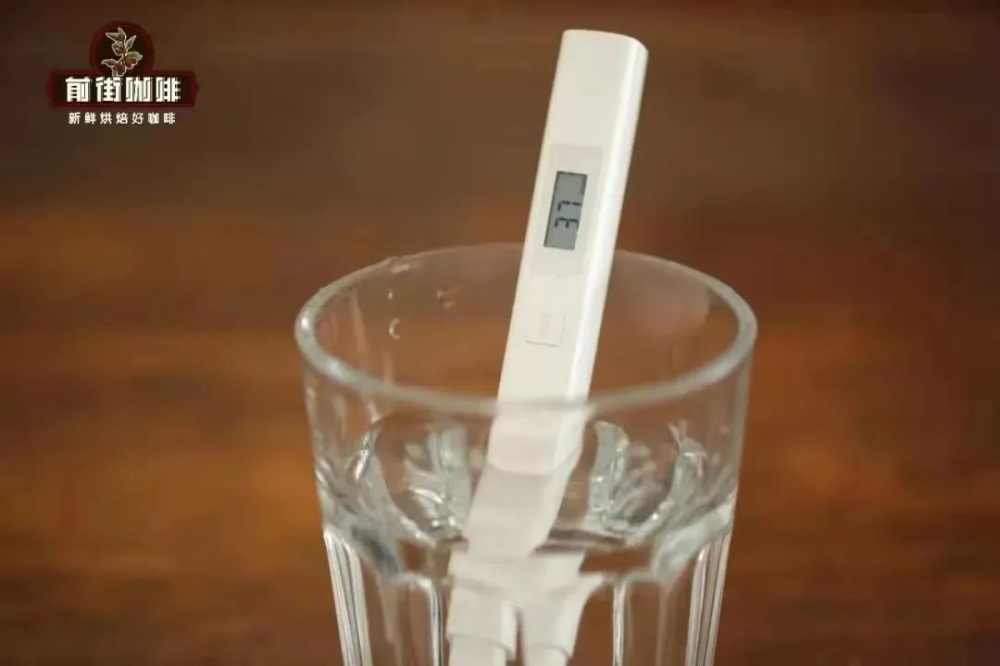
The SCAA's recommended TDS range for coffee water is 75-250 ppm, but in practice, water that more easily brews delicious coffee often has a TDS below 100 ppm.
The reason is that the TDS value can only reflect the total amount of soluble substances in water, but it cannot tell us which specific components are present or in what proportions. Related research points out that water containing an appropriate amount of calcium ions helps dissolve coffee's acidity better; but when the calcium content is too high, the problem of scale becomes very prominent. Conversely, a small amount of magnesium ions can enhance coffee's sweetness and aroma. Therefore, water with a moderate ratio of calcium ions to magnesium ions is the ideal choice for brewing coffee.
The pH of water also affects the taste of coffee. A pH value equal to 7 represents neutrality; the smaller the value, the stronger the acidity, and the larger the value, the stronger the alkalinity. Coffee itself has a pH of roughly between 5 and 6, making it a low-acid beverage. Generally speaking, when the pH of brewing water is controlled at 6.5-7, the resulting coffee tastes more pleasant.
Filtering according to these conditions, the first thing to rule out is tap water. In most regions, tap water has a relatively high TDS value. You can check the kettle at home to see whether a layer of white scale has formed at the bottom.
Even if the TDS of tap water in some regions happens to fall within the range for coffee water, trace amounts of chlorine may still remain in tap water. This is also why tap water often has a swimming-pool-like smell. Brewing coffee with this kind of water often produces a gritty mouthfeel, and the taste also seems muddled.
If a filtration device is installed at home to treat tap water, it is likewise necessary to measure the TDS value after filtration and actually brew and compare whether the taste has improved. This is because some filters have limited effectiveness, and the filtered water may still not be suitable for brewing coffee.
Second, purified water that contains no substances at all is also not suitable for brewing coffee. As Front Street Coffee mentioned earlier, an appropriate amount of calcium and magnesium ions can promote coffee extraction and enhance acidity, sweetness, and aroma. But because purified water has no minerals at all, the coffee brewed with it carries an indescribable hollow feeling; once sweetness and aroma are missing, the sourness also becomes sharp.
The last common option is mineral water. When purchasing, be sure to carefully read the mineral content on the label, and never judge water quality by price. For example, the expensive Evian water has a TDS as high as 489 ppm, far exceeding the upper TDS limit for coffee water, so it is not suitable for brewing coffee. If you plan to buy mineral water to brew coffee, it is best to first confirm the TDS value on the label and the content table of various minerals.
Finally, if you ask what water is best for brewing coffee, the answer you are most likely to get is Nongfu Spring.
The above content is compiled by CoffeeHunters, a coffee news website.


