







How Does Latte Coffee Origin Fit Starbucks' Juice Sale?
Starbucks announced it will sell its Evolution Fresh juice brand to Bolthouse Farms, concentrating resources on its coffee beverage business. The deal retains nearly 300 employees and is expected to close later this year, with terms not yet public and a limited financial impact expected. Starbucks bought Evolution Fresh in 2011 for $30 million.
The brand never matched the scale of latte and cappuccino sales that define the latte coffee origin story. IRI data showed Evolution Fresh, outside Whole Foods and Starbucks stores, held about 2% of the U.S. refrigerated beverage market. Bolthouse accounts for roughly a quarter of that category. The sale reflects a refocus on the U.S. coffee market and the unionization wave.
Starbucks is well known for its milk-based coffee drinks like lattes and cappuccinos, but it also once owned a juice brand called Evolution Fresh. Recently, Starbucks officially announced that it will sell this brand to Bolthouse Farms, thereby concentrating more resources on the growth of its coffee beverage business. The deal involves nearly 300 employees and is expected to be completed later this year. From a high-priced acquisition in 2011 to now being sold off, the fate of Evolution Fresh reflects Starbucks' strategic swings under different leaders. This article will sort out the ins and outs of this sale, and how Starbucks, after Schultz's return, is refocusing on the U.S. coffee market and responding to the wave of unionization.
When people think of Starbucks, most first think of classic milk coffees like lattes and cappuccinos. However, Starbucks actually once operated a juice brand—Evolution Fresh—though this is rarely noticed. Now, Starbucks has decided to transfer this juice brand and intends to devote more energy to expanding its coffee business.
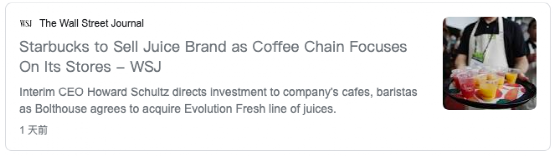
On May 24, U.S. Eastern Time, The Wall Street Journal reported that Starbucks announced that day that it had reached a definitive agreement with Bolthouse Farms, under which the latter will acquire the juice brand Evolution Fresh and its related business, which were originally part of Starbucks. Bolthouse said it will retain nearly 300 employees of the brand and expects the deal to be completed later this year, but the specific terms have not yet been made public. Starbucks said the financial impact of the deal is expected to be relatively limited.
It is understood that the Bolthouse brand currently accounts for about a quarter of sales in the U.S. refrigerated beverage industry. According to IRI data, as of last month, Evolution Fresh products sold by retailers other than Whole Foods stores in the U.S. and Starbucks stores accounted for only about 2% of the U.S. refrigerated beverage market.
Starbucks initially acquired Evolution Fresh in 2011 for $30 million, when Howard Schultz was in his second stint at the helm of Starbucks. Schultz once said that the acquisition would allow Starbucks to gain a firm foothold in the $1.6 billion premium juice and health supplement sector. After that, Starbucks successively opened several Evolution Fresh-branded juice bars, but after Kevin Johnson became chief executive in 2017, this juice business gradually became marginalized, leaving only bottled Evolution Fresh organic cold-pressed juice sold in U.S. Starbucks stores.
In 2022, Kevin Johnson stepped down from the CEO position, and Howard Schultz, then over 60, returned to take over the baton from Johnson.
Since then, Schultz has continued to push Starbucks to focus on improving its coffee business in the United States: in April, Starbucks canceled a multibillion-dollar share buyback plan and directed more funds to U.S. stores and employees; on May 23, Starbucks also announced a permanent exit from the Russian market, closing more than 130 stores and paying Russian employees about six months' wages.
At the same time, the unionization movement at U.S. Starbucks stores is growing, with more and more stores and partners hoping for better treatment. As a premium juice brand within Starbucks that is not closely related to coffee, Evolution Fresh being sold to Bolthouse, which focuses on juice beverages, can help Starbucks better build new communication bridges with emotionally volatile employees and inject new vitality into its stores.
According to U.S. Business Wire, Bolthouse, which is taking over Evolution Fresh, is very excited about the acquisition. A Bolthouse spokesperson said they appreciate the brand and are optimistic about its huge untapped potential in the premium beverage category.
Image source: Internet
For more coffee bean information, please follow Coffee Workshop (WeChat public account: cafe_style) For professional coffee knowledge exchange, please add WeChat ID: kaixinguoguo0925
The above content is compiled by CoffeeHunters, a coffee news website.


