








The Reality of Starting a Coffee Shop as an Escape
Many people dream of opening a coffee shop to leave a stressful job. One online post described it as self-destruction, sparking debate. The article examines a state-owned enterprise employee with depression who thought coffee's repetitive tasks would suit him. But running a café requires more than a love for brewing; it demands business skills, resilience, and the ability to manage finances and marketing while staying emotionally steady.
Success in coffee shop entrepreneurship depends on a genuine passion for the craft and a clear understanding of the work involved. If the main motive is to escape a difficult job, the challenges can quickly become overwhelming. The article suggests that without inner drive and careful planning, the outcome may be disappointing, reinforcing the idea that a café is not a refuge but a demanding business.
In today's increasingly prevalent coffee culture, many people harbor the dream of opening a café, hoping to escape the nine-to-five corporate life. However, a netizen's assertion that "opening a coffee shop is a standard act of self-destruction" has sparked widespread discussion. This article, by analyzing the case of a state-owned enterprise employee, explores the psychological, operational, and communication challenges behind coffee shop entrepreneurship, revealing that running a café is not as serene as it appears. Success hinges on a love for coffee, recognition of its value, and wholehearted dedication, but if the motive is merely to escape reality, the outcome often backfires.
Recently, while browsing coffee-related articles, a discussion thread titled "Opening a Coffee Shop Is a Standard Act of Self-Destruction" caught the editor's attention.
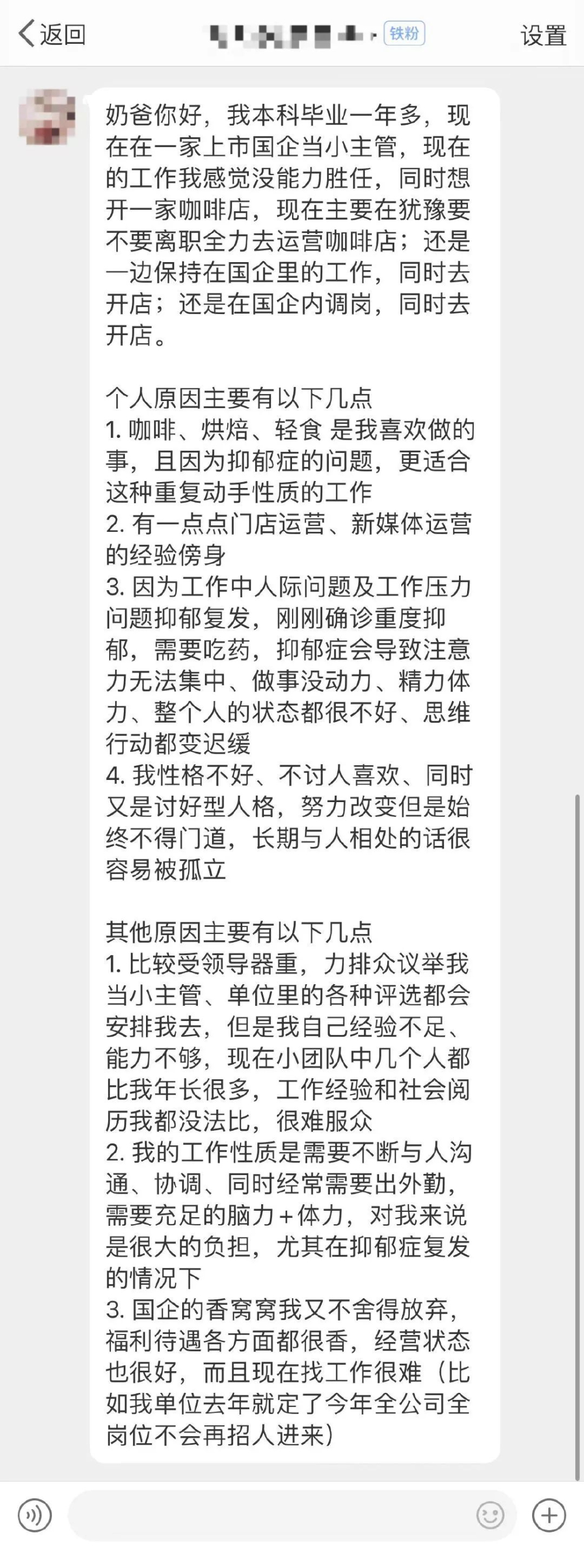
The post included a screenshot of a chat record:

The original poster wrote: "Opening a coffee shop is a standard act of self-destruction, extremely detrimental to the founder's finances, emotions, health, and even entire life. Whether part-time or full-time, it leads to disastrous consequences. If you're sick, you should seek medical help, not hide the illness and avoid treatment, toughing it out without medication or doctors—such reckless, arbitrary, escapist behavior." Although the wording is somewhat intense, it's clear the poster wants this netizen to seriously consider the real issues that need addressing.
First, let's analyze the psychological state of the netizen in the chat (hereafter referred to as Mr. Q): "Due to the pressure and interpersonal troubles in the state-owned enterprise, I developed severe depression, leading to difficulty concentrating, lack of drive, poor energy and physical condition, and overall sluggish thinking and action. Therefore, I feel I am more suited for repetitive manual work like coffee, baking, and light meals."
However, running a coffee shop relies heavily on the operator's inner drive and passion. Although Mr. Q loves coffee, he only enjoys the brewing process because it brings comfort to his emotions and mindset.
But running a coffee shop is not something you can do well just out of love—it's a business. It seems simple, but in today's society with coffee shops everywhere, successfully operating one is extremely difficult. Because you're not only responsible for making coffee but also need to focus on decoration, rent and utilities, marketing, raw material costs, etc. If your emotions and mindset are negative and you can't self-adjust, these operational costs will be hard to bear and manage, and they will further exacerbate your anxiety.
Loving coffee only sparks the idea of opening a shop, but opening a coffee shop requires far more than love—it demands appropriate marketing, operational, and management strategies based on actual conditions. Although Mr. Q mentioned having some experience in store operations and new media operations, it's clear he doesn't understand deeply and has only scratched the surface. Coupled with his state-owned enterprise background, where these store and new media operations inherently have resources and customers, Mr. Q developed the illusion that running a new coffee shop or public account would easily gain resources or customers.
Next, let's analyze Mr. Q's personality: "I have a bad personality and am not likable, yet I'm a people-pleaser. I try hard to change but never get it right. Long-term interaction with others easily leads to isolation. The reason is that I can't persuade and manage senior colleagues in the team, and as a result, I become even more afraid to communicate and coordinate with team members or clients."

From Mr. Q's statements, it's evident he lacks confidence. Because of this personality and the team's disobedience, he uses certain tones to mask his insecurity when expressing himself, or tries to force team members into compliance with a tough attitude. (Of course, this is only an inference based on his expression, not a definitive judgment of Mr. Q.)
The chat records show that Mr. Q's supervisor highly values him, which also proves that Mr. Q's abilities temporarily surpass those of the team members he leads. The relationship between seniors and juniors in the workplace has always existed, but society values ability, and the capable rise. It's normal to provoke jealousy or disobedience. Since his supervisor values him, it indicates he has a work advantage in the team.
As the saying goes, win people over with virtue. To gain others' recognition, you must first do well yourself and lead by example. When the team is initially unwilling to cooperate, stand on equal footing with team members—whatever the team does, the leader does too. Once everyone can agree on one task, then arrange the next, gradually widening the gap in responsibility and degree. By understanding and observing each person's work strengths, assign different tasks. The team needs good communication, discussion, and problem-solving together—not acting arbitrarily.
Communication is crucial whether working for others or opening a coffee shop. Whether partnering with someone or opening alone, from renting a shop onward, it's a long process of communication, and you're no longer dealing with people doing the same work as you. Landlords, renovation teams, wholesalers, customers, etc.—the people you meet outside your team can't all accommodate or cater to a personality even you find disagreeable.
Opening a coffee shop is not as wonderful as in the movies, especially now that the domestic coffee market is developing very rapidly. Coffee shops everywhere are struggling daily with the question of "how to attract new customers." Add to that the virus not yet effectively controlled, and there are simply too many unknown and uncontrollable factors!
Using opening a coffee shop to escape the nine-to-five work life is itself the wrong direction, because as an employee, you can still have at least one day off per week and have personal time after work. But opening a coffee shop means 7 days a week, 24 hours a day, except when sleeping, you need to be thinking about the coffee shop, constantly calculating various things. Although it's something you love, this pressure is no less than when working for others—it may even be greater.
What Mr. Q needs most now is to let go of the sources of pressure, use medication as an aid, and get himself out of the predicament as soon as possible... rather than opening a coffee shop and trapping himself in an endless cycle of anxiety.
Besides Mr. Q, many people from other industries now hope to apply as baristas, learn skills, and then open a coffee shop to escape the nine-to-five life. Everyone thinks being a boss is better than working for others. But in this matter, many haven't considered that entrepreneurship is a process requiring massive effort and continuous running. A café is absolutely not as serene as it appears. All successful coffee shops are inseparable from the owner's love for coffee + recognition of coffee's value + wholehearted dedication to the coffee shop... No one can succeed casually; all success comes with a lot of tears and sweat that others don't see.

Is being a coffee shop owner really better than being an employee? To quote a netizen's comment: "Opening a coffee shop is just working for others in a different posture. From pleasing one boss to pleasing many bosses." This statement captures the bitterness of entrepreneurs. So choosing to open a coffee shop just to escape reality and the nine-to-five life is truly unnecessary, because the final result won't be as one wishes.
Image source: Sina Forum Network
For professional coffee knowledge exchange and more coffee bean information, please follow Coffee Workshop (WeChat public account: cafe_style)
For more specialty coffee beans, please add private WeChat Front Street Coffee (FrontStreet Coffee), WeChat ID: kaixinguoguo0925
The above content is compiled by CoffeeHunters, a coffee news website.


