








How Do You Describe Pour-Over Coffee and Raw Coffee Flavor
Describing pour-over coffee relies on three bases: aroma, acidity, and mouthfeel. When all three match a fruit held in memory, the flavor can be named with confidence. Remove mouthfeel, as with juice, and aroma plus sweetness and sourness still identify most fruits, because each fruit carries a distinct scent.
Raw coffee is the unroasted green bean, and its flavor is grassy, earthy, and tart rather than sweet or roasted. Building a working vocabulary means accumulating flavor memories daily and grouping them through the coffee flavor wheel. Associations with color and season, such as cherry blossom foods, show how the mind links scent to context.
When drinking pour-over coffee, how do you accurately articulate the flavors you perceive? This article, drawing on Front Street Coffee's tasting experience, explores methods for accumulating flavor memories, and uses the classification logic of the coffee flavor wheel to explain, with fruit as an example, how aroma, acidity, and mouthfeel together build a judgment baseline. At the same time, through the case of cherry blossom-flavored foods, it illustrates the potential connections between flavor associations and color and season, helping you build a systematic coffee flavor description system and offering reference ideas for choosing the price of pour-over single-origin coffee beans.

In previous Front Street Coffee articles, we discussed how to lock in flavor memory points. Paying more attention to various flavor memories in daily life is very helpful for identifying flavors when tasting coffee, so the key to this matter lies in accumulation over time.
However, most people's memories are actually very easy to lose. In terms of flavor expression, this means: even though you taste a familiar flavor, you cannot accurately say what it is. Ultimately, it is because the way our brains retrieve "memories" is too crude. Think back to memorizing English vocabulary in school: using associative memory methods was far more efficient than simply rote memorization.
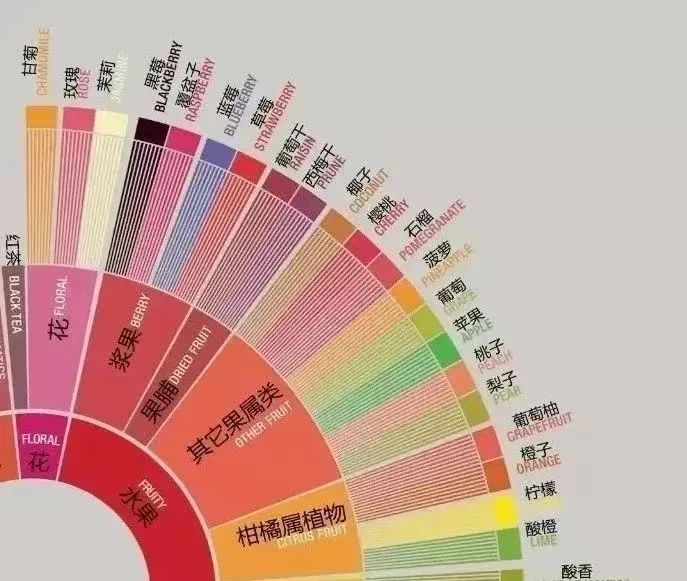
Understanding flavor works the same way. You need to know how to classify and summarize the knowledge you have already memorized. Everyone can use the flavor relationships presented on the coffee flavor wheel as a reference for organizing this. Take fruit as an example: even if blindfolded while tasting different fruits, we can still clearly distinguish them, because each fruit's unique aroma, acidity, and mouthfeel give us three dimensions for judgment. When the aroma, acidity, and mouthfeel all match a certain fruit in memory, we can naturally lock in the answer with complete certainty.
But if we remove mouthfeel, for example by juicing everything and drinking it that way, then we are left with only two bases—aroma and degree of sweetness and sourness. Even so, most people can still guess the vast majority correctly, relying on the fruit's own unique aroma.
Next, Front Street Coffee wants to tell a story: what exactly is the relationship between cherry blossom-flavored foods and cherry blossoms? Cherry blossoms give people a beautiful impression, but when made into food they often fail to win people over. In fact, cherry blossoms themselves have almost no flavor. The aroma in cherry blossom-flavored foods on the market is blended by flavorists using edible flavorings. To truly recreate the real cherry blossom flavor is indeed very difficult for flavorists, because cherry blossoms are simply too faint and have hardly any scent at all. However, they found an approach associated with cherry blossoms, and that is the feeling of spring. Whether in product packaging or in that somewhat strange sweet-and-sour taste, they are deliberately conveying a "springtime" atmosphere. Of course, the ideal is beautiful, but reality often falls short, and flavorists still have to keep working hard.
The reason Front Street Coffee tells this story is actually to explain that potential connections exist among many things, such as fruit going from sourest to sweetest, and color going from green to yellow, to red, and then to black; light things often correspond to light colors, while heavy things correspond to dark colors.
So returning to the matter of drinking coffee, what color of fruit does the degree of sweetness and sourness in coffee correspond to? Is the aroma the stimulating and vibrant citrus type, or the soft and sweet berry type, or the tropical fruit type with a strong ripe fermented quality? Following this line of thought and extending it by analogy, floral, nutty-cocoa, and roasted flavors work the same way.
However, Front Street Coffee also wants to remind you of one more thing: coffee is ultimately coffee. Tasting strawberry flavor in coffee does not mean it has become strawberry juice; coffee having a juice-like texture does not mean it is juice.
The above content is compiled by CoffeeHunters, a coffee news website.


