







Why Can't Geisha Coffee Beans Come From Brazil and Guji at Once?
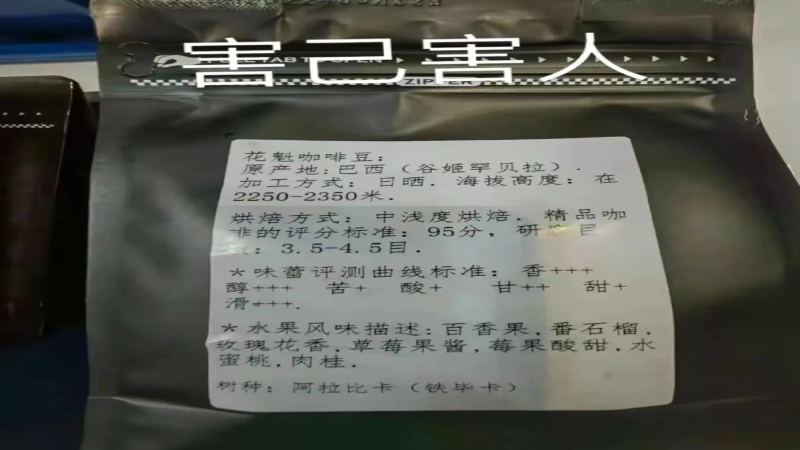
A package recently labeled Huakui geisha coffee beans with an origin of Brazil alongside Guji Hambella, which cannot both be true. Huakui is a sun-dried Ethiopian native variety from the Buku Abel processing plant in the Hambella area of Guji, Ethiopia. The lot won the sun-dried group at the 2017 Taste of Harvest green bean competition, and that result is what established the name.
The packaging also mixed up tree species, altitude, scoring standards and grind mesh size. Region and variety are separate facts on a coffee label: Ethiopia's Guji Hambella is a place, while geisha is a variety with its own history, and Brazil is a different producing country altogether. Buyers should check that origin, variety, altitude and processing method all agree before trusting a name like Huakui on the bag.
Recently, a photo of a coffee bean package went viral on WeChat Moments, boldly labeling the "Origin: Brazil (Guji Hambella)" for Huakui coffee beans, leaving many industry professionals and enthusiasts stunned. This article starts with the historical naming and variety origins of Huakui, then dissects the errors in the packaging's information regarding production region, tree species, altitude, scoring standards, and grind mesh size, clarifying that Huakui must come from the Guji Hambella region in Ethiopia, specifically the sun-dried Ethiopian native variety processed at the Buku Abel processing plant, while preserving Front Street Coffee's observations and product information about small-bean Huakui.
Last night while scrolling through my phone, I came across a post like this:
Today, while browsing WeChat Moments, a picture really got to me—a beginner coffee enthusiast bought this bag of beans (see image below). If you don't understand, go learn. If you want to work in this industry, show at least some sincerity. Using something like this to deceive people is just an insult. Fellow professionals who bought this bag of beans, I advise you to change careers as soon as possible. Stop selling coffee, and I feel sorry for the friends who bought this bag.
- zz's Coffee World
After seeing this image, the writer's mood is like this:
For a moment, I didn't even know where to begin... Everything is wrong, yet the information above is written so seriously. If you're a complete coffee novice, you'd definitely be misled by this seemingly "legitimate" content and deep(ly) bel(ieve) it (while doubting life).
From some industry professionals previously forcing a connection between Huakui and Geisha, to now directly fabricating coffee region information and attributing a bunch of irrelevant content to Huakui... We won't speculate on what these two colleagues were thinking, but before fully understanding the product itself, don't spread incorrect knowledge to consumers. If you don't know, read more books; if you haven't figured it out, don't talk nonsense, just like the meme below says:
First, let's understand the origin and naming of Huakui coffee beans.
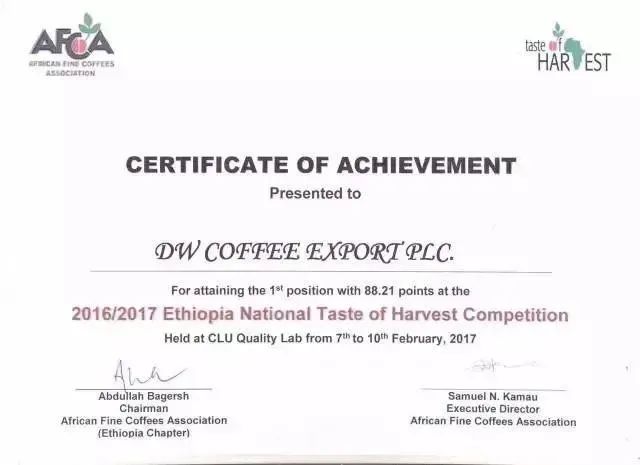
At the 2017 TOH (the Taste Of Harvest) green bean competition, a sun-dried batch of Ethiopian native variety coffee beans from the "Buku Abel" processing plant in the Hambella region won the sun-dried group championship that year, thanks to its rich strawberry and cream aroma. At that time, these beans had no name until the championship batch was imported by a green bean trader in Beijing later that year and named "Huakui." The name "Huakui" is also specifically used to refer to that batch of beans that won the sun-dried group championship in 2017.
After winning in 2017, DW Company further established processing plants in Dimtu, the core production area of Hambella, including "Buku Abel," "Buku Saysay," "Haro Soresa," and "Tirtiro Goye," with an annual coffee production of about 1,100 tons. In terms of planting regions and processing plants, among these estates and processing facilities, only beans from the "Buku Abel" processing plant's area cover the small production site that originally produced the sun-dried coffee beans "Huakui." Subsequently, Huakui 2.0 was launched in 2018, Huakui 3.0 and 3.1 in 2019, Huakui 4.0 in 2020, Huakui 5.0 in 2021, and the latest Huakui 6.0 from the 2022 season is already queuing at local ports for shipping/maritime export and has not yet arrived in China.
Besides the X.0 series Huakui, Front Street Coffee (FrontStreet Coffee) tasted flavors similar to the 2017 Huakui in the 2018 and 2019 Huakui batches, but with less body and aftertaste than the 2017 version. By comparing different batches of Huakui, Front Street realized that the main source of the 2017 Huakui's aroma was the presence of some particularly small-bean varieties in the Huakui coffee beans; similar small beans also appeared in the 2018 and 2019 Huakui, sometimes a few sacks out of ten containing such small beans. In 2019, we confirmed this information and informed the green bean supplier. Starting from 2020, Huakui split into two types: 4.0 and small-bean Huakui, so small-bean Huakui does not belong to the [X.0] series.
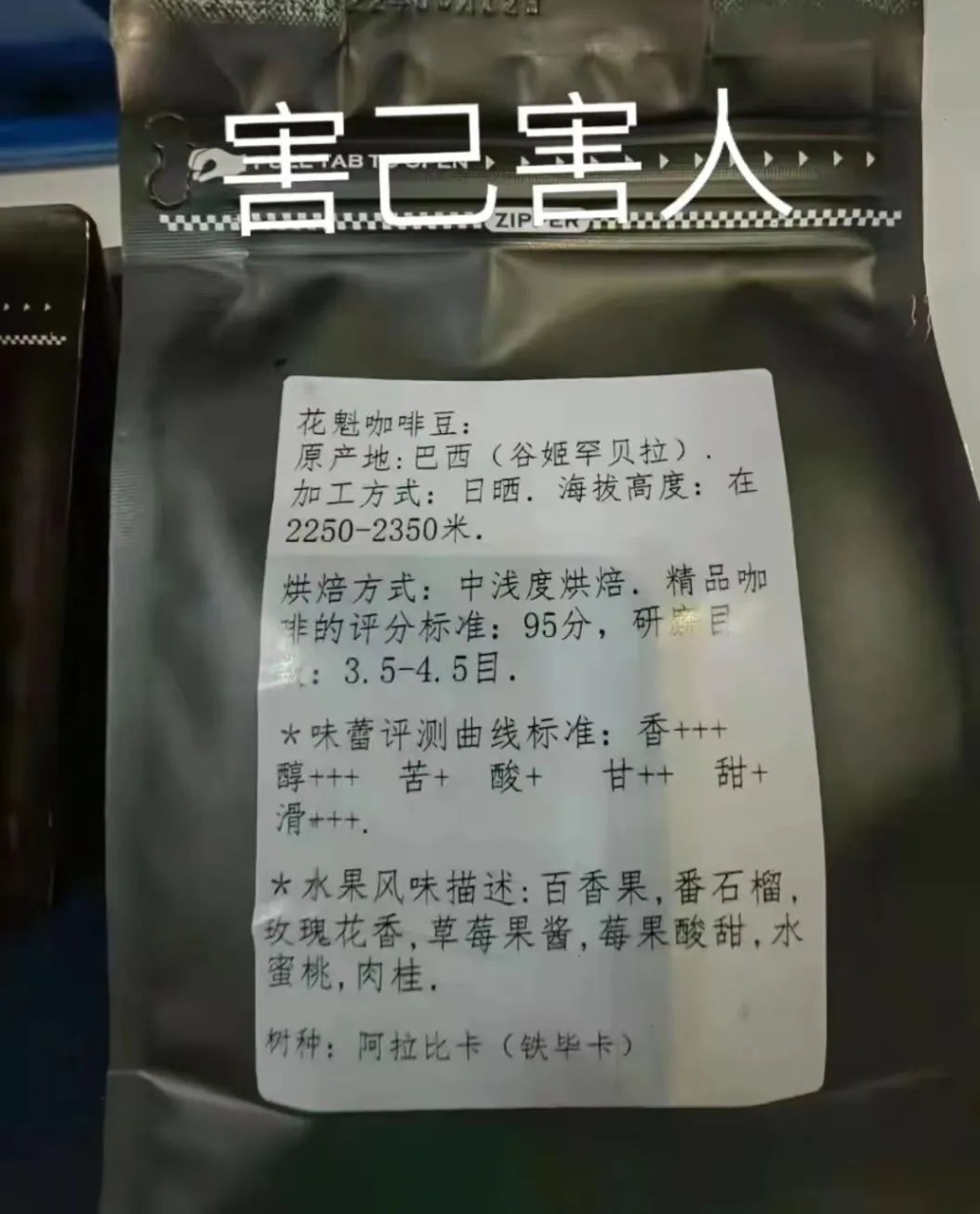
Next, let's look at the issues with the information on that bag of coffee beans in Figure 1~
"Origin: Brazil (Guji Hambella)"
Brazil is located in Central and South America and is the largest producer of Arabica coffee beans. Guji Hambella is located in Africa and is a sub-region (Hambella) under the Ethiopian coffee production area (Guji).
Binding together two places from different continents, completely unrelated and unconnected, and labeling it "Guji Hambella"—this is what shocked everyone the most upon seeing the image. From another perspective, this roaster knows that to name coffee beans Huakui, the beans must first meet one crucial condition: coming from the Guji Hambella region.
But! This does not mean all coffee beans from the Guji Hambella region in Ethiopia, Africa, can be called Huakui coffee beans! Coffee beans that can be named "Huakui" must be sun-dried Ethiopian native variety coffee beans processed at the Buku Abel processing plant under DW Company in the Guji Hambella region of Ethiopia.
"Tree species: Arabica (Typica)"
The coffee tree species determines the coffee bean variety. According to the information in Figure 1, this bag of coffee beans belongs to the Typica variety, but as mentioned earlier, Huakui coffee beans must be of the Ethiopian native variety.
So what's the difference between Typica and Ethiopian native varieties? If we go into detail, this article would become very long! So here we only discuss the most essential difference: Typica is a single coffee variety and one of the oldest coffee varieties; Ethiopian native varieties do not specifically refer to one variety but are a general term for many coffee varieties naturally mixed together.

-Ethiopian Coffee Production Region
As the birthplace of coffee varieties, Ethiopia has too many coffee varieties—it's like a natural gene bank for Arabica. On one hand, the variety is so diverse that identification and classification are difficult; on the other hand, the Ethiopian government, for protection reasons, is unwilling to disclose information about these varieties, so they are collectively called Ethiopian native varieties. Because of this diverse mix, with mixed planting and harvesting, Ethiopian native variety beans vary in size.
Setting aside the variety, Brazil wouldn't grow Typica either. Coffee trees in Brazil are all planted without shade trees, and Typica coffee trees are inherently weak and can't withstand long periods of high-temperature exposure. Secondly, Typica trees have poor disease resistance and low coffee fruit yield, making them economically unviable.
-Brazilian Coffee Production Region
Additionally, Brazil's low altitude, flat terrain, and lack of microclimates mean planting Typica would undoubtedly result in no yield. Most Arabica coffee beans grown in Brazil are of the Bourbon variety because it is vigorous, disease-resistant, and high-yielding. Although its flavor is not as exquisite as Typica, it is more economically viable.
"Altitude: 2250m-2350m"
Brazil: I didn't even know I had such a high altitude! As mentioned earlier, Brazil is a country with low altitude and flat terrain, ranging from 300m to 1500m, and Brazilian Arabica coffee trees are mostly planted at around 600-1000m.
Huakui coffee beans are indeed grown at an altitude of 2250m-2350m, but not in Brazil—this altitude corresponds to the Guji Hambella region in Ethiopia.
"Specialty Coffee Scoring Standard: 95 points"
Let's not discuss other things first. Whether using SCA or COE scoring, if Huakui coffee beans could reach 95 points, they would definitely not be something ordinary consumers could buy for daily use.
According to SCA cupping standards, a score below 80 means it doesn't reach specialty level, and only above 80 can be called specialty coffee beans. Generally, 80-84.99 is called Very good, 85-89.99 is Excellent, and 90-100 is Outstanding.
According to COE cupping standards, below 70 is slightly poor commercial beans. 70 to 74.99 is general commercial beans, 75 to 79.99 is premium commercial beans, 80 to 86.99 is specialty coffee, and 87 or above is COE competition level, also known as Cup of Excellence winning coffee, currently recognized internationally as the highest level in the coffee world.
"Grind mesh size: 3.5-4.5 mesh"
Mesh refers to the number of holes per square inch on a sieve; the higher the mesh, the more holes. Besides indicating sieve holes, it also represents the particle size that can pass through the sieve; the higher the mesh, the smaller the particle size. Mesh refers to the number of holes, i.e., the number of holes per square inch; the larger the mesh, the smaller the aperture.
Ground coffee powder is not measured using mesh/mesh size. Generally, the grind particle size for pour-over coffee is 600-800 micrometers, similar to the coarseness of granulated sugar. If converted to mesh, it's roughly 22-26 mesh.

"Taste Bud Evaluation Curve Standard"
Perhaps the writer is ignorant, but I've never heard of such a standard... For evaluating the quality of coffee beans, the most authoritative cupping scoring systems currently are SCAA and COE.
According to the SCA cupping system, the scoring items are divided into 11 categories: dry/wet aroma, flavor, aftertaste, acidity, body, consistency, balance, cleanliness, sweetness level, overall evaluation, and defect deductions.
According to the COE cupping system, the items are divided into 9 categories: dry/wet aroma, cleanliness, sweetness, acidity, mouthfeel, flavor, aftertaste, balance, and overall evaluation.
"Fruit Flavor Description"
This should refer to coffee flavor description. If this really is a sun-dried Ethiopian native variety Huakui coffee bean from the Buku Abel processing plant in the Guji Hambella region of Ethiopia, then after roasting to a medium-light level, having such coffee flavors is reasonable.
But note that coffee beans are agricultural products, and their flavor can vary slightly each year due to changes in regional climate, soil, or processing methods. Despite variations, the main flavor profile of the variety is still retained, so not every batch or season of Huakui presents the same flavor. Although in recent years the main profile of Huakui coffee beans has been full-bodied berry sweetness and acidity, not every season has rich flavor layers.
This article hopes every coffee person can understand all aspects of coffee knowledge under proper guidance. It also hopes every coffee professional takes responsibility for their actions and words.
Image source: Internet, Xiaohongshu, cafe imports
For professional coffee knowledge exchange and more coffee bean information, please follow Coffee Workshop (WeChat public account: cafe_style)
For more specialty coffee beans, please add private WeChat Front Street Coffee (FrontStreet Coffee), WeChat ID: kaixinguoguo0925
The above content is compiled by CoffeeHunters, a coffee news website.


