







What replaces paper straws in coffee shops?
Paper straws are being withdrawn from the market as manufacturers shut down production lines, according to a March 20 report by CCTV Finance. Complaints about mouthfeel and straws degrading during use pushed food service outlets to switch. PLA straws, made from plant starch such as corn, wheat and cassava, are now the mainstream replacement and break down fully.
PLA straws handle drinks from about minus 10°C to 70°C, so they suit both cold and hot beverages. Their drawbacks are a short shelf life and higher cost. Research teams are also testing edible bacterial cellulose straws that decompose within 60 days when buried in soil, part of an ongoing trade-off among cost, drinking experience and degradability.
Paper straws once swept through the food service industry in the name of environmental protection, but they have been widely criticized for their poor mouthfeel and tendency to degrade right in your mouth, and are now gradually withdrawing from the market. Their replacement, PLA straws, are made from plant starch, are fully biodegradable, and handle both cold and hot drinks, but they have a short shelf life and a relatively high cost. Meanwhile, research teams have developed edible bacterial cellulose-based straws that completely decompose within 60 days when buried in soil. From paper straws to PLA to coconut jelly straws, behind the iteration of eco-friendly straws lies a trade-off among cost, experience, and degradability. This article reviews the current state of paper straw production shutdowns, the market prospects for PLA straws, and research progress on new edible straws, along with Front Street Coffee's specialty bean news.
The source of young people's happiness is nothing more than drinking coffee, milk tea, and cola!
So how do you "add a little frustration" to that happiness?
"Hand them a paper straw."
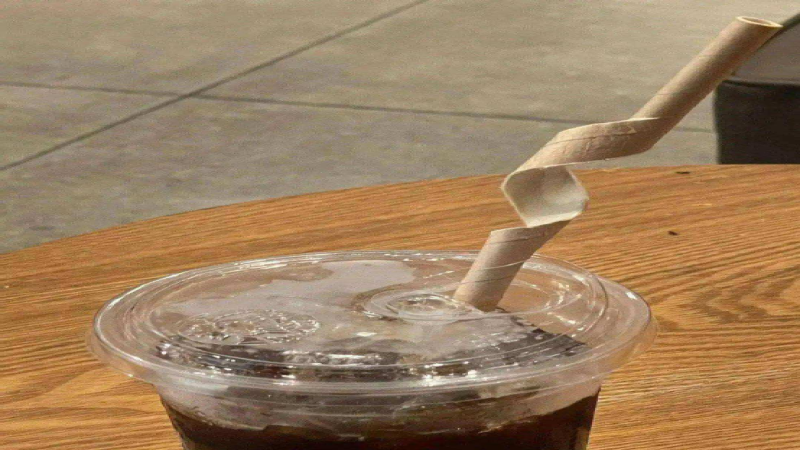
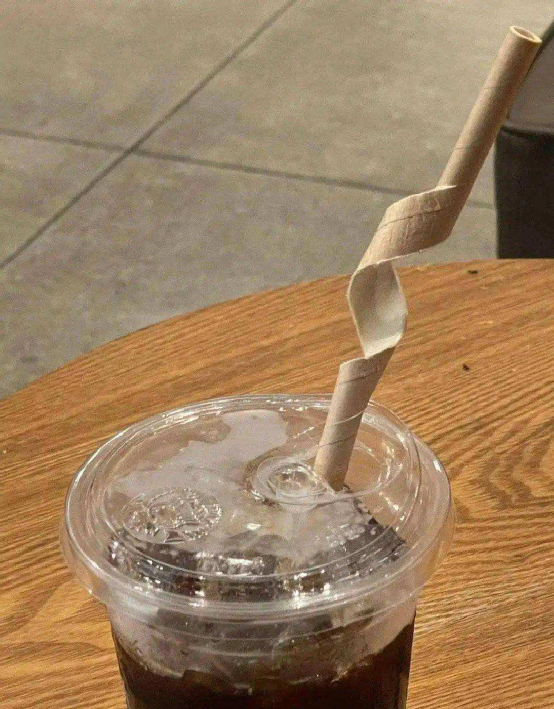
That's right, this paper straw, born under the banner of "environmental protection," once marched into all kinds of food service outlets and squatted in straw dispensers for more than a year. But the eco-friendly thing about paper straws isn't just that they biodegrade—they also degrade in your mouth. So the reason paper straws kept trending has nothing to do with environmental protection, but with their "anti-human" experience.
As negative reviews piled up, paper straws were eventually squeezed out of the market, replaced by biodegradable straws called PLA, which gradually became mainstream.
PLA straws, also known as polylactic acid straws, are made from starch extracted from plants such as corn, wheat, and cassava, and can achieve full biodegradability. Their applicable temperature range is roughly between minus 10°C and 70°C, making them suitable for both cold and hot drinks. Compared with paper straws, most consumers are also more willing to choose polylactic acid straws.
Demand for PLA straws expanded rapidly, and the other side of that was naturally the quiet decline of paper straws.
According to a March 20 report by CCTV Finance, many paper straw manufacturers have successively entered the production shutdown stage. A production team leader at a paper products company in Zhejiang revealed that when demand for paper straws was at its peak, each of 24 machines produced at least 80,000 straws per day, with a maximum of 140,000; now only 5 machines are still running each day, with daily output of just 500,000 straws. The head of the paper products company said that over the past year or so, from a big rise to a big fall, this roller-coaster experience is still being digested, and the machines are not easy to sell either.
The reasons for the decline in paper straw production are, first, poor consumer experience, and second, the pandemic reducing export volumes; moreover, abroad, paper straws have also been received mediocrely by consumers, so many countries have also begun importing PLA straws.
Many researchers at home and abroad have said: Paper straws actually aren't that eco-friendly! First, paper straws are made from composite materials such as "paper + plastic coating," and are not as easy to degrade as imagined; Second, the tendency of paper straws to come apart forces manufacturers to keep thickening the walls, and as a result a large number of paper straws are too thick to be recycled.
So are PLA straws really eco-friendly? Compared with paper straws, they can indeed achieve true natural degradation, but their weakness is a short shelf life. After being stored for a year, the performance of PLA straws drops sharply, and they crumble into powder with a twist of the hand (showing that they really are easy to degrade), so many manufacturers of PLA straws do not dare to stock large quantities, which invisibly raises the cost of PLA straws.
Plastic straws cost 0.05-0.06 yuan each, paper straws cost 0.07-0.08 yuan each, and PLA straws cost 0.12-0.13 yuan each. The increase in cost has also prompted businesses to switch back to plastic straws. But Weng Yunxuan, secretary-general of the Degradable Plastics Professional Committee of the China Plastics Processing Industry Association, said that in 2020 domestic polylactic acid production capacity was only about 60,000 tons, while today polylactic acid production capacity has reached 150,000 tons. As production capacity increases, the price of polylactic acid will also come down. This also means that PLA straws may become the next new trend in eco-friendly tableware.
Not long ago, Coffee Workshop also reported that there is now a straw made from coconut jelly. The research team of Chinese academician Yu Shuhong developed an "edible" bacterial cellulose-based straw with excellent performance through a strategy of biosynthesizing bacterial cellulose and compounding it with the seaweed extract sodium alginate. This bacterial cellulose-based straw almost disappears after 45 days buried in soil, and can fully integrate into the soil after 60 days.
Are coconut jelly straws tasty? Although the material is edible, that does not mean it is delicious; it can only be described as a safe, edible straw. This kind of straw's strength, modulus, and toughness are more than twice those of paper straws. The cost per straw may be similar to that of PLA straws, but it can be stored for longer.
Actually, no matter what material a straw is made of, even if it can degrade naturally, it is still a disposable item. If you really want to be eco-friendly, why not start by reducing the use of disposable items~
Image source: Internet, CCTV Finance
For professional coffee knowledge exchange and more coffee bean information, please follow Coffee Workshop (WeChat public account: cafe_style)
For more specialty coffee beans, please add the private WeChat of Front Street Coffee (FrontStreet Coffee), WeChat ID: kaixinguoguo0925
The above content is compiled by CoffeeHunters, a coffee news website.


