







Why Do Yellowing Point and First Crack Matter When Learning Coffee Roasting
Two milestones decide how a roast tastes: the yellowing point and the first crack. Beginners often misjudge both by eye and ear, and a wrong call on the first crack leaves coffee underdeveloped with a baked, astringent flavor. The fix is to treat temperature and aroma as auxiliary signals for the yellowing point instead of relying on color alone.
Front Street Coffee's roasting course stresses that curve data should not be copied mechanically. A new roaster needs two or three batches to get a feel for heat and airflow adjustments, and temperature rise lags by about 30 seconds after each change. Learning coffee at this stage is about understanding the logic behind the data, not memorizing numbers, so the words used to describe coffee taste match what is actually in the cup.
In the process of learning coffee roasting, there is often a gap between theoretical understanding and hands-on practice. This article focuses on judging two key milestones: the yellowing point and the first crack point. It analyzes one by one the visual and auditory misjudgments that beginners easily make, and provides temperature and aroma as auxiliary indicators for the yellowing point. It also explains how deviations in judging the first crack point can lead to underdeveloped flavors and astringency in coffee. Combining the roasting course philosophy of Front Street Coffee, the article reminds readers not to mechanically copy curve data, but to understand the logic behind the data, so as to find a roasting path that truly suits them.
We must face a fact: theory usually looks flawless, but in reality, things often don't follow the script. For example, when you carefully study the content on roasting curves from the first five lessons of Front Street Coffee, you gain a general understanding of concepts like the drop point, yellowing point, first crack point, heat, airflow, and time.
But when you confidently start your first hands-on session, you find yourself in the predicament of "your brain says you've got it, but your hands say no"—the temperature won't rise, there's too much smoke when discharging, you're so focused on recording data that you forget to adjust the heat, and you're all over the place. After roasting a few batches, your confidence is severely shaken.
This situation is completely normal. To get familiar with operating a roaster and understand the relationship between adjusting heat and airflow and the rate of temperature rise, you rely heavily on feel. Even experienced masters, when switching to a new machine, need to roast two or three batches to get the hang of it. So, the first hurdle in practice is mastering the roaster's operation—put simply, being able to achieve your desired temperature by adjusting the heat. (Note that temperature rise has a lag; after adjusting the heat, it generally takes about 30 seconds to see a change, so you need to learn to anticipate.)
After passing the "roaster operation" hurdle, don't celebrate too soon, because at this point you're just an "emotionless boiler operator." Like a new driver who just got their license and is on the road for the first time, you'll find that the standardized and fixed maneuvers from driving school are almost useless in real traffic.
Although you've now grasped the basic theoretical knowledge of roasting and understand the principles behind judging the yellowing point and first crack point, when it comes to actual operation, your mind is full of questions: "Has it changed color?" "It should be yellow by now, right?" "Did I just hear a crack?" "Why is the second crack taking so long? Does that first sound even count?" "Or did I mishear?"
You'll start doubting your eyesight and hearing. As a beginner, when judging these key milestones, it's best to stay as consistent as possible with common standards; otherwise, when communicating with others, it's easy to end up in an awkward "chicken-and-duck" conversation. Front Street Coffee here tries to describe in words all the situations that might lead to misjudgment.
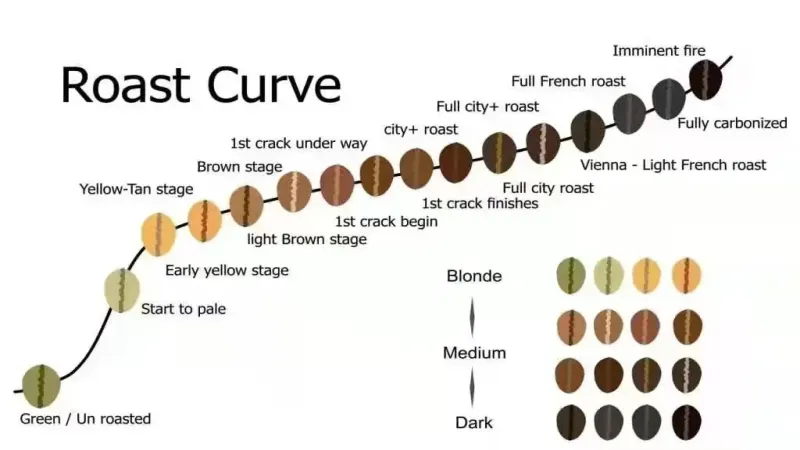
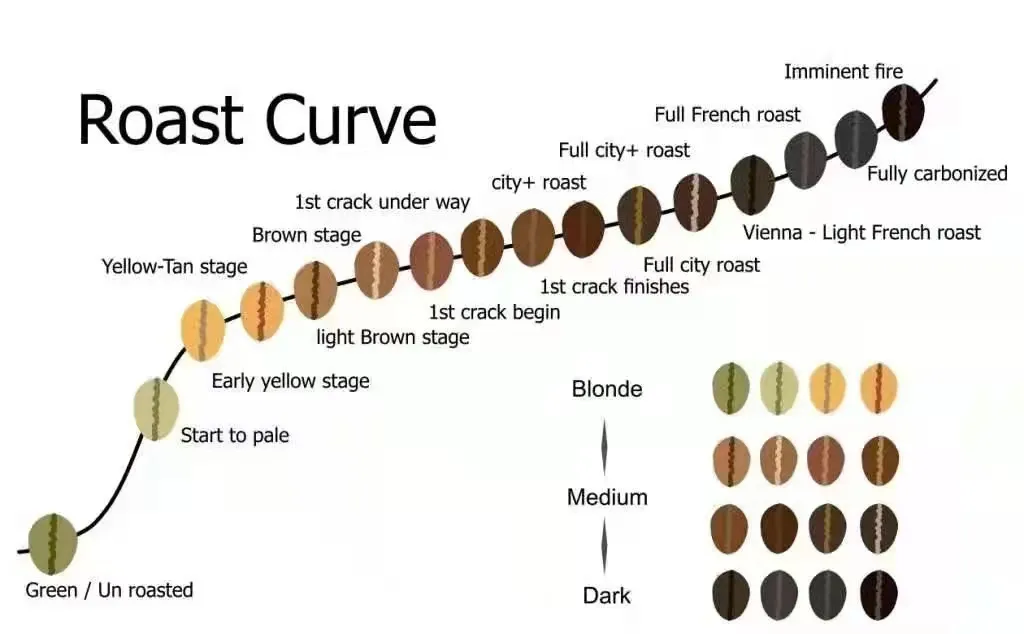
In judging the yellowing point, washed coffee beans are relatively easy to identify, since the color change from pale green to yellow is quite visual. But sun-dried or anaerobic sun-dried coffee beans are not so easy to judge, because their green beans are already yellowish, and the color value change during yellowing is not significant enough. In addition, Front Street Coffee adds two auxiliary indicators: first, temperature—yellowing typically begins only after 150°C; second, aroma—before yellowing, the beans have a grassy and wheat-like scent, and after yellowing, these odors fade, replaced by a sweet corn-like fragrance.
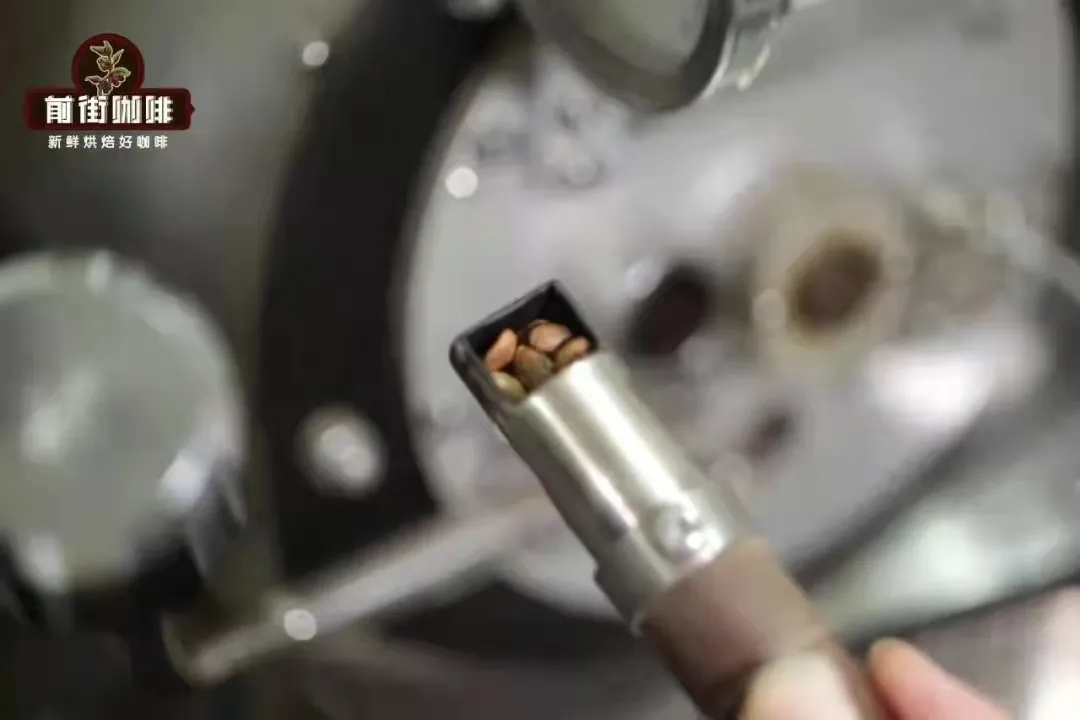
The judgment of the first crack point directly affects the overall discharge time, and our basis for deciding to discharge is the development time after first crack and the discharge temperature. Suppose "your judged" first crack time is later than the "actual" first crack time; then, assuming the same recorded development time, your roasted coffee will be darker than others'. Conversely, if "your judged" first crack time is earlier than the "actual" first crack time, with the same development time, your roasted coffee will be lighter than others', potentially resulting in underdeveloped flavors. (A 20-second difference in development time already makes a very noticeable change in flavor.)
Why is the "first crack" point so difficult to judge? Front Street Coffee's criterion for the start of first crack is: the second consecutive cracking sound. The sound of first crack is very crisp, similar to the "crackling" sound made when using an electric mosquito swatter to hit a mosquito.
Front Street Coffee believes the reason misjudgments easily occur is that before the crisp "crackling" sound appears, there are often "false crack" sounds interfering. False cracks are not as crisp and sound duller, mainly from defective beans or scattered beans that roast faster and crack early—these beans crack due to insufficient heat absorption because of their own defects, so the sound is naturally muffled. Some individual coffee beans might crack early purely due to their position, often at the bottom during drum rotation, absorbing more heat than others, and thus cracking first with a crisp sound, but after one crack, the second one is delayed—these are "early runners" and don't count as the first sound of first crack.
The last thing that drives beginners crazy is: "I followed the roasting curve, and I was satisfied with the bean color value when discharging, but when I tasted it, it was awful." This is really maddening—after working hard to roast a batch of coffee beans you think is decent, you wait impatiently for 8 hours to cup it, only to be hit with a harsh disappointment.
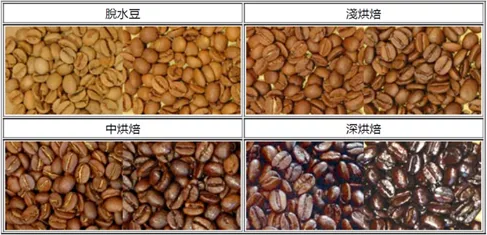
If you're currently facing this situation, don't lose heart. "There are countless curves that can roast good coffee, and roasting curves are infinite—is it possible that the curve you used was never suitable for you from the start?" In the previous roasting courses, Front Street Coffee also mentioned that you shouldn't directly copy data from roasting curves shared online, but understand the logic behind the data. By identifying the reasons in each failed roast and plugging these defects one by one, you'll be able to find a curve that belongs to you.
The above content is compiled by CoffeeHunters, a coffee news website.


