







Why Do Coffee Particles Matter for Pour-Over Grind Size?
Grind size is the hardest pour-over variable to control, and the usual fix is a target of 80% passing a No. 20 sieve, which separates particles above and below 0.85mm. That single number hides a lot, because the sieve cannot show whether the remaining coffee particles sit near 0.3mm or 0.6mm. Two grinders can hit 80% and still brew very differently.
Uniform grinders such as the EK43s produce mostly particles around 0.6mm, few above 1mm, and few fines. Grinders with a wider spread leave visible coarse pieces and dust, which shifts extraction. Hand grinder RPM control, staged pull-back grinding, and a single-pour flush to wash fines out of the bed are practical ways to narrow that spread and find repeatable settings.
Grind size is the most difficult aspect of pour-over parameters to master. Front Street Coffee uses an 80% pass rate through a No. 20 sieve as a beginner-friendly calibration baseline, but different grinders perform vastly differently, and the same sieve pass rate can produce completely different flavor outcomes. This article focuses on grind calibration, first explaining the limitations of the sieve method and the particle size distribution characteristics of uniform grinders like the EK43s, then offering remedial solutions for inferior grinders, including hand grinder RPM control, the pull-back technique of staged grinding, and adjustment directions when excessive fines cause off-flavors. Finally, it discusses how to judge whether sieving flour is necessary and the practical technique of a single-pour flush to wash away fines, helping you find grind parameters that suit you.
This "correct" value is not absolutely unique — it is simply a figure that Front Street has summarized through long-term exploration, and it is quite friendly to beginners, allowing them to reach the finish line with ease.
As you delve deeper into the world of pour-over, you will always want to try some new tricks. Once you thoroughly understand each parameter and know which direction the coffee flavor will move when you change a certain variable, you will eventually develop your own brewing philosophy.
Among all the parameters, grind size is the easiest to get wrong. Other parameters are relatively easy to lock in, but grind size always keeps people guessing. Although every café tries its best to help customers understand grind size, Front Street's approach is to calibrate by sifting through a No. 20 sieve.
A No. 20 sieve can only separate particles larger than 0.85mm from those smaller than 0.85mm. As for whether the remainder is mostly small particles around 0.3mm or medium particles around 0.6mm, the sieve cannot tell. Add to that the wildly different performance of the grinders everyone uses, and unifying standards becomes even harder.
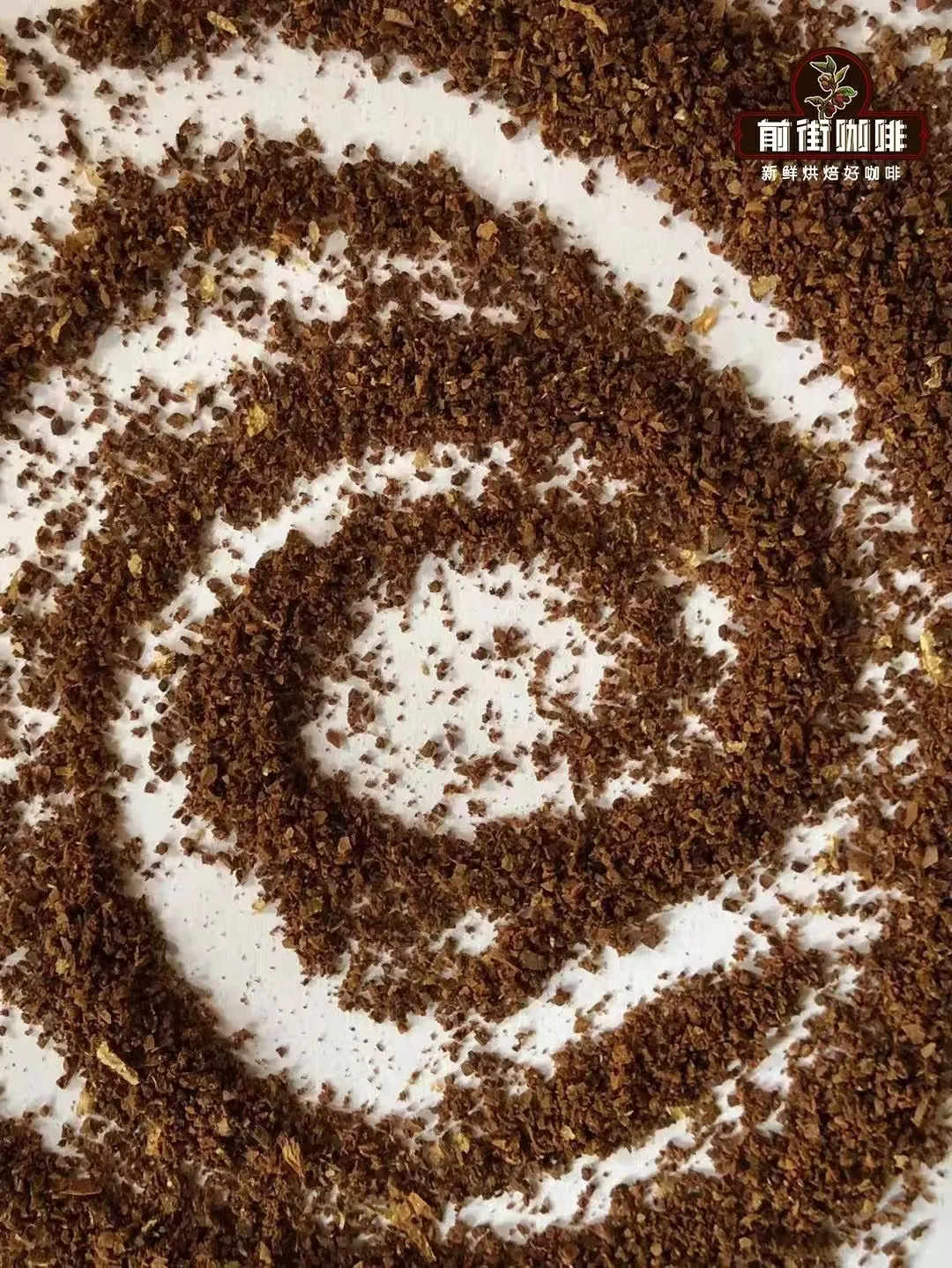
Take the EK43s that Front Street uses as an example — its grind uniformity is very high, with very few fines. Under such equipment conditions, what Front Street calls "80% pass rate through a No. 20 sieve" corresponds to a particle size distribution roughly as follows: particles around 0.6mm make up the majority, the coarsest particles do not exceed 1mm, and the number of such coarse particles is very small.
With an inferior grinder, the coffee particles come out with wildly varying sizes, and you can see obvious coarse particles and fines with the naked eye. Even if you sift to the same 80% pass rate, with all other conditions unchanged, it is no surprise if the brew turns out with off-flavors or tastes thin and bland.
The easiest solution is to switch to a better-performing grinder — one step to solve it all.
If that is not feasible, then you can only compensate by adjusting parameters. If you use a hand grinder, the biggest characteristic of a hand grinder is that the squeezing action causes coffee beans to fracture and produce fines. So theoretically, the faster the rotation speed, the fewer fines are produced by fracturing.
Next, based on the grind size you have already determined to pass 80% through the sieve, adjust coarser by 2-3 clicks to grind the beans, then use the sieve to separate the particles. Pour the particles larger than 0.85mm back into the grinder, dial the setting back 2-3 clicks, and grind again. After this process, the variation between coffee particles will be relatively reduced.
If off-flavors frequently appear in your coffee, most of the time it is caused by excessive fines, and a small portion of the cause lies in high water temperature, strong agitation, or long extraction time. So once you detect off-flavors, lock your adjustment directions onto these items: lower the water temperature, pour more gently, or shorten the extraction time.
So then, is sieving out fines — the most commonly used method — the most practical approach? This question depends on the specific situation. If it is only slow drainage (slight clogging) and the final flavor does not show obvious negative notes, then you can completely ignore it. If it is indeed fines causing bitter, off-flavors, then sift the flour to deal with it.
Additionally, you can also use a single-pour technique to quickly finish pouring the water, raising the height of the coffee bed so that fines are washed to the edge of the dripper — this is equally effective.
The above content is compiled by CoffeeHunters, a coffee news website.


