







Why Is a 1,700-Year-Old Temple Selling Coffee?
Shanghai's Longhua Temple, the city's oldest and largest ancient temple, opened a beverage window beside its vegetarian restaurant and began selling vegan coffee made with oat milk instead of dairy. The drink suits vegetarians and lactose-intolerant visitors. The move drew online debate about whether coffee fits a temple setting or is simply a gimmick.
Temples have tried coffee before. Guangzhou's Dafo Ancient Temple ran the Dafo Temple Coffee House from 2018, though it has closed. Hangzhou's Yongfu Temple opened Cibei in September 2021, naming drinks after Zen terms, including a caramel macchiato called Ink White. Longhua chose a simpler route inside its restaurant.
As the coffee wave sweeps across every industry, even ancient temples with millennia of history can't resist the urge to跨界—er, cross over. Shanghai's oldest temple, Longhua Temple, recently opened a beverage window next to its vegetarian restaurant, launching "vegan coffee" that replaces milk with oat milk, catering to both vegetarians and those who are lactose intolerant. This isn't the first time a temple has dabbled in coffee; from Dafo Temple in Guangzhou to Yongfu Temple in Hangzhou, the collision of Buddhist sanctuaries and coffee has long existed. Longhua Temple's move, with its affordable prices, has sparked heated discussion online: Can coffee be classified as vegetarian or non-vegetarian? Is a temple selling coffee a new path for cultural dissemination, or just a gimmick? This article takes you behind the scenes.
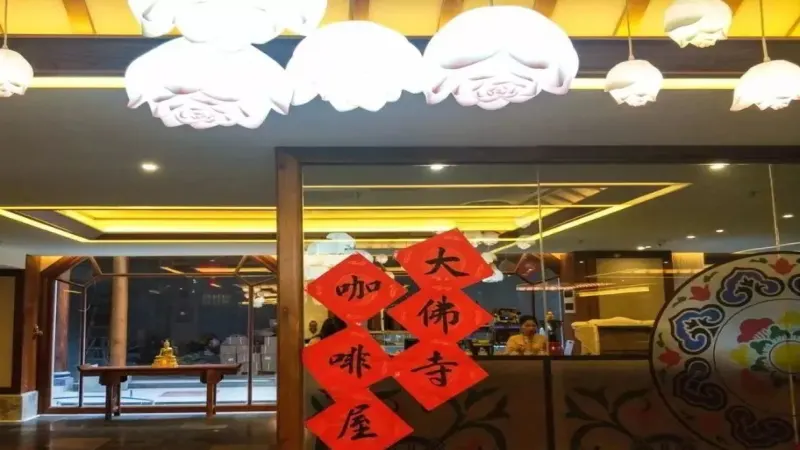
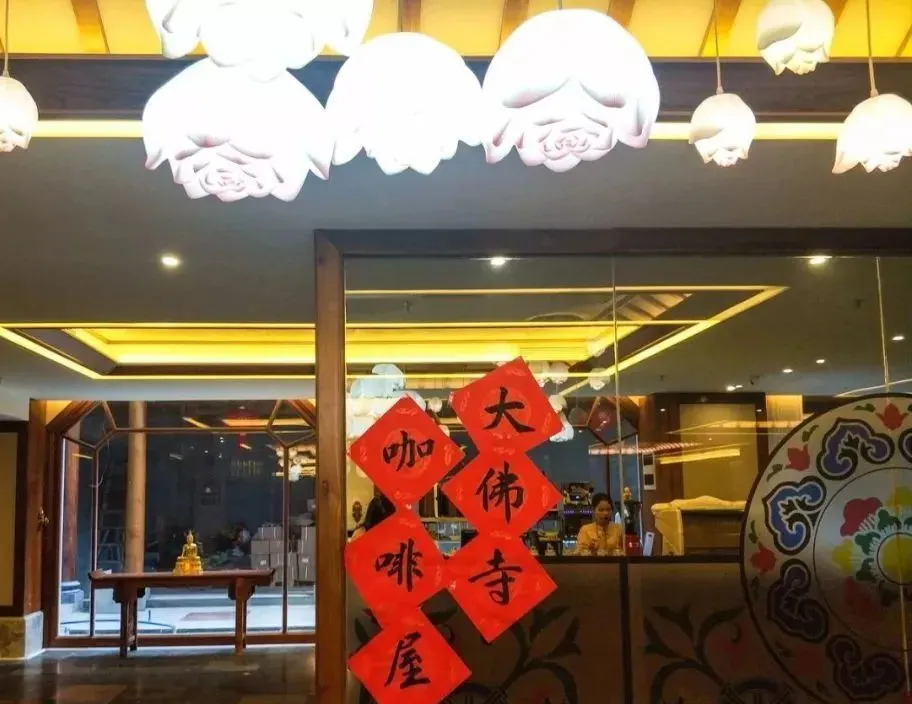
In 2018, before the coffee industry entered fierce competition, Guangzhou's Dafo Ancient Temple had already opened the "Dafo Temple Coffee House" at the temple exit. The shop's decor exuded a Zen vibe, with a glowing lotus-shaped sign above the entrance, creating an atmosphere imbued with Buddha's light. The signage was simply written on a few red papers—plain, direct, and without pretense. The shop offered milk tea, freshly ground coffee, and health drinks, catering to the diverse needs of temple visitors. (The coffee shop is currently closed.)
In September 2021, Hangzhou's Yongfu Temple quietly opened a café called "Cibei" at its exit. Each coffee on the menu bore a Zen-inspired name—for example, mocha was called "Joy," coconut latte was named "Zen Beginning," and caramel macchiato was dubbed "Ink White"—successfully attracting many young people to visit and check in.
As the saying "Drink coffee in a Buddhist sanctuary, don't argue about others' coffee" spread, a 1,700-year-old ancient temple in Shanghai—Longhua Temple—also began selling "vegan coffee." This time, however, the temple didn't open a separate café but chose a very down-to-earth approach: selling vegan coffee inside its vegetarian restaurant.
Longhua Temple is Shanghai's oldest and largest ancient temple. Unlike most temples that have the Hall of Heavenly Kings as their first hall, Longhua Temple's first hall is the Maitreya Hall, highlighting the temple's reverence for Maitreya. Additionally, Longhua Temple's vegetarian noodles and snacks have always been popular. Recently, Longhua Temple introduced "vegan coffee," adding a beverage window next to the vegetarian food service window, offering fresh juices, lemon tea, and freshly ground coffee to visitors.
Since milk is an animal product, many people consider it non-vegetarian, but in reality, milk is regarded as vegetarian. However, to avoid public confusion over whether milk is vegetarian or not, Longhua Temple's "vegan coffee" specifically uses oat milk instead of milk, making it suitable for vegetarians and those with lactose intolerance. The prices are also quite affordable—very cheap for downtown Shanghai's consumption levels. Regarding the ancient temple selling "vegan coffee," some netizens expressed being "inexplicably impressed," marveling that coffee could be classified as vegetarian or non-vegetarian.
The popularity of coffee culture has turned coffee into a business that everyone wants a piece of, attracting people from different fields and industries eager to get their "cup of coffee." In today's diverse market, as long as you're creative enough, anything can cross over—and temples are no exception.
Opening a café or selling coffee in a temple might be an attempt by temples to leverage different markets to expand new development channels, generate high-frequency attention, and let more young people learn about temple history and city history through checking out these seemingly "unrelated" combinations.
Seeing temples start selling coffee, many netizens questioned: Can centuries or millennia of historical accumulation be less appealing to young people than a cup of foreign coffee? Is this good or bad for the dissemination of history and culture?
Image source: Internet; screenshot from Morning News video
For professional coffee knowledge exchange and more coffee bean information, please follow Coffee Workshop (WeChat public account: cafe_style)
For more specialty coffee beans, please add private WeChat Front Street Coffee (FrontStreet Coffee), WeChat ID: kaixinguoguo0925
The above content is compiled by CoffeeHunters, a coffee news website.


