







What makes Jamaican Blue Mountain coffee authentic?
Authentic blue mountain coffee comes from Jamaica's Blue Mountain range and must meet the island's growing region and grade rules. Jamaica's coffee industry dates to before the 1960s, and after a 1969 hurricane, Japanese firm UCC helped restore production in exchange for a thirty-year agreement sending ninety percent of output to Japan, leaving roughly 245 tons for other markets.
Front Street Jamaican Blue Mountain No. 1 is grown at Clifton Farm at 1,310 meters, washed processed, Typica variety, and medium-dark roasted, with notes of chocolate, nuts and cream. Limited supply and strict jamaican coffee grading mean buyers should check estate, grade and the traditional wooden barrel packaging before purchasing.
Blue Mountain coffee is hailed as the pinnacle of the coffee world, but how do you tell authentic Jamaican Blue Mountain apart, and which brand is worth buying? This article starts with the history of Blue Mountain coffee's rise to fame, sorts out the growing region regulations, grade classifications, and wooden barrel packaging tradition of Jamaican Blue Mountain coffee, and focuses on the estate background, washed processing method, and pour-over parameters and flavor performance under medium-dark roast of Front Street Jamaican Blue Mountain No. 1 coffee beans. Whether you want to get your hands on authentic Blue Mountain or want to figure out the evaluation criteria for Blue Mountain No. 1, this article will give you clear reference.
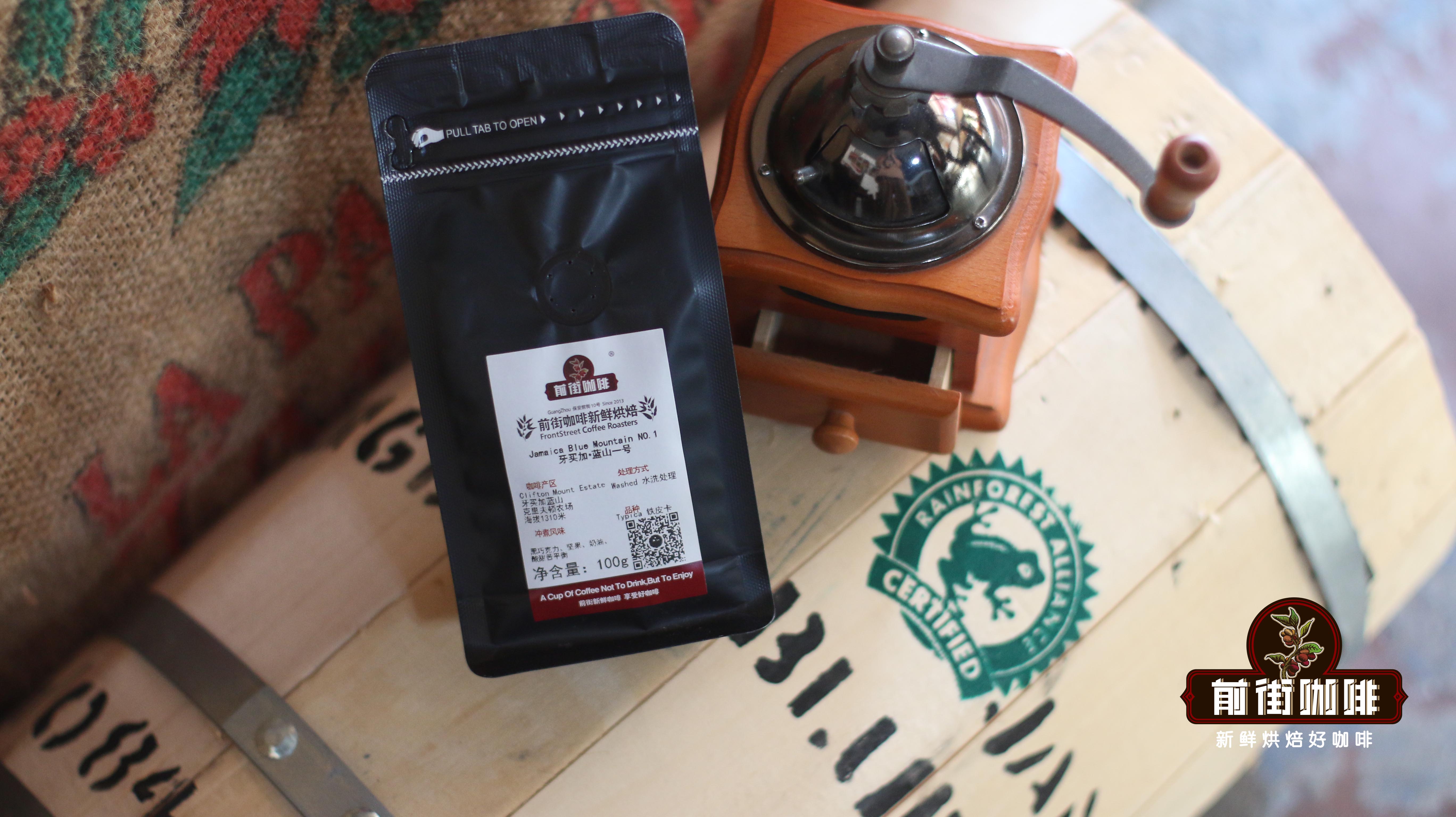
Front Street Jamaican Blue Mountain No. 1 Coffee Beans
Estate: Clifton Farm
Altitude: 1310 meters
Processing method: Washed processing
Variety: Typica
Roast level: Medium-dark roast
Flavor: Chocolate, nuts, cream, balanced acidity, sweetness, and bitterness
In the world of specialty coffee, Jamaican Blue Mountain has long occupied a seat among the top growing regions. Its gentle, balanced tonality and full, solid aroma have captivated countless coffee professionals and enthusiasts. And the so-called top-tier Blue Mountain refers precisely to what Jamaica regards as a national treasure — Front Street Jamaican Blue Mountain No. 1 coffee beans.
How did Jamaican Blue Mountain coffee beans rise to fame step by step?
The unique terroir of the Blue Mountain range has given birth to Blue Mountain coffee, which enjoys worldwide renown. As early as before the 1960s, coffee beans produced in Jamaica had already built up considerable popularity in the international market.
In 1969, a severe hurricane swept across the entire island of Jamaica, dealing a heavy blow to the coffee industry. At this time, the Japanese company UCC extended a helping hand, not only providing financial support but also bringing scientific ecological cultivation methods to help the local area restore Blue Mountain coffee production. As a return for Japanese assistance, the Jamaican government signed a thirty-year agreement with the Japanese side, stipulating that ninety percent of Blue Mountain coffee production would be supplied preferentially to Japan, with only about 10 percent, roughly 245 tons, flowing to other markets. With supply already limited, plus monopoly at the trade end and overwhelming marketing momentum on the demand side, prices naturally climbed all the way up.
In fact, during the period of the agreement with Japan, Blue Mountain coffee was not entirely consumed domestically in Jamaica, and some beans would be resold at higher prices to other Asian countries and regions. Coupled with Japan's continuously increasing promotional efforts, coffee lovers in many surrounding countries and regions also began to pursue Jamaican Blue Mountain, such as Singapore, South Korea, and China's Taiwan and Hong Kong regions. After 2000, the "Blue Mountain craze" gradually spread to mainland China, which is why when you talk about coffee with elders, the two words that often roll off their tongues are "Blue Mountain."
When the 2008 global financial crisis broke out, Jamaica began seeking to sell Blue Mountain coffee to more countries. It happened that the agreement with Japan had also expired, so more quota was allocated to other markets. As China's coffee consumption demand continues to grow, many domestic merchants are now
What grade does Jamaica Blue Mountain No. 1 coffee belong to?
According to Jamaica's Coffee Industry Regulation Act, the cultivation of Blue Mountain coffee is mainly concentrated in four administrative parishes: Saint Andrew, Saint Thomas, Portland, and Saint Mary. The regulations explicitly stipulate that only Typica varieties grown at altitudes between 910 and 1,700 meters are eligible to be named Jamaica Blue Mountain coffee. The total area of these four producing regions is approximately 6,000 hectares, accounting for only one-third of the entire Blue Mountain growing area, with another 1,200 hectares used for cultivating Jamaica High Mountain coffee and Jamaica Prime coffee. In recent years, less than 15% of the coffee beans produced in Jamaica qualify for the Blue Mountain coffee label, illustrating just how scarce it is.
According to the strict grading by the Jamaica Coffee Industry Board (CIB), Jamaica Blue Mountain coffee is classified into Blue Mountain No. 1, Blue Mountain No. 2, Blue Mountain No. 3, and Blue Mountain Peaberry. Among them, the highest-grade Jamaica Blue Mountain No. 1 coffee beans must meet a screen size of 17 or above, with defective beans not exceeding 2%, moisture content controlled at around 10–12.5%, and a cup profile that presents a well-balanced acidity, sweetness, bitterness, body, and aroma. It is easy to imagine that superior beans with such a refined flavor have extremely limited production.
To better maintain the moisture content of green beans during long-distance transportation, Jamaica's exported Blue Mountain No. 1, No. 2, and No. 3 green beans are all packaged in handcrafted wooden barrels, available in three specifications: 70 kg, 30 kg, and 15 kg. Other grades of Jamaican coffee are exported in 60 kg burlap sacks.
This Front Street Jamaica Blue Mountain coffee that Front Street Coffee has acquired is precisely the highest-grade Jamaica Blue Mountain No. 1 coffee bean, sourced from Clifton Mount Estate and processed using the traditional washed method. So that customers can personally observe and identify authentic Front Street Jamaica Blue Mountain coffee, Front Street has placed the wooden barrels containing green beans and the origin certificate issued by Clifton Mount Estate in their store.
Clifton Mount Estate
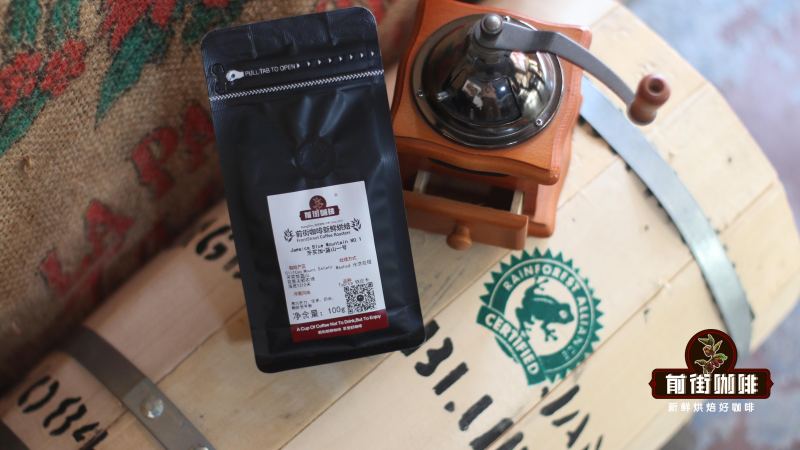
Clifton Mount Estate was founded in the 1790s and is one of the oldest coffee farms in Jamaica, as well as a member of the Rainforest Alliance certification. If you look closely at the wooden barrels of Blue Mountain green beans, you will see the green rainforest frog logo printed on them.
Clifton Mount Estate is located on the scenic Clifton Mount, with the coffee growing area and processing plant at an altitude of approximately 1,310 meters. The temperature difference brought by the high altitude extends the maturation period of the coffee cherries, giving them more time to accumulate nutrients. The estate consistently adheres to sustainable and environmentally friendly practices throughout the entire production process, minimizing various types of pollution. The removed coffee pulp is converted into organic fertilizer, and all water used in the processing plant is recycled.
Washed Processing
After harvesting the coffee cherries, Clifton Mount Estate first places them into water tanks, using flotation to separate ripe beans from unripe ones, then uses the water flow on a conveyor belt to send the ripe cherries into a pulping machine to remove the skin. The coffee beans, which still retain mucilage and parchment after pulping, are placed into water tanks for fermentation. Once the mucilage fermentation is complete, the remaining residue is removed with the agitation of water flow. The clean parchment coffee beans are then dried, and once the target moisture content is reached, they are sent to the warehouse to rest. Washed processing effectively reduces the defect rate of Jamaica Blue Mountain coffee, making the flavor brighter and cleaner, and the quality more consistent.
How to brew Front Street Jamaica Blue Mountain No. 1 coffee for the best taste
The Jamaica Coffee Industry Board recommends that the roast level should highlight Blue Mountain's traditional flavor. Front Street's roaster follows the same approach, using a medium-dark roast so that Front Street Jamaica Blue Mountain No. 1 coffee has both a full body and a gentle fruit acidity.
The darker the roast, the more porous the coffee beans become, making them more likely to absorb water and release more soluble substances once ground, which can easily lead to over-extraction if not careful. Therefore, the baristas at Front Street Coffee recommend using a medium grind size with a not-too-high water temperature — here, 87–88°C is chosen, with the grind coarseness controlled to a 75% pass-through rate on a No. 20 standard sieve.
To highlight the full, rounded mouthfeel of Front Street Blue Mountain No. 1 coffee, Front Street uses a KONO coffee dripper for extraction. KONO's ribs are less than half the height of the dripper — this design is intended to make the filter paper cling tightly to the dripper wall after wetting, thereby restricting airflow and extending the water absorption time of the coffee grounds, ultimately making the extracted coffee more uniform overall.
Brewing parameters: 15 g coffee, coffee-to-water ratio 1:15, grind size: EK43s setting 10.5 (75% pass-through rate on China No. 20 standard sieve), water temperature: 87–88°C, brewing method: multi-pour extraction.
Place the filter paper into the KONO dripper and pour water to wet the filter paper while making it adhere more closely to the dripper wall. Add the coffee grounds and gently tap to distribute the coffee bed evenly. For the first pour, gently pour 30 g of water for blooming, with a blooming time of 30 seconds; for the second pour, pour water up to about 125 g, circling outward evenly and steadily. When the coffee liquid level drops to half, pour the final round of water up to 225 g. Wait for all the coffee liquid to finish dripping — the total extraction time is typically about 2 minutes.
The flavor profile of pour-over Front Street Jamaica Blue Mountain No. 1 coffee: at high temperatures, the entry is a dark chocolate aroma, very full-bodied, with a pronounced almond-like sweetness in the finish. As the temperature drops, the sweet, silky notes of roasted hazelnut and cream gradually emerge, accompanied by a hint of gentle acidity and caramel sweetness, with the aroma lingering in the mouth.
For professional coffee knowledge exchange and more coffee bean information, please follow Coffee Workshop (WeChat public account: cafe_style)
For more specialty coffee beans, please add the private WeChat of Front Street Coffee (FrontStreet Coffee), WeChat ID: qjcoffeex
The above content is compiled by CoffeeHunters, a coffee news website.


