







Black tea categories and how they differ from coffee
Black tea falls into three main categories: Souchong, Congou, and broken black tea. Souchong comes from Fujian and is dried over open pinewood fires, giving Lapsang Souchong its pine-smoke aroma. Congou is made across more than ten provinces in fine, tight strips and is China's traditional export tea. Broken black tea is cut into granules, brews quickly and strongly, and is often used for milk tea.
The classification comes from the Tea Evaluator Training Manual, published under the China Tea Science Society. Lapsang Souchong is produced only in Tongmu Pass and Xingcun inside the Wuyi Mountains; leaf grown outside is called Waishan Souchong. Smoked Souchong is instead made by smoking coarser Congou leaves. For coffee drinkers, the same logic of origin, processing and grade applies to types of sugar for coffee and to beans.
The world of black tea is far richer than one might imagine. According to the classification system in the "Tea Evaluator Training Manual," black tea can be divided into three major categories: Souchong black tea, Congou black tea, and broken black tea, each with distinct differences in origin, processing, and flavor. Souchong black tea originates from Fujian, where drying over open pinewood fires imparts a unique pine-smoke aroma, with Lapsang Souchong being the most famous; Congou black tea is produced across more than ten provinces nationwide, with fine, tight strips and a rich fragrance, and is the mainstay of China's traditional export black tea; broken black tea is made into granular form through a cutting process, producing a quick brew with high concentration, and is often used for making milk tea. This article will systematically sort through the definitions, representative varieties, quality characteristics, and suitable applications of these three types of black tea, helping coffee enthusiasts also gain a cross-disciplinary understanding of the classification logic of the black tea world.
In the book "Tea Evaluator Training Manual," edited under the auspices of the China Tea Science Society, black tea is broadly divided into three major categories: Souchong black tea, Congou black tea, and broken black tea.
I. Souchong Black Tea
Souchong black tea is a type of strip-shaped black tea unique to Fujian Province. Souchong black tea is the earliest tea category to appear in the history of black tea. Fujian's Souchong black tea has a special production method: during the tea-drying stage, it is dried over open pinewood fires, so the finished Souchong black tea has a pine-smoke aroma. Famous Souchong black teas include Lapsang Souchong, Waishan Souchong, and Smoked Souchong.
Lapsang Souchong is produced in Tongmu Pass and Xingcun; Waishan Souchong is produced outside the Wuyi Mountains in Fujian's Tanyang, Zhenghe, Pingnan, Gutian, and other places; Smoked Souchong, on the other hand, is made from the coarse, old leaves of Congou black tea that have undergone a smoking process to become the finished tea. In other words, genuine Lapsang Souchong is produced only in Tongmu Pass and Xingcun within the Wuyi Mountains, and once outside the Wuyi Mountains, it cannot be called Lapsang Souchong and can only be called Waishan Souchong. Interestingly, the Wuyi Mountains are only such a small patch of land, so production cannot possibly be very large, yet so many tea merchants advertise their Souchong black tea as Lapsang Souchong when selling externally. Whether it is authentic Lapsang Souchong is truly perplexing.
Quality characteristics of Lapsang Souchong black tea: the appearance has dark black leaf color, with tight, straight, thick, and sturdy strips; the internal quality has a high aroma, slightly carrying a pine-smoke scent; the liquor color is red and thick, and the taste is strong yet refreshing, lively, and sweet, somewhat similar to the flavor of longan soup.
II. Congou Black Tea
Congou black tea is a strip-shaped black tea with fine, tight dry leaves. Congou black tea is produced in more than 10 provinces and autonomous regions across the country. This type of black tea is China's traditional export black tea category, sold as far as Europe and more than 60 other countries and regions. Famous Congou black teas include Keemun Congou black tea, Yunnan Dianhong Congou black tea, Guangdong's Yinghong, Fujian's Minhong, Jiangxi's Ninghong, Hubei's Yihong, and others.
The raw materials used for Congou black tea are tender, and its production process is refined. The appearance of Congou black tea has fine, tender, tight, straight, and even strips, a dark lustrous color, a rich fragrance, a mellow and sweet thick taste, and a red, bright liquor and infused leaf. Its quality characteristics are excellent in both appearance and internal quality.
III. Broken Black Tea
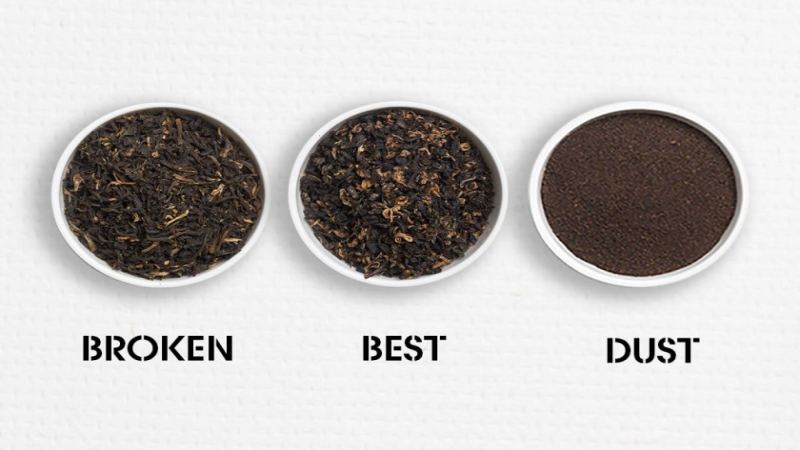
This type of black tea is granular black tea made by cutting during processing. Since the introduction of the CTC black tea production machine, large quantities of this type of tea have appeared, while in China large amounts of broken black tea only began to appear in the 1960s, and this type of black tea is mainly circulated in the international market. When brewing broken black tea, the extraction amount is large and the steeping time is short, making it suitable for preparing drinks with milk and sugar.
According to appearance and shape, broken black tea is divided into four major grades: leaf tea (OP, FOP), broken tea (FBOP, BOP), fannings (BOPF, F), and dust (D).
Broken black tea from large-leaf variety production areas has sturdy finished dry tea, tightly twisted, even, and showing pekoe, a red brilliant tea liquor, a fresh and rich aroma, a red bright infused leaf, a strong and intense taste, and high stimulation. Broken black tea produced in medium- and small-leaf variety tea areas has a fresh, clear aroma in the finished dry tea, a still rich and refreshing taste, and its strength is weaker than that of large-leaf varieties.
The above content is compiled by CoffeeHunters, a coffee news website.


