







Can You Make Cappuccino at Home Without an Espresso Machine?
A cappuccino can be made at home by splitting it into two tasks: the coffee and the steamed milk. Without an espresso machine, a moka pot or pour-over can supply a strong, crema-topped base. The milk is then frothed with an electric frother, a frothing pitcher, or a French press.
A traditional cappuccino uses 1 part espresso to 2 parts steamed milk, and the milk portion includes both liquid milk and foam, so in practice there is slightly more milk than foam. The drink is served at 60-65°C, a range that keeps the coffee flavor prominent without letting the milk or the foam dominate.
Cappuccino has always been a popular choice in cafes thanks to its rich coffee aroma and dense milk foam. But have you ever thought about recreating an authentic cappuccino at home without a professional espresso machine? This article starts with the flavor characteristics of cappuccino, breaks it down into two parts—espresso and steamed milk—and introduces extraction methods such as the moka pot and pour-over, as well as frothing techniques using an electric milk frother, a milk frothing pitcher, and a French press. Front Street Coffee will also share a sunflower warm sun blend bean suitable for pairing with milk, along with specific coffee-to-water ratios, water temperatures, and step-by-step instructions to help you easily make a cappuccino at home with a pleasant temperature and full-bodied taste.
Introduction
Cappuccino was born in the 1930s, created from the fusion of espresso, milk, and milk foam. Its name carries an exotic flair, its taste is rich and aromatic, and its texture is smooth and fine—which is why it is so beloved. Today it can be found in cafes everywhere, and Front Street wants to teach everyone an easy way to make cappuccino at home!
What Are the Characteristics of Cappuccino?
A traditional cappuccino consists of 1 part espresso to 2 parts steamed milk, and the steamed milk itself contains both milk and milk foam. The written ratio is often expressed as 1:1, though in reality there is usually slightly more milk than foam. The book Latte Art describes cappuccino as follows: [The foam of a cappuccino has a cream-like effect, at a comfortable temperature between 60-65°C, and its full and comforting texture caresses the taste buds.]
From this we can summarize several key characteristics of cappuccino: ① The coffee flavor is prominent enough not to be overwhelmed by the milk; ② The milk foam is fine, dense, and generous, delivering a full mouthfeel; ③ The temperature is kept between 60-65°C, making it comfortable to drink.
Practical Methods for Making Cappuccino at Home
Most households rarely have the kind of professional coffee equipment found in cafes. So we need to take a different approach and use easily accessible tools to make cappuccino. Front Street's method is to break it into two parts—espresso and steamed milk—and tackle each one separately.
Espresso
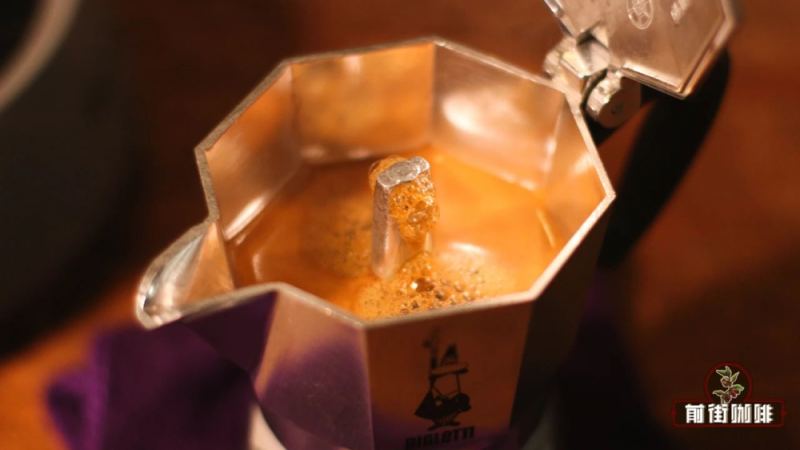
If you want a rich, crema-topped black coffee without an espresso machine, the moka pot is the most suitable choice. The moka pot also comes from Italy—if the espresso machine is the standard fixture of Italian cafes, then the moka pot is the standard fixture of Italian homes. Brewing strong coffee with a moka pot is not complicated; for detailed instructions, you can refer to the previous article "Barista Training Diary | Teaching You to Brew Coffee with a Moka Pot."
Among domestic coffee enthusiasts, the moka pot is not particularly widespread. This part can also be done with pour-over. There are a few things to keep in mind when choosing beans: try to pick medium-dark roasted coffee beans so the flavor won't be masked after mixing with milk, and medium-dark roasted beans also produce a fuller-bodied coffee. Front Street has chosen the Sunflower Warm Sun Blend (Sherry and Yirgacheffe) coffee beans here.
The brewing approach draws on the Matsuya style, aiming to extract a more complete, high-concentration coffee liquid. If conditions allow, you can use flannel for filtration, which will result in a higher coffee concentration. If not, a dripper with filter paper works too—try to choose a dripper with a slower flow rate. Front Street used a KONO dripper this time.
Take 20g of coffee grounds and adjust the grind size to 80% passage through a No. 20 standard sieve (finer than regular medium-dark roast pour-over). The coffee-to-water ratio is 1:4, meaning you'll end up with 80ml of coffee liquid, with the water temperature controlled at 90°C.
During brewing, first pour in 30ml of hot water and let it bloom for 3 minutes. Medium-dark roasted coffee grounds are highly absorbent; pouring 1.5 times the water volume is to reduce coffee liquid dripping during the bloom. Since we only take the early-stage extraction, there's no need to worry about bitterness from blooming too long. During the bloom, keep the kettle insulated to maintain the water temperature at 90°C. Once the time is up, pour in a circular motion from the center outward, and when the coffee liquid in the dripper reaches 80ml, remove the dripper—and your espresso is ready.
Steamed Milk Foam
Without the steam wand of an espresso machine to heat and froth the milk, it's certainly less convenient. But where there's a will, there's a way—for example, an electric milk frother or a milk frothing pitcher. The former creates a vortex to force air into the milk for frothing, while the latter uses a repeatedly pumped metal mesh to introduce air into the milk, forming fine foam.
Electric milk frother (left), manual milk frothing pitcher (right)
Image from a helpful reader
Of course, the versatile French press can also be used to froth milk—the principle is the same as a milk frothing pitcher. First, heat the milk to 65°C using a microwave, a saucepan, or a double boiler. Then pour it into the French press and pump the plunger up and down for about 30 seconds. Once the milk has expanded by 1/2 in volume, it's done. If there are large bubbles on the surface, just skim off the coarse foam with a spoon.
Now you can fully mix the coffee and steamed milk together—you can even pour simple patterns. First, pour a small amount of milk into the cup to mix with the coffee, then integrate and create your pattern as usual. And just like that, a homemade cappuccino is complete!
The above content is compiled by CoffeeHunters, a coffee news website.


