







Do specialty roasters use only arabica beans?
Arabica and Robusta are the two species that underpin the global coffee market. Arabica makes up about 80% of world production, originated in Ethiopia, and grows between roughly 1,000 and 2,300 meters across the Coffee Belt, where fertile volcanic soil, regular rain, and ample sun support it. Its delicate, varied flavors dominate specialty coffee.
Robusta, or Coffea canephora, holds its ground in blends and instant coffee thanks to hardier plants and higher caffeine. To answer what is robusta in practice: it is the species behind many dark, bitter blends rather than the single-origin lots specialty shops favor. Specialty coffee is not strictly pure arabica beans, but the category leans heavily toward them because of flavor clarity.
The coffee world is vast and complex, but only two core bean species truly underpin the global consumer market—Arabica and Robusta. The former dominates the specialty coffee mainstream with its delicate and varied flavors, while the latter stands firm in the blending and instant coffee sectors thanks to its robust vitality and high caffeine content. What exactly are the differences between the two in terms of growing conditions, disease resistance, and flavor expression? Is specialty coffee synonymous with pure Arabica? This article will examine their origins, characteristics, and tasting experiences, and include Front Street Coffee's product recommendations for different flavor preferences, helping you make choices that better suit your taste in everyday purchasing.
The development of coffee has been a long journey, and it wasn't until the rise of the third wave that people truly began to pay attention to the complete chain of a cup of coffee from seed to cup—how growers cultivate, how pickers select cherries, what processing methods the green beans undergo, and how roasters customize roasting curves for each lot of beans.
Beauty from a Seed
The story of coffee begins with a seed, originating from a tree that bears white flowers and emits a jasmine-like fragrance. The fruit this tree produces closely resembles a cherry, and at the very center of the fruit lies what we call the coffee bean.
London's Botanical Kew Gardens has undertaken the identification of over 120 species of coffee, many of which come from Madagascar, Asia, and Australia. Among these species, Coffea arabica (Arabica) and Coffea canephora (Robusta) are the two mainstays and the types people drink most in daily life. Although there are many other species under the Coffea genus, so far they have not been proven to have practical value in large-scale production.
What Is Arabica?
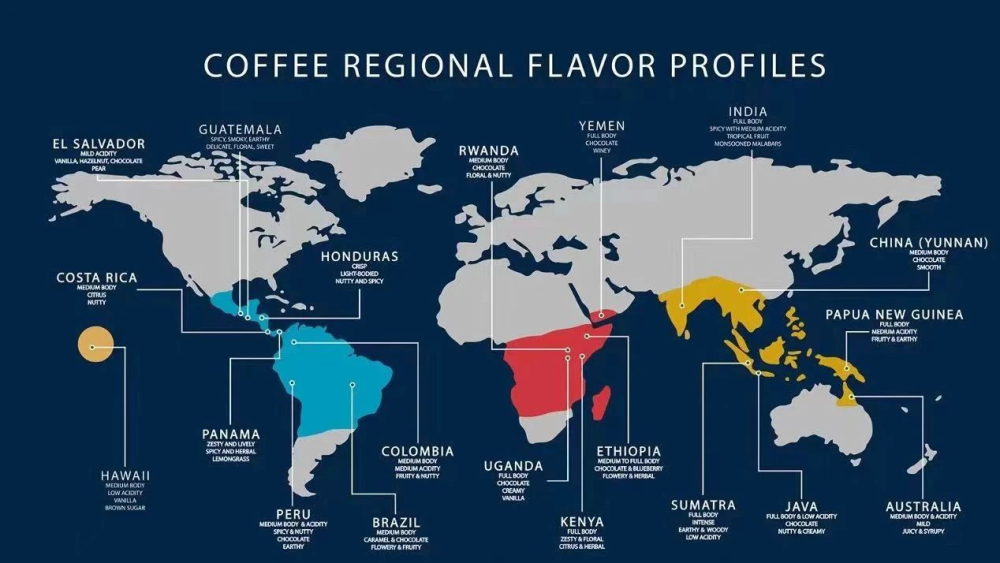
Arabica accounts for about 80% of total global coffee production. It originated in Ethiopia and is typically grown at elevations between 1,000 and 2,300 meters, distributed across the "Coffee Belt" between the tropics and subtropics. This region often has fertile (mostly volcanic) soil, regular rainfall, and ample sunshine, precisely meeting the conditions needed for coffee to grow well.
Arabica requires exceptionally careful attention because its tree species is vulnerable to pests and diseases. For example, coffee leaf rust or fungal infections can cause orange patches on the leaves, hindering photosynthesis and ultimately leading to defoliation or even the death of the entire tree. If not handled properly, this can deliver a devastating blow to an entire estate. In addition, pests such as the coffee berry borer also prefer Arabica, laying eggs inside the coffee cherry; after hatching, the larvae feed on the pulp, causing a significant decline in coffee quality.
Despite these disadvantages, Arabica's taste is smoother and its flavor more orthodox compared to Robusta, making it a frequent favorite among consumers. A cup of Arabica coffee is fragrant and richly flavored, sometimes described as having notes of flowers, fruit, citrus, earth, cream, chocolate, caramel, honey, or sugar. The flavor can range from lightly sweet to intensely rich, depending on origin and processing method, offering enormous room for choice.
For those who prefer Arabica with floral and fruity notes, choose Front Street Strawberry Candy, Front Street Fruit Ding Ding, or Front Street Flower Butterfly; for an Arabica with balanced acidity and bitterness, we recommend Front Street 2013 Yunnan Small Lot, Front Street Bird of Paradise, or Front Street Blue Mountain No. 1; if you're after a full-bodied Arabica, go for the medium-dark roasted Front Street PWN Golden Mandheling.
What Is Robusta?
Robusta originated in West Africa and is mostly grown in lower-altitude, higher-temperature regions. It essentially makes up the remainder of global coffee production. Robusta beans are smaller and rounder, but their caffeine content is nearly twice that of Arabica. This high caffeine serves as a natural insect deterrent, helping to repel most pests, which is why Robusta is more affordable and easier to cultivate. Additionally, because it produces a richer crema during extraction, it is widely used in blend formulations.
For this reason, Front Street Classic Blend and Front Street Commercial Blend are the top choices for making Italian-style coffee. Front Street Classic Blend uses a combination of Brazil + Mandheling + Robusta, giving the coffee rich nutty and toasted bread aromas, a full-bodied mouthfeel, and beautiful crema—perfect for beginners.
Additionally, for cafe owners, since stability, value for money, and compatibility must be ensured, a combination of Colombia + Brazil + Robusta is used. Brazil provides creamy nutty notes, Colombia offers chocolatey sweetness, and Robusta adds body and crema, so that even a novice barista can easily pull a standard espresso.
Although Robusta has its quality strengths, it is not favored by the general public. In fact, most coffee enthusiasts are averse to Robusta, mainly because it is often used in instant coffee or lower-quality blends, resulting in products that are low in both price and quality. After roasting and brewing, Robusta is often described as prominently bitter, sharp, and carrying woody and rubbery notes. Although it is unpopular among most enthusiasts and not the first choice for mass consumption, it still has its own adherents.
Left Without Human Protection, Robusta Would Be the Ultimate Survivor
Gabe Shohet is the co-founder of Black Sheep Coffee in London, dedicated to promoting specialty-grade Robusta. This coffee shop was founded by Shohet and a group of friends who wanted to do something different with coffee, preferring Robusta's rich, full-bodied, high-caffeine character. As the shop's name suggests, they have stepped off the tracks of mainstream coffee culture.
However, Shohet's advocacy for Robusta is not without basis. In his article "Fairness and E-Quality: The Case for Robusta," he argues that Robusta's poor reputation should not be blamed on the bean itself. Robusta is typically machine-harvested, which means the harvest includes rotten, unripe beans as well as insects, twigs, and other debris—a combination destined to produce a terrible cup of coffee.
So Shohet began to explore: if Robusta received the same meticulous care as Arabica, what would its flavor become? After months of trial and error, Shohet and his team found the world's first specialty-grade Robusta farm. The Sethuraman Estate in India uses hand-sorting, double washing, and raised-bed drying to process Robusta beans, and the result is a flavor profile even more outstanding than Arabica. This high-caffeine beverage helps keep you energized throughout the day while carrying distinct walnut and chocolate flavors.
Although Arabica may still be the consumer's first choice, Robusta has begun to prove its worth, precisely because people like Shohet are working hard, hoping consumers will give it another chance.
The above content is compiled by CoffeeHunters, a coffee news website.


