







What Does Mandheling Mean for Arabica Bean Drinkers?
Mandheling is not a coffee variety. The name comes from the Mandailing people of the Tapanuli region in northwestern Sumatra, and it became attached to the coffee traded from that area. The beans themselves are an arabica bean grown around Lake Toba and Lake Tawar, where altitudes and a tropical rainforest climate with 25-28°C average temperatures and year-round rain suit coffee trees well.
Sumatra supplies more than 70% of Indonesia's exported coffee, and the Lintong region is known for a full-bodied cup shaped by wet-hulling, a local coffee bean processing method. Indonesian coffee trade quiets down for about four months after the October harvest exports finish, with growers waiting for the new season in May.
Is Mandheling a variety name or a regional label? Why has Sumatra, Indonesia's Lintong region become the quintessential daily drinker? This article starts with the recent state of the Indonesian coffee market, sorts out the terroir of Sumatra and the origin of the name Mandheling, explains in detail the flavor characteristics of the Lintong region and how the wet-hulling process shapes its full-bodied mouthfeel, and includes Front Street Coffee's roasting and brewing parameters to help you systematically understand this distinctive Indonesian Arabica.
For professional coffee knowledge exchange and more coffee bean information, please follow Coffee Workshop (WeChat public account cafe_style)
Recent State of the Indonesian Coffee Market
NEWS!
According to Coffee Financial Network, Indonesian coffee beans from the October harvest season have basically finished exporting, and the locally tradable coffee inventory has become quite limited. Industry insiders expect that the tight supply situation for Indonesian coffee will be difficult to ease in the short term. Local growers and traders are now waiting for the arrival of the new season in May, and Indonesian coffee trade activity will be relatively quiet over the next four months.
Sumatra
Sumatra Island
When it comes to Indonesian coffee, the word that immediately comes to most people's minds is Sumatra. This island contributes more than 70% of Indonesia's exported coffee beans (including Robusta), and Lake Toba and Lake Tawar on the island provide abundant water sources for the surrounding areas.
Suitable altitude combined with a tropical rainforest climate keeps the island's average annual temperature stable between 25-28°C, with evenly distributed rainfall across seasons and no obvious dry season, providing quite ideal growing conditions for coffee trees. However, the rainy season that accompanies the tropical rainforest climate may also interfere with Sumatra's October main coffee harvest season.
Is Mandheling a Coffee Variety?
Mandheling
One of the most frequently asked questions to Front Street about Indonesian coffee is "Does Mandheling count as a coffee variety?" The answer is no. Mandheling originally referred to the Mandailing people of the Tapanuli region in northwestern Sumatra. When a Japanese person asked locals what the coffee they produced was called, the locals mistakenly thought they were being asked which ethnic group they belonged to and blurted out "Mandheling." Since then, Arabica coffee beans produced in Sumatra have all been labeled with this homophone of the ethnic name—Mandheling coffee—and only Arabica beans from the island of Sumatra are eligible to use this name.
The local who answered "Mandheling" back then also sensed a business opportunity and founded Indonesia's well-known green bean company Pwani Coffee Company, which is exactly the company behind Front Street's beloved PWN Golden Mandheling. Nearly all the top-quality Mandheling coffee on the island has been acquired by this company. An unintentional act that bore fruit—this local probably never expected that a small misunderstanding would make him an important figure in Indonesia's specialty coffee scene.
Lintong Coffee Region
Lintong
The Lintong region is located in northern Sumatra, adjacent to Lake Toba, in the Lintong Hill area, at an altitude of approximately 1,000-1,500 meters on highland mountains. The region contains multiple volcanoes and numerous volcanic lakes, bringing fertile volcanic soil. Combined with the abundant year-round rainfall of the local tropical rainforest climate, this creates extremely suitable geographical and climatic conditions for coffee growing.
Lintong Mandheling is not particular about the sorting process, so beans of varying sizes are quite common. Insufficiently refined processing can easily lead to inconsistent output, but this does not hinder Lintong beans' expressiveness in flavor. Coffee from this region generally lacks some cleanliness, yet it can present the signature full body, intense flavor, and unique herbal spice notes of Indonesian coffee, which is why Front Street has included the Lintong region in its daily drinker series.
Must-Try Coffee for Beginners!
Front Street Daily Drinker
The FrontStreet Coffee daily drinker series serves as the "flagship representative" of flavors from major regions. Each daily drinker region has highly recognizable basic flavors, making it a super cost-effective freshly roasted Arabica coffee bean. When you're unsure of your taste preferences but afraid of spending too much and stepping on a landmine, the Front Street daily drinker series is absolutely the best choice.
Coffee Bean Processing Method
Wet Hulling
Wet hulling is a method of quickly processing coffee beans, and it is one of the reasons why Indonesian coffee has a full-bodied, intense flavor and distinctive character. Normally, coffee beans need 2-3 weeks to dry, but Indonesia's year-round humidity reaches 70-90%, with frequent typhoons and heavy rainfall. Under such humid climatic conditions, drying coffee becomes a thorny problem.
In pursuit of higher economic returns, local coffee farmers invented the wet-hulling process. It differs significantly from the washed method: after removing the skin and pulp, the parchment and mucilage are retained and fermented in a water tank, then the mucilage is washed off, and the beans are sun-dried with parchment for 2-3 days to a moisture content of 20-24%. Then the parchment is hulled off, completing the final drying step to a moisture content of 13-15%.
When using the wet-hulling method, the half-hard, half-soft moist green beans are prone to compression damage during the process of hulling off the mucilage and parchment layer, causing the bean body to crack into a sheep's hoof shape, commonly known as sheep hoof beans. Sheep hoof beans can be said to be one of the characteristics of Mandheling coffee.
FrontStreet Coffee Roasting Notes
Charge when the drum temperature reaches 200°C, set the damper to 3, adjust the flame to 160°C, keep the damper unchanged. The turning point is at 1 minute 45 seconds, maintain the flame. At 140°C, reduce the flame to 1 and adjust the damper to 4; at 5 minutes 8 seconds, the bean surface turns yellow, the grassy smell completely disappears, and it enters the dehydration phase;
At 7 minutes 30 seconds, dehydration is complete, reduce the flame to 110°C. The bean surface shows ugly wrinkles and dark spots, and the toast aroma noticeably transitions to coffee aroma, which can be defined as the prelude to first crack. At this point, listen carefully for the sound of first crack. First crack begins at 9 minutes 00 seconds, open the damper fully to 5. After first crack, develop for 4 minutes 00 seconds, and drop at 202°C.
FrontStreet Coffee Brewing Notes
When brewing full-bodied coffee, Front Street recommends using a Kono dripper to enhance the coffee's body. However, quite a few friends have said they don't have a Kono at home, only a V60. So how do you brew full-bodied coffee with a V60? First, use 15g of coffee beans, adjust the grind to medium-fine (78% passing rate on a No. 20 standard sieve), then use 88°C water temperature, with a coffee-to-water ratio of 1:15. When pouring, try to pour in circles as slowly as possible—how slow? 3-4ml per second.
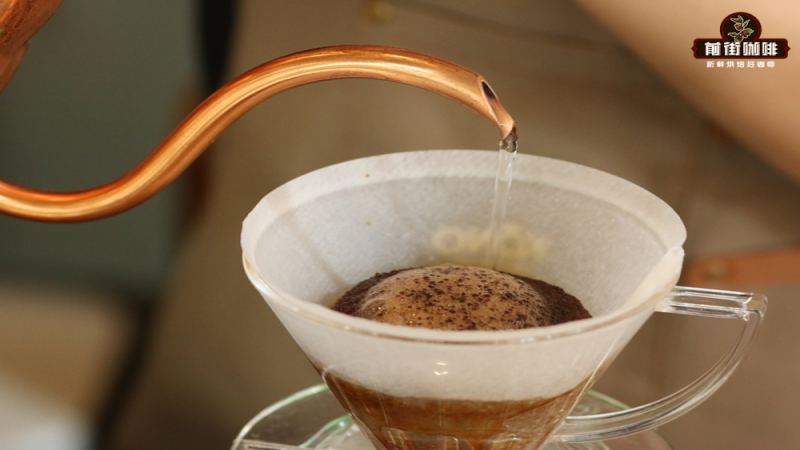
Front Street's staged extraction method: First, use 30g of water to fully saturate the coffee bed into a "hamburger" shape and bloom for 30s; for the second pour, at 55 seconds on the timer, pour water until it reaches 125g, then stop and wait for the water level to drop to 2/3 of the coffee bed before pouring the third stage; for the third pour, at 1'30" on the timer, pour water until it reaches 225g. After the coffee liquid has completely dripped through, the total extraction time is 2'01". After extraction is complete, gently swirl, and wait for the coffee liquid to be fully uniform before tasting.
Brewing flavor: The entry is a rich herbal aroma, the mid-palate has a slight acidity of dark chocolate, the finish has a caramel-like aroma, and the aftertaste is a licorice-like sweetness.
For more specialty coffee beans, please add private WeChat FrontStreet Coffee, WeChat ID: kaixinguoguo0925
The above content is compiled by CoffeeHunters, a coffee news website.


