







What Sets Longberry Apart From Other Mandheling Coffee?
Longberry is a natural mutation of Typica grown in the Lake Tawar area of Aceh, Sumatra, at 1,200 to 1,600 meters. It shares the low-acid, full-bodied character associated with Mandheling, but its elongated shape, slow growth and scarce yield set it apart, and the wet-hulled process gives it herbal and spicy notes.
Aceh sits at the northwestern tip of the Indonesian archipelago on the equator, with high temperatures year-round and a rainy season from October to March. The wet-hulled method, coffee bean processing typical of the region, shapes the bean's clean mouthfeel. Roasting and brewing with a Kono dripper at 87-88°C brings out spicy fruit and green apple acidity.
Indonesian coffee has long been known for the mellow, low-acid character of Mandheling, and this time Front Street Coffee turns its attention to the birthplace of Golden Mandheling—Mount Gayo in Aceh, Sumatra—bringing a distinctive coffee known as Longberry. This bean comes from the Lake Tawar region at an altitude of 1,200 to 1,600 meters, is processed using the wet-hulled method, has an elongated shape, and is a natural mutation of Typica. The article traces the three-century cultivation history of Longberry in Aceh, explains its slow growth and scarce yield, and details how the wet-hulled method gives the beans their unique herbal and spicy flavors. Front Street Coffee also shares roasting suggestions, a cupping report, and brewing parameters, using a Kono dripper with water at 87-88°C, ultimately presenting spicy fruit, green apple acidity, and a clean mouthfeel. Whether for variety exploration or brewing practice, this content provides coffee lovers with a complete and professional reference.
When people think of Indonesian coffee, the first thing that comes to mind for most is Mandheling. Its solid, full body, steady mouthfeel, and relatively low acidity have won it the favor of a large number of coffee lovers. Front Street Coffee is also particularly fond of Mandheling. Whenever a customer asks whether there is a coffee that is not sour at all, Front Street's baristas always first recommend the Golden Mandheling produced by Indonesia's PWN company. This time, however, Front Street wants to introduce another special variety also from the core production area of Golden Mandheling—Mount Gayo in Aceh, Sumatra. It is called Longberry.
Front Street Coffee: Sumatra·Lake Tawar Wet-Hulled Longberry Coffee Beans
Sumatra Lake Tawar Longberry Mandheling G1
Growing country: Indonesia
Coffee region: Lake Tawar area, Aceh Province
Growing altitude: 1,200 to 1,600 meters
Coffee variety: Longberry
Processing method: Wet-hulled
Coffee Region
Aceh Province is located at the northwestern tip of the Indonesian archipelago, with the equator running through it, forming a typical tropical equatorial maritime climate with high temperatures year-round and an average annual temperature of about 27°C. There is abundant rainfall here. From October to March of the following year, under the influence of Asian and Pacific air currents, it enters the rainy season with considerable rainfall and relatively cool weather; from April to October, because continental air currents from Australia block moisture, it turns into the dry season, with hot and dry weather.
Lake Tawar is located in the Gayo highlands of northern Aceh Province on Sumatra. It is a crater lake left after an ancient volcanic eruption, with a surface elevation of about 1,100 meters. Because early transportation was inconvenient, local coffee cultivation did not begin until the 1930s. Today, coffee farms are mostly distributed at elevations of 1,200 to 1,600 meters and generally use traditional shade-growing methods. In the early morning, moist, cool clouds and mist pass through; at noon there is ample sunlight; and in the afternoon there are frequent showers. This natural microclimate, together with volcanic soil, provides ideal conditions for coffee growth. The coffee beans produced here are plump and emerald green. Coffee lovers in Taiwan habitually call it Emerald Mandheling, while on the international market it is more often called Lake Tawar Mandheling.
Coffee Variety
Among Sumatra's coffee varieties, Longberry—Mandheling stands out as especially distinctive. Its coffee trees grow extremely slowly, taking seven years from planting to maturity and fruiting, whereas ordinary coffee trees usually bear fruit in three to four years. Coupled with low yields per unit, Longberry is not commonly seen on the market.
Longberry originally came from the Harrar region of Ethiopia in Africa and has been cultivated in Aceh Province for three centuries. This lot is named for its relatively elongated bean shape, and some also call it Long-Bean Mandheling. It is a natural mutation of Typica.
Coffee Bean Processing Method
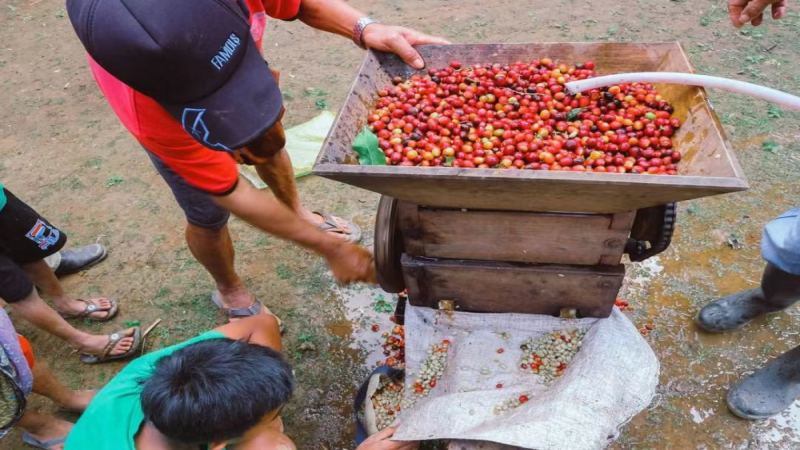
The wet-hulled method is a highly efficient way of processing coffee. First the skin and pulp of the coffee cherry are removed, and after a short fermentation the beans are sun-dried; then the mucilage and parchment layer are removed, and drying continues until the moisture content drops to 12%. Mandheling coffee beans processed by the wet-hulled method often show varying degrees of compression cracks on the surface, and the bean color tends toward dark bluish-green. Because the entire drying process is shortened to two to four days, the fermentation time of the coffee beans is reduced, acidity drops noticeably, while body instead increases, caramel and fruit aromas stand out, and sometimes there are also herbal, grassy, or woody notes. This is precisely where the flavor of the Sumatra production area comes from. Front Street listed this bean, first, because the variety itself is quite distinctive, and second, because cupping confirmed that it can fully express the flavor profile of the Sumatra production area.
Front Street Roasting Suggestions
Front Street Cupping Report
Front Street Brewing Suggestions
When brewing coffee from the Indonesian production area, Front Street usually chooses the Kono dripper. The ribs of the Kono are less than half the height of the dripper. This design is intended to let the filter paper cling closely to the dripper wall after it is wet, thereby restricting airflow, extending the water absorption time of the coffee grounds, making extraction more even, and enhancing body. In addition, the groove structure at the bottom of the Kono dripper is also key to creating a siphon effect.
Suggested water temperature: 87-88°C
Grind size: coarse granulated sugar size (70% passing through a Chinese No. 20 standard sieve)
Coffee-to-water ratio: 1:15
Dose: 15 grams
Front Street Coffee brewing method: first bloom with 30 grams of water for 30 seconds, then pour in a small stream in circles up to 125 grams for a stage, and when the water level drops to the point where the coffee bed is almost exposed, continue pouring to 225 grams and stop. When the water level again drops to the point where the coffee bed is about to be exposed, remove the dripper. (Start timing from the beginning of the bloom.) Total extraction time is 2 minutes 00 seconds.
Brewed flavor: The spicy fruit flavor is reminiscent of the green apple-like acidity characteristic of Panamanian coffee, accompanied by herbal and spicy notes, with bright acidity and a clean mouthfeel.
The above content is compiled by CoffeeHunters, a coffee news website.


