







What Sets Colombian Coffee Beans From Antioquia Apart?
Colombian coffee beans from Antioquia and its Fredonia sub-region tend to show balanced sweetness and a delicate mouthfeel. The northwestern Andes offer high altitudes, volcanic soils and varied microclimates that suit coffee cultivation. Colombia is the world's third-largest coffee producer and exporter, after Brazil and Vietnam, and this region is one of the reasons its coffee carries a strong reputation abroad.
Coffee reached Colombia around 1723 through Jesuit monks and spread gradually, but the industry only took off in the late 19th century. Civil conflict from 1899 to 1903 cut the growing population and left plantations abandoned. Afterward the government divided wasteland into small plots sold cheaply to farmers. By 1912, coffee accounted for 50 percent of Colombia's total exports.
Colombia is the world's third-largest coffee producer, and the high altitudes, volcanic soils, and diverse microclimates of its Andean region give rise to highly distinctive coffee flavors. In this article, Front Street Coffee will systematically review the spread, history, industry development, and regional layout of Colombian coffee, with a special focus on the northwestern Antioquia region and its sub-region of Fredonia, analyzing the local coffee's growing conditions, variety composition, and flavor performance, to help you understand how this important region produces coffee with balanced sweetness and a delicate mouthfeel.
For more specialty coffee knowledge, follow our WeChat official account: Front Street Coffee. Colombian coffee enjoys an excellent reputation in the international market, and its production scale is also considerable—it is the world's third-largest coffee producer and exporter, after Brazil and Vietnam. In this article, Front Street Coffee will introduce you to this highly representative coffee-growing region.
Colombian Coffee Cultivation
Geographically, Colombia can be broadly divided into the mountainous west and the plains of the east. The west is dominated by the Andes Mountains, while the east consists mainly of the Orinoco Plains and the Amazon Plains. Because it lies in the tropics, the local climate varies significantly with elevation. High-altitude mountains, volcanic soil, and distinct microclimates provide ideal conditions for coffee cultivation, which is an important reason why Colombia has become the world's third-largest coffee producer.
History of Colombian Coffee
After reviewing relevant materials, Front Street learned that records show coffee was brought to Colombia around 1723 by Jesuit monks and then gradually spread throughout the country.
However, the coffee industry truly began to take off only in the late 19th century. Between 1899 and 1903, civil conflict broke out in Colombia, greatly reducing the coffee-growing population and leaving many plantations abandoned. After the conflict subsided, in order to revive the coffee industry, the government consolidated wasteland and divided it into small plots, selling them to farmers at extremely low prices so they could grow coffee and other crops to make a living. By 1912, the coffee industry had developed and accounted for 50% of Colombia's total exports.
However, small coffee farms lacked sufficient bargaining power in the international coffee market. Thus, in 1920, at the initiative of coffee farmers, the Colombian Coffee Federation was established to protect the interests of small coffee farms. The organization subsequently grew stronger and, in 1927, helped establish the more authoritative and standardized National Federation of Coffee Growers of Colombia, or FNC for short.
After its establishment, the FNC took a series of measures, including strictly controlling quality, setting up a national coffee research center, and creating the promotional figure of Juan Valdez and his mule Conchita to promote Colombian coffee, thereby enhancing its global competitiveness and influence. Today, Colombia is the world's third-largest coffee producer and exporter, but coffee cultivation is still mainly based on small estates.
Colombian Coffee Regions
Colombia's producing regions are fairly clearly divided. Influenced by the latitudinal span of the regions and the topography of the Andes, they can be divided from south to north into three major areas: the north, the center, and the south. The harvest seasons differ noticeably between north and south, with two harvests a year. The main season in the south is concentrated from October to January, while in the north it runs from April to July.
Because Colombia is a relatively large country, it contains multiple coffee-growing areas, and since growing conditions such as mountainous terrain and microclimates vary from place to place, the coffees produced in different regions differ considerably in taste. Currently, Colombia's better-known producing regions include Antioquia, Santander, Huila, and Narino. Among them, Front Street Coffee's introductory selection of Colombian coffee beans comes from the Huila region.
Antioquia Region
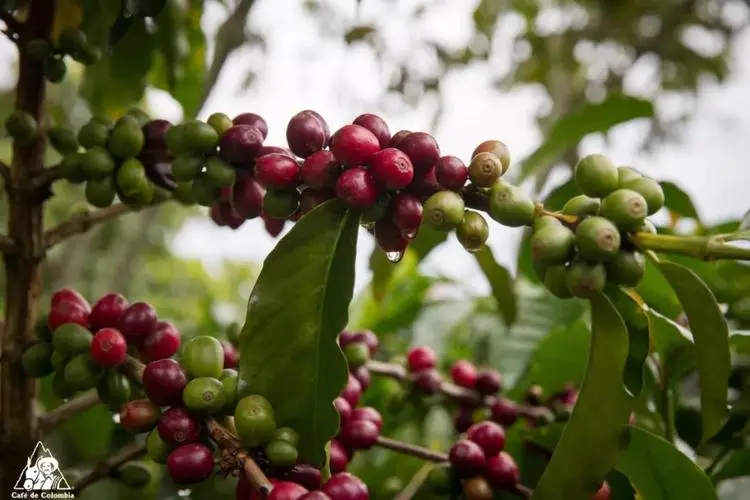
The Antioquia region is the birthplace of Colombian coffee and an important coffee-producing region, as well as one of the areas with the most concentrated coffee cultivation. The region includes both small producers and large estates.
The region is located in northwestern Colombia. Four municipalities in the department of Antioquia contribute roughly 7% of Colombia's coffee output, with a planted area of more than 18,000 hectares, and about 9,800 families involved in production. The coffee varieties grown locally are also very diverse. In addition to common varieties, there are Pacamara, Castillo, the Colombia variety that shares its name with the country, Gesha, Eugenioides, Laurina, and others. After trying them, Front Street believes that the coffee produced in this region has a light sweetness, a delicate and mild mouthfeel, excellent sweetness and balance, and herbal fruit flavors.
The town of Fredonia is located within the department of Antioquia. As early as 1873, the first coffee trees were planted locally, and they remain to this day. The area lies in the high mountain zone of the Andes, with growing elevations between 1,300 and 2,200 meters, and it borders the Caribbean Sea, giving it a rather unique climate. Combined with volcanic soil, this enables it to produce coffee beans with a light sweetness, a delicate and mild mouthfeel, balanced sweetness, and fruity flavors.
The above content is compiled by CoffeeHunters, a coffee news website.


