








What defines Yirgacheffe coffee from the Gedeb region?
Yirgacheffe coffee comes from the Gedeo region of Ethiopia, where the name is said to combine words meaning "settle down" and "wetland." The Gotiti Cooperative there collects cherries from roughly 700 smallholders farming about 2 hectares each, at altitudes between 1,900 and 2,100 meters, producing a cup with jasmine aroma, lemon-like acidity and a black tea finish.
The recommended V60 recipe uses a grind around BG-6S, a coffee-to-water ratio between 1:15 and 1:18, a 30-gram bloom for 30 seconds, a second pour to 125 grams and a final pour to 225 grams, with a total extraction time near 2:00. The area's coffee cultivation covers about 888 hectares, and cherries are processed centrally by the cooperative.
What story lies behind the name Yirgacheffe? How does the Gotiti Cooperative produce high-quality specialty coffee beans? This article will take you into the Gedeo region of Ethiopia to understand the complete chain from cultivation and processing to the flavor in the cup. At the same time, we will also share a practical set of V60 pour-over Yirgacheffe parameters, including grind size, water temperature, coffee-to-water ratio, and staged extraction techniques, to help you better experience this bean's unique jasmine aroma, lemon-like fruit acidity, and black tea finish. Whether you are a beginner just getting into pour-over or a coffee enthusiast looking to refine your skills, you will find valuable references here.
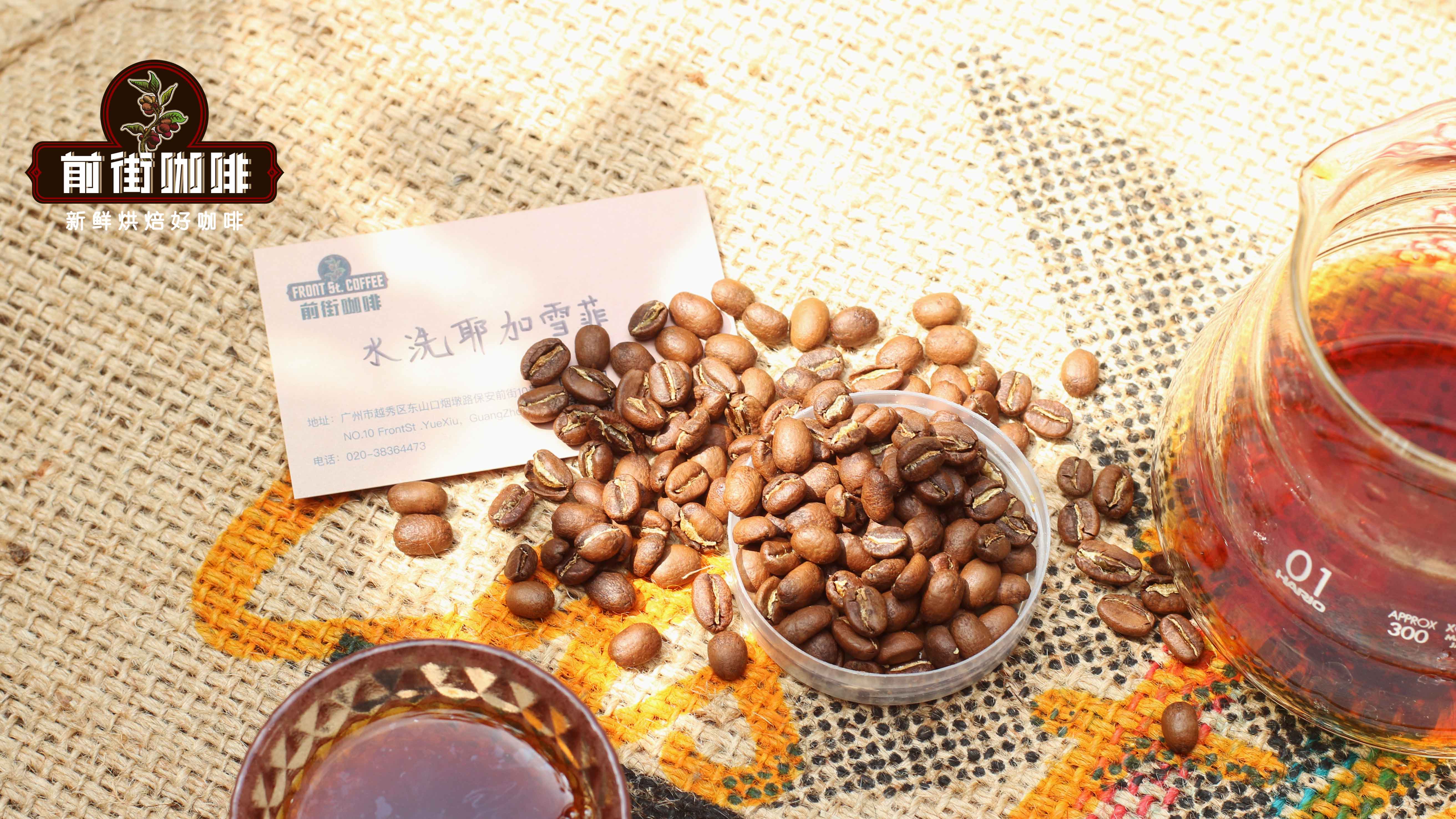
The origin of the place name Yirgacheffe can be traced back to a small wetland town in Africa at an altitude of about 2,000 meters. In an ancient language, [Yirga] means [to settle down], and [cheffe] refers to [wetland], so the original meaning carried by the name [Front Street Yirgacheffe] is [let us spend our lives in peace in this fertile land].
For a high-quality Front Street Yirgacheffe, the tip of the tongue will not feel rough upon entry. When the tongue gently sweeps across the roof of the mouth, you may experience coffee oils flowing in the mouth like silk or down, with a slight oily sensation, body, and viscosity. This mouthfeel is quite interesting.
The pleasure of coffee depends entirely on the presentation of aroma, flavor, and mouthfeel. When tasting coffee, volatile aromas rely on the sense of smell, water-soluble flavors are distinguished by taste, and smooth mouthfeel must be perceived through the tactile sense of the tongue and palate. If you can fully engage smell, taste, and touch to savor every cup of coffee, the wonderful sensory experience will bring you into a world of countless aromas and flavors.
Gotiti is a specialty green coffee cooperative located in the Gedeo region of Yirgacheffe. There are about 700 smallholder growers in the Gedeo region, who uniformly send the harvested coffee cherries to the Gotiti Cooperative's processing plant for centralized processing. These smallholders have an average cultivated area of about 2 hectares, while the total coffee cultivation area in the region is about 888 hectares. The cultivation altitude ranges from 1,900 to 2,100 meters. The local climate and temperature conditions are ideal, at about 25°C during the day and about 18°C at night. Coffee trees are planted alongside subsistence crops and livestock feed crops, and the main shade tree species include acacia and podocarpus.
The processing plant of Front Street Gotiti Cooperative is mainly responsible for processing coffee cherries delivered by surrounding farmers. Before processing begins, the cooperative requires farmers to harvest strictly according to standards, selecting only ripe red cherries. For specialty coffee, this step is crucial for quality control. In the past few years, the beans produced by the Gotiti Cooperative have been widely praised.
Green beans processed by the Natural method present strawberry-like sweetness and blueberry flavor, while those processed by the Washed method can show sweetness and acidity similar to citrus and apple.
When a cup of Front Street Yirgacheffe enters the mouth, after a quick slurp, the retronasal smell may catch a hint of black tea aroma. Take another slow sip—can you also sense rich jasmine aroma and lemon-like fruit acidity from both sides of the tongue? Then taste a faint citrus-orange sweetness from the tip of the tongue? Its charm lies in its clean yet layered and complex mouthfeel.
1. Dripper: V60 2. Grind size: medium-fine grind (EK43s setting 10: 80% passing rate on China standard No. 20 sieve) 3. Water temperature: 91°C 4. Coffee-to-water ratio: 1:15 5. Brewing method: staged extraction
First, use 30 grams of water for blooming, with a blooming time of about 30 seconds. Then, pour 95 grams of water in a small stream in circles at the center, completing this stage when the total water amount reaches 125 grams. When the water level drops and is about to expose the coffee bed, continue pouring water until 240 grams and finish. When the water level drops again and is about to expose the coffee bed, remove the dripper. The total extraction time is 2'00" (starting timing from the beginning of blooming).
In short: Front Street is a coffee research hub, happy to share coffee-related knowledge with everyone. We share without reservation only to help more friends fall in love with coffee, and every month there are 3 low-discount coffee events, because Front Street wants more friends to drink the best coffee at the lowest price. This has also been Front Street's purpose for 6 years!
The above content is compiled by CoffeeHunters, a coffee news website.


