







How Can Buyers Tell Authentic Blue Mountain Coffee Apart?
Jamaica produces only about 1,200 to 2,400 tons of coffee a year, and Blue Mountain accounts for roughly 40 percent of that, or 300 to 600 tons. Authentic beans are grown in the designated Blue Mountain area and graded accordingly, so origin and grade labels are the first things to check when judging whether a bag is genuine.
Before 2009 Japan held priority purchasing rights and at one point controlled more than 80 percent of the supply; the Jamaican government ended that privilege, but pests, typhoons and leaf rust kept production falling and prices rising. Genuine Blue Mountain coffee shows high cleanliness, good body and balanced acidity, sweetness and bitterness.
Blue Mountain coffee is one of the most globally recognized coffees, but what exactly lies behind its high price? This article will analyze the uniqueness of authentic Jamaican Blue Mountain coffee from multiple dimensions, including scarce production, historical quota systems, and terroir conditions. At the same time, we will also discuss how to identify genuine versus fake Blue Mountain coffee in the domestic market, and introduce in detail the Clifton Estate Blue Mountain No. 1 coffee beans launched by Front Street Coffee, taking you through origin information, grade classification, and brewing and tasting, for a comprehensive understanding of this legendary beverage known as the "Hermès of the coffee world."
For more specialty coffee knowledge, please follow the WeChat official account: Front Street Coffee (FrontStreet Coffee)
Jamaican Blue Mountain coffee is so famous that even people who rarely encounter specialty coffee have mostly heard of its high price. Previously, at the Front Street Coffee (FrontStreet Coffee) store, a customer asked while choosing Blue Mountain coffee beans: why is Blue Mountain coffee sold so expensively?
After analysis, Front Street found that the high pricing of Jamaican Blue Mountain coffee mainly comes from two aspects. First, Jamaica's total annual coffee production itself is not large, usually only 1,200 to 2,400 tons, of which Blue Mountain coffee accounts for about 40%, roughly 300 to 600 tons. Second, before 2009, Japan held priority purchasing rights for Blue Mountain coffee beans and at one point controlled more than 80% of the supply. It was not until 2009 that the Jamaican government ended Japan's privilege. But even so, the price of Blue Mountain coffee beans still did not come down, because Jamaica's producing regions were successively hit by pests and diseases, typhoons, leaf rust, and other disasters, causing coffee production to continue declining, and prices accordingly rose.
Of course, the high price of Blue Mountain coffee is also inseparable from its flavor performance. The taste brewed from authentic Jamaican Blue Mountain coffee beans is highly recognizable, with extremely high and bright cleanliness, excellent body, and a perfectly balanced combination of acidity, sweetness, and bitterness. This is exactly why it is renowned worldwide. According to Jamaican standards, only coffee beans grown in the Blue Mountains at an altitude between 1,000 and 1,700 meters are eligible to be called authentic Blue Mountain coffee beans. The Blue Mountain No. 1 coffee launched by Front Street comes precisely from this producing region.
Can genuine Blue Mountain coffee be bought in the domestic market?
If you type the two words "Blue Mountain" into a search engine, a large number of articles teaching people how to distinguish genuine from fake Blue Mountain will pop up. Indeed, Blue Mountain coffee has such high international fame that many merchants borrow the name "Blue Mountain" and use lower-quality commercial coffee to pass off as the real thing, so the market is flooded with counterfeit Blue Mountain products. The most common borderline terms include "Blue Mountain flavor," "Blue Mountain blend," and "Blue Mountain instant," none of which actually have anything to do with real Blue Mountain coffee.
Although fake Blue Mountain is widespread in China, the real thing has not completely disappeared. In fact, as early as April 2011, there were reports in China of Blue Mountain coffee imported directly from Jamaica. At that time, Zhejiang DUNN'S RIVER Import and Export Trading Co. purchased on behalf of the "Hangzhou Coffee and Western Food Association" from Jamaica, totaling 1000*70kg, with a total value of two million US dollars. Today, Jamaica also attaches considerable importance to the Chinese market, and many authorized domestic exporters can be found on the CIB official website.
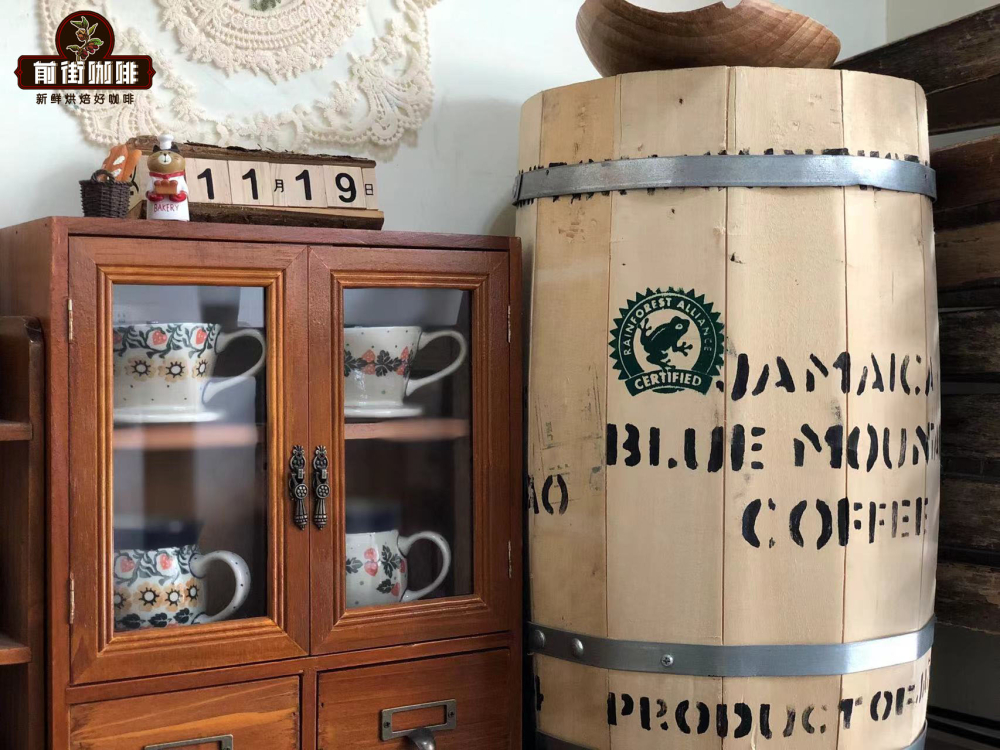
Front Street's own-roasted Blue Mountain No. 1 coffee comes from Jamaica's Clifton Estate and has a quality certificate issued by the Jamaica Coffee Board, an authorized sales certificate issued by the Blue Mountain coffee producer, and a Jamaican Blue Mountain coffee certificate of origin. In the Dongshankou store, there is also an oak barrel holding Blue Mountain green beans. When the store is full, it becomes a small wooden table for customers to place their coffee on, which is quite charming.
Why is genuine Blue Mountain so expensive?
Blue Mountain coffee was once called the Hermès of the coffee world. Authentic Blue Mountain lets people experience a rich, dense, and lasting aroma of chocolate and roasted hazelnut, while achieving excellent balance in acidity, sweetness, bitterness, aroma, and body. Front Street believes that Blue Mountain coffee's ability to build such a high reputation is inseparable from the careful management and strict grading system of Jamaican growers.
The Blue Mountains have exceptional terroir conditions, and the combination of various favorable factors makes this an ideal place for coffee cultivation. However, coffee is ultimately an agricultural crop, and variety, altitude, picking method, and post-processing method all affect the final aroma.
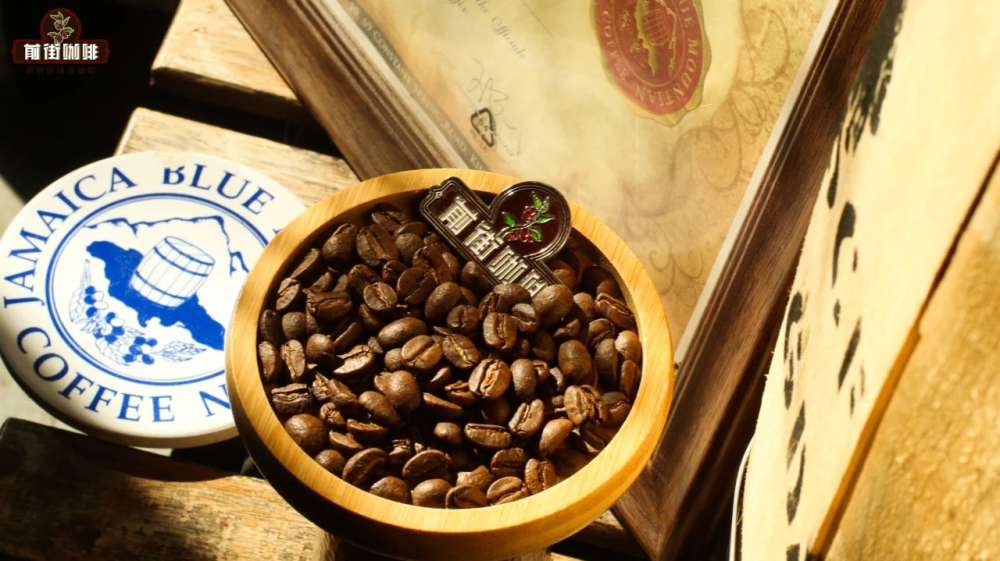
According to the official designation of the Jamaica Coffee Industry Board (CIB), only Typica variety coffee grown in forest areas at an altitude of about 910 to 1,700 meters can be labeled "Jamaican Blue Mountain Coffee." Typica needs to be grown at high altitude for its flavor to be fully expressed. In addition, this variety has weak disease resistance and is highly susceptible to infection, and the yield per plant is also relatively low, so it requires more manpower for careful care. Moreover, the high-altitude areas of the Blue Mountains are rugged, making management and harvesting very difficult and demanding extremely high skill from pickers, which further restricts production. In recent years, less than 15% of coffee beans produced in Jamaica can carry the Blue Mountain label, only about 900 tons.
Many friends may have heard a saying: "Authentic Blue Mountain coffee is all monopolized by Japan." This saying is not entirely unfounded. UCC is a Japanese coffee company, formerly Ueshima Coffee Co., Ltd. In 1981, it established a farm in Jamaica to operate a Blue Mountain coffee project. Jamaica promised to sell 90% of the Blue Mountain coffee quota to Japan. Combined with Japan's vigorous promotion of Blue Mountain, this created a situation where Blue Mountain was expensive and hard to obtain. Today, with the vigorous development of coffee culture, drinking a cup of Blue Mountain coffee is no longer difficult. At Front Street, for only 60 yuan you can drink a cup of the highest-grade Blue Mountain No. 1 hand-brewed black coffee.
Front Street Coffee (FrontStreet Coffee) — Jamaican Blue Mountain No. 1 coffee beans
Farm: Clifton Farm
Estate owner: The Sharp family
Certification: Rainforest Alliance certification
Location: Newcastle area
Total area: 250 acres
Coffee planting area: 180 acres
Altitude: 1,310 meters
Processing method: washed
Variety: 100% Arabica Typica
Roast: medium-dark
Compared with other coffee-producing regions, Jamaica was the earliest country to realize that coffee has a "taste of place." Local quality evaluation standards for Blue Mountain green beans cover multiple aspects: green bean size, defect rate, color, uniformity, and post-roast cupping performance (including dry aroma, wet aroma, acidity, flavor, body, cleanliness, etc.).
Bean size is measured using screens with different aperture sizes, and coffee beans that cannot pass through the holes meet the corresponding standard. Color evaluation combines visual observation with colorimeter readings, with blue-green being the highest grade. Based on the above standards, Blue Mountain coffee is divided into four grades, from high to low: NO.1, NO.2, NO.3, PB, and mixed. NO.1 is the highest-grade top Blue Mountain, called "Blue Mountain No. 1" in China. Blue Mountain No. 1 must meet a screen size of 17 or above, a defect rate below 3%, a moisture content of about 13%, and when cupped present a rich coffee aroma, a smooth and balanced mouthfeel, low weak acidity, and a lasting sweet aftertaste.
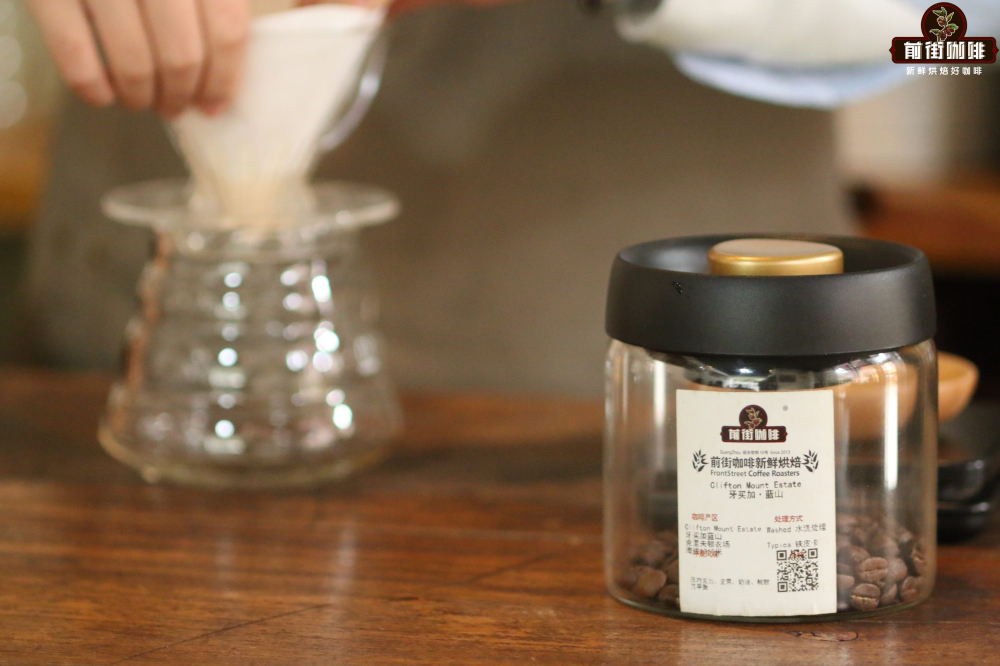
In terms of roasting, CIB also gives roasting degree recommendations for the classic Blue Mountain flavor. Front Street's roaster also follows this principle, using a medium roast so that Blue Mountain No. 1 coffee shows both a rich chocolatey sweetness and retains a suitable gentle fruit acidity.
How to taste Front Street Blue Mountain No. 1 coffee?
In order to highlight the rich, rounded mouthfeel of Blue Mountain No. 1 coffee, Front Street uses a KONO coffee dripper for extraction. KONO's ribs are less than half the height of the dripper. This design is intended to make the dripper cling closely to the cup wall after wetting, restricting airflow, thereby extending the water absorption time of the coffee grounds and making the extracted coffee more uniform overall.
Brewing parameters: 15 grams of grounds, coffee-to-water ratio 1:15, grind size: EK43s setting 10.5 (75% passing rate with China No. 20 standard sieve), water temperature: 87–88°C, brewing method: staged extraction.
Place the filter paper into the KONO dripper and wet it with water while making it adhere to the cup wall. Pour in the coffee grounds and tap lightly to distribute the bed evenly. For the first stage, gently pour 30 grams of water for blooming, with a blooming time of 30 seconds. For the second stage, pour to about 125 grams, circling outward evenly and steadily. When the coffee liquid drops to half, pour the final stage to 225 grams. After all the coffee liquid has dripped through, the total extraction time is usually about 2 minutes.
When the coffee enters the mouth, the first thing Front Street feels is an extreme sense of balance, with acidity, sweetness, and bitterness just right and mutually enhancing; next comes the traditional coffee flavors of dark chocolate, nuts, and cream, prominent but not harsh, very gentle; then comes the mouthfeel. Blue Mountain is not wild like Mandheling, but rich and smooth; finally, there is the finish after swallowing, long and lasting, and if savored carefully, one can feel that elegant, subtle fragrance of legend. Overall, it is very pleasant to drink.
The above content is compiled by CoffeeHunters, a coffee news website.


