







What do Kenyan coffee regions taste like?
Kenya is usually summed up by its berry notes, but region-level detail explains the differences in the cup. Nyeri, Kirinyaga and Muranga form the core specialty growing area on the foothills of Mt. Kenya and the Aberdare Range. Nyeri sits at 1,200 to 2,300 meters with red volcanic soil and mostly smallholder cooperatives.
Harvest runs October to December in the main season, with a secondary season from June to August, and common varieties include SL-28, SL-34, Ruiru 11 and Batian. Muranga, at 1,350 to 1,950 meters, has roughly 100,000 coffee farmers and also relies on volcanic soil. These coffee bean descriptions are guides rather than rules, since altitude, variety and washed processing all shape the final flavor.
Kenyan coffee has long been known for its distinct berry notes, but a country label alone can hardly satisfy enthusiasts' curiosity about regional details. This article focuses on three major specialty regions in Kenya—Nyeri, Kirinyaga and Muranga—outlining their respective geographic environments, altitude ranges, main cultivated varieties and harvest rhythms, and, combined with Front Street Coffee's cupping records, presenting the flavor differences among regions under washed processing. It also reminds readers that regional styles are not ironclad rules; altitude, variety and processing method all sway the final flavor in the cup.
For more specialty coffee information, follow: Front Street Coffee (Frontsteet Coffee)
As a coffee-growing country, Kenya is usually summarized by its berry notes. As the specialty coffee wave advances, drinkers pay more and more attention to region-level information; a country name alone can hardly answer everyone's questions about origin details.
So how are coffee regions divided within Kenya? And what flavor characteristics do the major regions show?
What areas do Kenya's main coffee regions include?
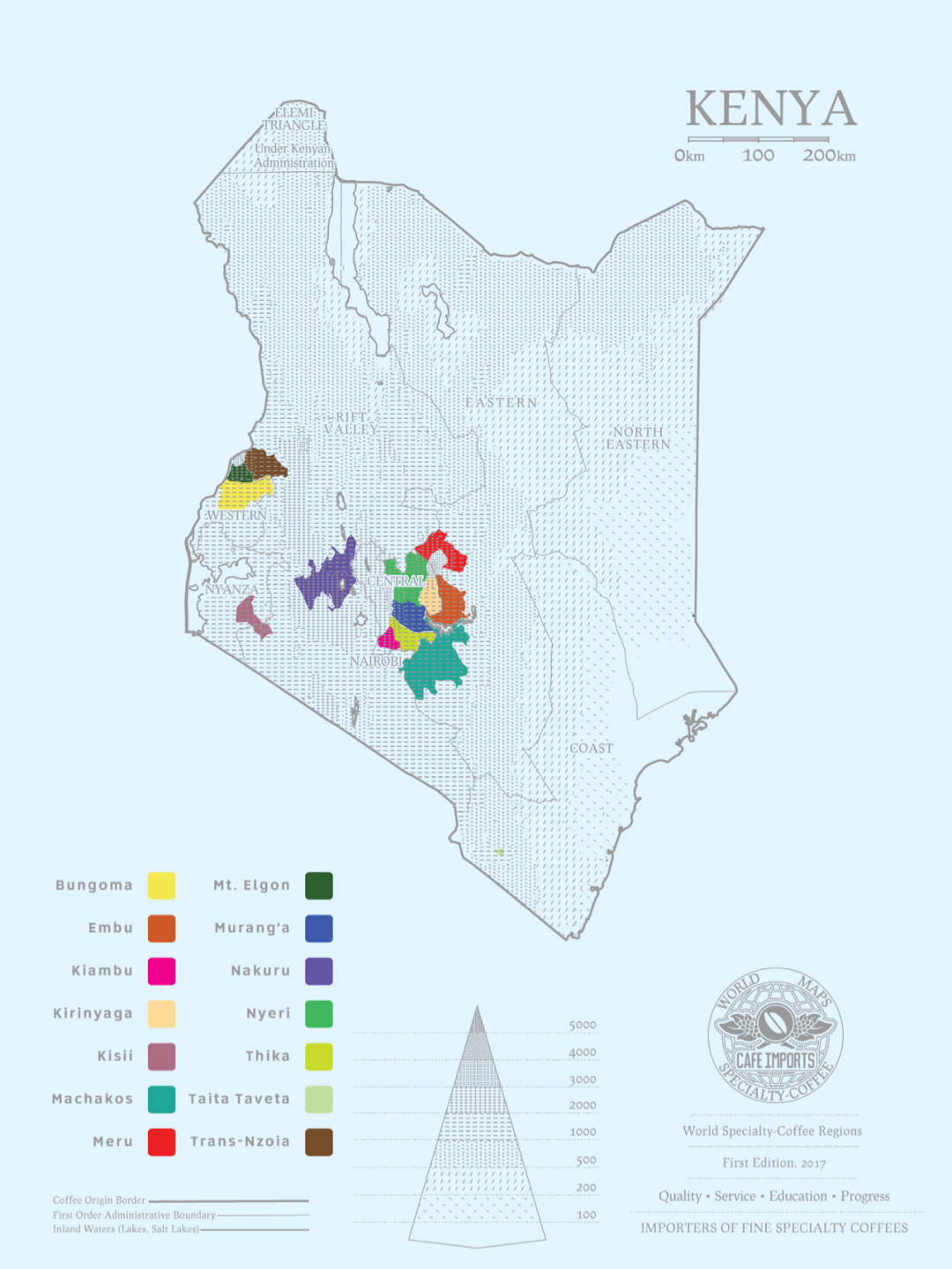
In Kenya, there are seven most renowned coffee regions: Thika, Kirinyaga, Mt. Kenya West, Nyeri, Kiambu, Ruiru and Muranga. Among them, the foothills of Mt. Kenya and the Aberdare Range form the core growing area.
Specialty coffee mainly comes from the following regions: Nyeri, Kirinyaga, Murang'a.
Nyeri
Nyeri is located in central Kenya and is home to the extinct volcano Mount Kenya. The red soil in this area is considered to produce Kenya's finest coffee. Agriculture holds an extremely important place locally, and coffee is its main crop. In the Nyeri region, cooperative societies made up of smallholder farmers are more common than large estates.
Altitude: 1,200 to 2,300 meters
Harvest period: October to December (main season), June to August (secondary season)
Varieties: SL-28, SL-34, Ruriu11, Batian.
Muranga
The Muranga region belongs to Central Province, with about 100,000 coffee farmers cultivating there. This inland region was among the first places missionaries chose to settle, because the Portuguese at the time forbade them from living in the coastal areas. This region also benefits from volcanic soil, and smallholder coffee farmers also outnumber estates.
Altitude: 1,350 to 1,950 meters
Harvest period: October to December (main season), June to August (secondary season)
Varieties: SL-28, SL-34, Ruiru11, Batian
Kirinyaga
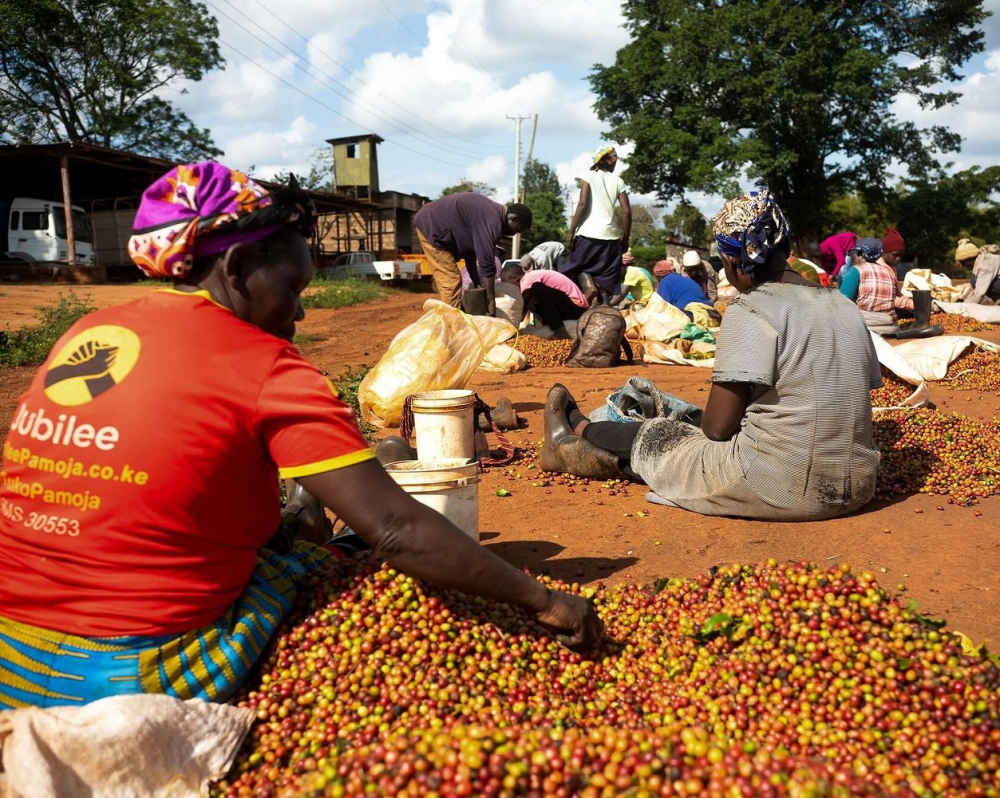
The Kirinyaga region is located on the slopes of Mount Kenya, adjacent to the Nyeri region. It is world-renowned for coffee with strong flavor, rich layers and a solid mouthfeel, and together with Nyeri it is regarded as one of Kenya's two current outstanding regions. Producers here are mostly small coffee farmers who join cooperatives; the cooperatives play a coordinating role and provide washing stations, while farmers send their coffee cherries to the cooperatives' washing stations for processing.
Kirinyaga originally referred to Mount Kenya, but during the British colonial period the name was considered hard to remember, so the mountain was renamed "Mt Kenya" and "Kirinyaga" fell out of use. Mount Kenya is Africa's second-highest peak; despite being in the tropics, its summit is covered in snow year-round, and the original meaning of Kirinyaga is precisely "white peak." Mount Kenya is not only a UNESCO protected area; the wildlife that gathers to feed on the surrounding foothills and grasslands also makes it a popular spot for tourists. According to Front Street's research, Kirinyaga comes from the Kikuyu people and means "white mountains," regarded as the dwelling place of the gods. The Kikuyu are Kenya's most populous ethnic group, accounting for one-fifth of the total population.
Altitude: 1,300 to 1,900 meters
Harvest period: October to December (main season), June to August (secondary season)
Varieties: SL-28, SL-34, Ruiru11, Batian.
What flavors do these Kenyan regions each have?
To clarify the characteristics of these regions, Front Street Coffee (FrontStreet Coffee) separately acquired several coffees from different Kenyan regions, with the bean list as follows:
These coffees are all from the new 2020 harvest, all processed by 72-hour washing, and all are of the SL28 and SL34 varieties.
Cupping was used to reduce human interference and restore the coffee's own quality and taste.
After a round of cupping, the flavor profiles formed their own characteristics by region:
The three coffees from the Nyeri region share a common profile of berry-like flavors, moderate sweetness, honey and cream.
The Kagumoini from the Muranga region showed distinct berry-like flavors, slight floral notes and slight green tea characteristics.
The two from the Kirinyaga region both presented berry-like flavors and moderate sweetness, with distinct roasted nut flavors after cooling.
Combined with Teacher Xu Baolin's flavor descriptions of Kenyan regions in "Bean Seeker 2":
Coffees from the Nyeri region have bright blackberry, a thick oily body, citrus and even floral aromas; Front Street's Little Tomato Coffee comes precisely from Kenya's Nyeri region.
Coffees from the Muranga region show bright acidity and a thick mouthfeel.
Coffees from the Kirinyaga region have bright fruit acidity, a medium oily body and refined sweetness.
At this point we can roughly see the outline of regional flavors, but Front Street Coffee (FrontStreet Coffee) needs to remind you that these are not universal formulas, and you must not develop the habit of applying a fixed description whenever you see a certain region. With a little thought, one can conclude that "not all coffees from the Nyeri region have bright blackberry, a thick oily body, citrus and even floral aromas."
A coffee's final flavor must be considered comprehensively in light of region (climate, growing methods, soil), processing method, coffee variety, storage method and other factors. Even with the same region, same variety and same processing method, as long as the growing altitude differs, the taste will differ as well.
In the cupping, the three in the Nyeri group showed a decreasing pattern in acidity. As altitude increased, the coffee's acidity in cupping increased accordingly, and high-altitude coffees' acidity was more elevated; low-altitude coffees' overall acidity declined at low temperatures, shifting from lively to dull, while the same group's high-altitude coffee, though its acidity dropped slightly at low temperatures, still retained full acidity. Therefore, not all coffees from the Nyeri region can maintain a lasting bright fruit acidity.
The above content is compiled by CoffeeHunters, a coffee news website.


