







How Do Ice Drip and Cold Brew Differ for the Coffee Enthusiast?
Cold drip coffee and cold brew coffee are both cold preparations, but they are not the same drink. Cold drip runs ice water drop by drop through a tower over 6 to 8 hours, giving a clear, transparent cup with fermentation and vinous notes. Cold brew steeps grounds in cold water for 12 to 24 hours, yielding a full body and obvious fruity sweetness.
Front Street compared both methods using the same sun-dried Huakui beans, matching the coffee and running the extractions at the same time so the differences came from process rather than bean. The comparison covered production time, equipment, powder-to-liquid ratio and final taste, and it also raised the question of whether cold drip qualifies as true black coffee for the coffee enthusiast.
Cold brew coffee and cold drip coffee are two common methods of making cold coffee, and many coffee enthusiasts often discuss the flavor differences between them when tasting. Front Street Coffee conducted an experiment using the same sun-dried Huakui coffee beans, preparing them separately with cold drip and cold brew methods, and comprehensively compared them from production time, equipment, powder-to-liquid ratio to the final taste. Cold drip coffee is clear and transparent, with fermentation notes and a vinous quality; cold brew coffee has a full-bodied mouthfeel with obvious fruity sweetness. This article will detail the differences in production and flavor performance between the two, and explore whether cold drip coffee qualifies as authentic black coffee.
For more specialty coffee knowledge, please follow: Front Street Coffee (Frontsteet Coffee)
Many customers at Front Street, when tasting coffee, chat about whether there is a difference in taste between cold drip coffee and cold brew coffee. Both methods are common cold coffee preparations, and Front Street today will conduct an experiment to compare their respective flavor characteristics.
Differences in Production Methods
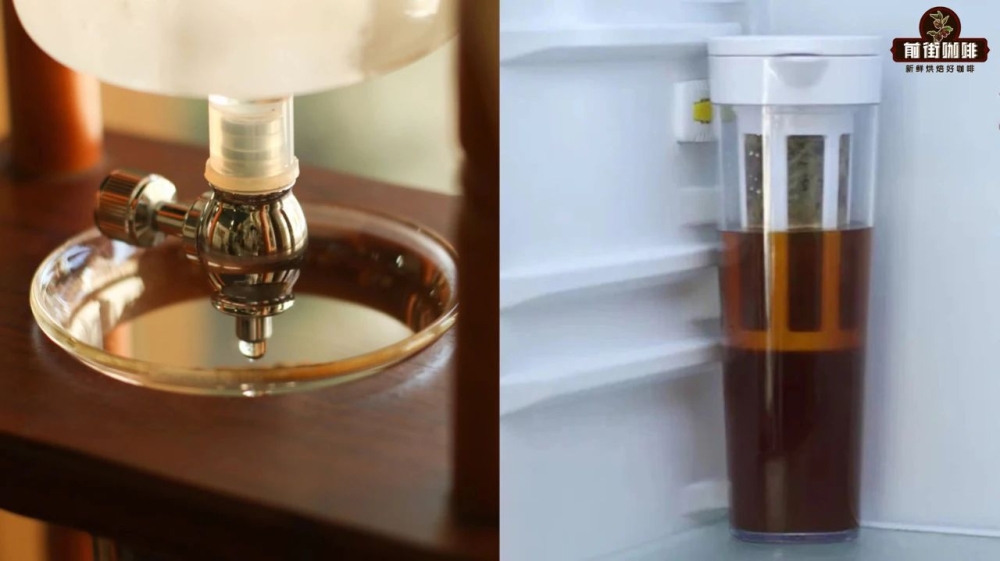
First, the production processes of both coffees are quite time-consuming. Cold drip coffee is usually made with a cold drip tower, which consists of three parts: the upper chamber (holding ice water), the middle chamber (containing coffee grounds), and the lower chamber (collecting the coffee liquid). The ice water from the upper chamber drips drop by drop into the coffee grounds in the middle chamber, and after slow extraction, the coffee liquid flows into the lower chamber. The entire process generally takes 6 to 8 hours.
(Cold drip on the left, cold brew on the right)
Cold brew coffee, on the other hand, involves placing ground coffee into a container, adding cold water or ice water in proportion, stirring evenly, sealing, and then extracting in a low-temperature refrigerator environment for 12 to 24 hours. Afterwards, the coffee grounds are filtered out with filter paper, and the resulting liquid is cold brew coffee.
Experimental Comparison
Front Street first developed extraction protocols for cold drip coffee and cold brew coffee, using the same coffee beans and conducting them simultaneously.
The coffee beans used were Front Street sun-dried Huakui, which features prominent creamy strawberry notes and a sweet-tart texture, suitable for making various iced coffees. The grind size was uniformly fine, calibrated with a No. 20 standard sieve to a 75% pass rate, with the EK43s grinder set at 9, and the C40 hand grinder set at 22.
Production Plan for Cold Drip Coffee
Front Street Coffee's cold drip plan is: use 60 grams of coffee powder, extract 600 milliliters of coffee liquid, with a powder-to-liquid ratio of 1:10. The water drip rate is about 6 drops per 10 seconds, and the upper chamber water source is an ice-water mixture. The extraction time is 7 to 8 hours, after which the coffee liquid is poured into a sealed bottle and placed in the refrigerator to rest for 48 hours.
Production Plan for Cold Brew Coffee
Front Street Coffee's cold brew plan is: use 50 grams of coffee powder, restore the powder-to-liquid ratio to 1:10, so add 400 milliliters of cold water and 200 grams of hard ice (totaling 600 grams of ice-water mixture; the coffee powder absorbs twice its own weight in water). Stir evenly, seal, and store in the refrigerator for 24 hours. After taking it out, completely filter the coffee grounds with filter paper, then pour the coffee liquid into a clean sealed bottle, and place it in the refrigerator for 2 to 4 hours before drinking for a fuller mouthfeel.
Result Comparison
Pour cold drip coffee and cold brew coffee separately into glass cups for observation: cold drip coffee is clear and transparent, while cold brew appears cloudy with oil on the surface.
Flavor of cold drip coffee: refreshing, clean mouthfeel, rich fermentation notes, with some vinous quality, and a slight berry sweet-tartness.
Flavor of cold brew coffee: relatively full-bodied mouthfeel, more uniform flavor, very obvious fruity sweetness, and not very strong fermentation notes.
Comparing the flavors of these two cold coffees, the differences are actually quite noticeable, especially in the clean and refreshing mouthfeel, which is very easy to identify.
The above content is compiled by CoffeeHunters, a coffee news website.


