







Why Is Turkish Coffee Served With the Grounds?
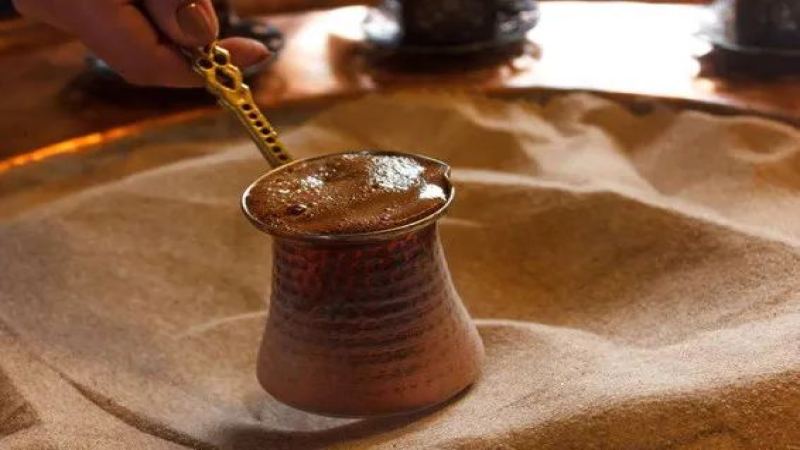
Turkish coffee is not filtered, so the grounds settle in the cup and are drunk along with the liquid. It is heated in a small long-handled pot called a Cezve, often placed in hot sand, and brought to a boil several times. The method descends from the Ottoman Empire rather than from modern Turkey alone.
Before the Turks, Middle Eastern Arabs brewed lightly roasted or even unroasted coffee in a large pot called a Dallah. The Turks adapted it into the Cezve, which Greeks call an Ibrik, and as the empire expanded the drink spread across Europe. That shared origin is why turkish coffee vs arabic coffee is often treated as one tradition, and why Greek and Armenian coffee are closely related.
Turkish coffee is famous for its unique brewing method and rich cultural flavor. It does not use filter paper and is drunk together with the grounds and liquid, having been brought to a boil three times in hot sand. Passed down from the Ottoman Empire to the present day, this coffee is not only a beverage but also carries a tradition of fortune-telling. This article will guide you through the historical origins, brewing principles, and steps of Turkish coffee, and provide a detailed explanation of the meanings of common patterns in coffee-ground fortune-telling, such as the full moon, half moon, heart, and ring, allowing you to fully appreciate the charm of this ancient coffee culture.
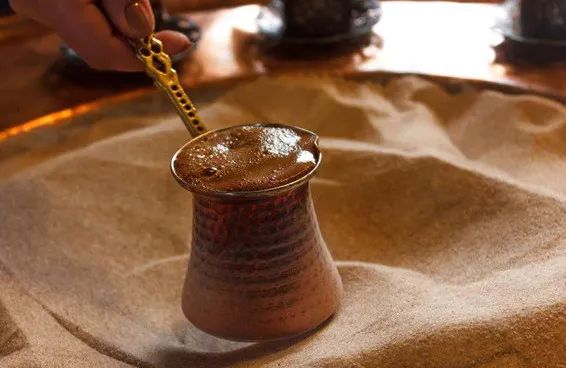
Strolling along the exotic streets of Turkey, you will notice many vendors selling a distinctive kind of coffee. They place the coffee pot in scorching hot sand to heat it, and when the coffee inside boils and overflows, the vendor pours part of the coffee liquid into a cup, then continues heating it, repeating this several times—quite an interesting scene. This is the renowned Turkish coffee.
Front Street would like to offer a brief explanation here: so-called Turkish coffee does not specifically refer to coffee from the modern region of Turkey, but rather to coffee passed down from the Ottoman Empire period. Before the Turks, Arabs in the Middle East had already used a large pot called a Dallah, whose spout resembled a toucan's beak, to brew very lightly roasted—or even possibly completely unroasted—raw coffee. Later, the Turks improved the Arab pot and switched to a small long-handled pot called a Cezve (which Greeks call an Ibrik). They still placed water and coffee grounds together in the pot and heated it over charcoal, and over time this evolved into today's Turkish coffee.
With the territorial expansion of the Ottoman Empire, Turkish coffee spread as a cultural symbol throughout the empire and even to various European countries. For example, today's Greek coffee and Armenian coffee actually share the same origin as Turkish coffee, which is why Turkish coffee is sometimes also called Arab coffee.
The principle of brewing coffee with a Turkish pot
The vessel used to make Turkish coffee is called a [Cezve]. This type of pot is usually made of brass, and its most distinctive feature is a slender handle connected to a cylindrical container with a narrowed opening. Even today, high-quality Turkish pots are still made by hand, with copper walls about 1 to 1.5 millimeters thick, ensuring both sufficient hardness and good heat conductivity.
In today's era when pour-over coffee is all the rage, Turkish coffee is one of the few schools of coffee extraction that uses "boiling." Its most fundamental difference from common modern brewing methods is this: most methods today filter out the coffee grounds to obtain a clear coffee liquid, while Turkish coffee is drunk together with the powder.
At present, Turkish coffee usually uses commercial beans from Brazil, which is also one of the reasons its flavor is often criticized. However, some cafés have now begun using high-quality single-origin Arabica beans to make Turkish coffee.
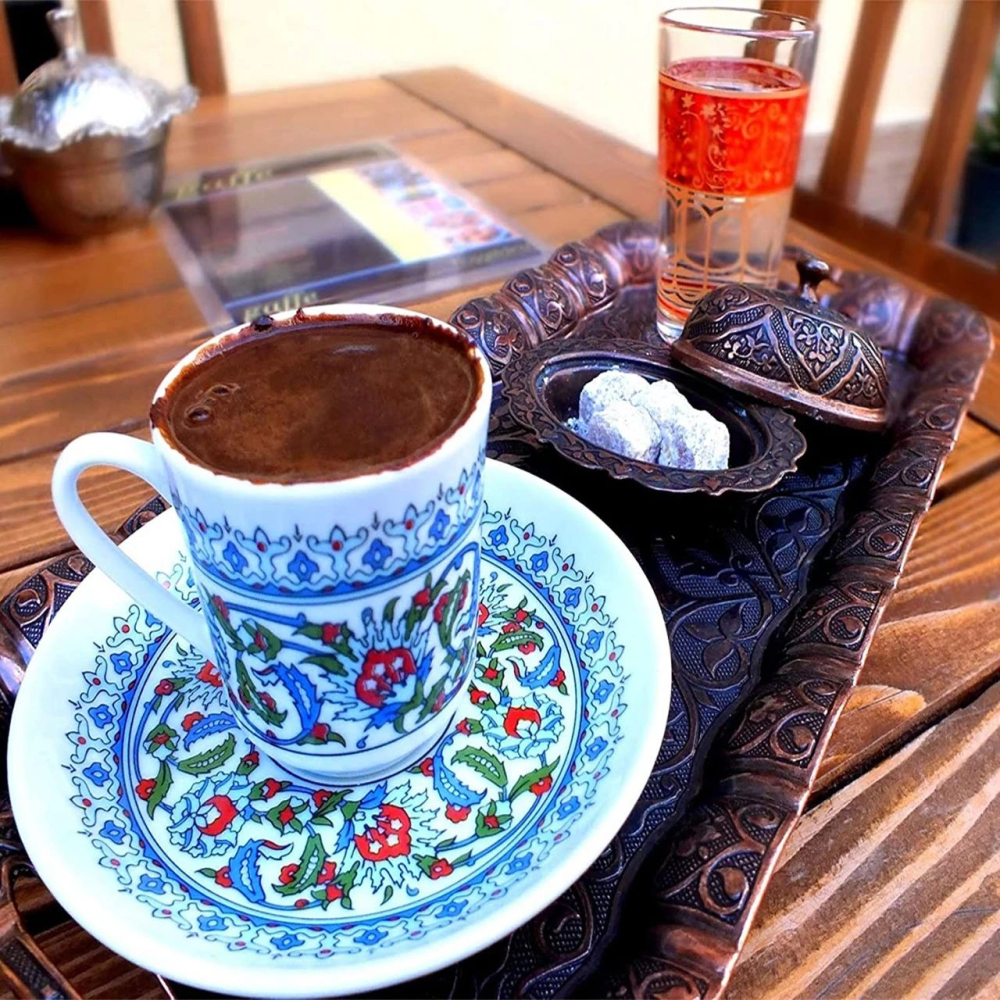
Turkish coffee requires an extremely fine grind, almost like refined flour, finer than espresso. The traditional heat source is sand heated to about 200°C, though today some people also use gas stoves, charcoal stoves, and other alternatives.
In practice, first take a Turkish pot of one-cup capacity, add 12 grams of extremely finely ground coffee powder, and then pour in 120 to 180 grams of cold water (depending on the size of the cup used). Then bury the pot in a preheated sand furnace (if using another heat source, heat from the bottom), with the sand wrapping around the entire pot so that the inside heats more evenly.
The traditional brewing method emphasizes "three boils": after heating for about 5 to 7 minutes, the coffee reaches boiling point and begins to roll; just as it is about to expand and overflow, remove the pot from the heat source, then put it back later to continue heating. Repeat this twice, and when it boils for the third time, pour the coffee into the cup.
Another method is to first pour about one-third of the coffee into each cup, then put the remaining coffee back on the fire to continue boiling, and after it boils again, distribute it in turn among the previous cups.
Fortune-telling explanation
Tasting Turkish coffee has also given rise to an interesting cultural tradition, the most widespread of which is coffee-ground fortune-telling. After finishing the coffee, first place the coffee saucer over the mouth of the cup, then turn the cup upside down. After the coffee grounds in the cup solidify, one can infer fortunes based on the patterns they form. Of course, this has become a form of entertainment in Turkish coffee culture (not superstition).
Full moon type: It means today is an extremely lucky day, and the goddess of fortune will always favor you. No matter what you do, as long as you are willing to put in effort, you will certainly succeed.
Half moon type: Today will be a smooth day. You will be able to cooperate well with others and advance work entirely according to the established plan. If you seize the opportunity, you may also receive an unexpected sum of money.
Crescent moon type: There will be some minor setbacks in work and life. As long as you adjust your mindset and temporarily set aside unpleasant matters, you can still achieve your goals.
New moon type: This is a rather unlucky day. You must be cautious and careful in everything, and remember to stay calm when things happen, so as not to ruin matters through impatience and leave the situation difficult to clean up. Treat everything with a calm mind; patience and humility can keep you safe and sound.
Other types: Nothing is foretold, and no one knows what will happen. In short, this day is full of thrills and excitement, but as long as you keep a calm mind, nothing bad will befall you.
Explanation of other shapes
Four-legged animals or trees
Usually symbolizes success, such as promotion at work, smooth exams, and gaining reputation and status.
Heart shape
Usually foretells that love is about to arrive. If there is only one heart in the cup, for single people it means love is coming, while for those who already have a partner it means the other person will be utterly devoted to you. If two hearts appear in the cup, it is a symbol of mutual affection, and if a ring-shaped pattern also appears, the possibility of the two marrying is extremely high.
Ring
Usually represents an engagement, or that within the next three months someone around you may hold a wedding.
Numbers or dates are usually related to months or dates. If it is a number with special meaning to the individual, pay extra attention. For example, if 8 appears, and the 8th of this month has already passed while it is currently May, then this most likely points to August.
English letters
Usually represent someone's surname. Perhaps C stands for "Zhang," or "Zheng," and so on, while K may correspond to the surname "Jin," etc.
Birds or bird-like patterns
Usually means there will be an unexpected surprise, or good news will arrive. If it is a bird soaring with wings spread, it indicates that something astonishing will happen very soon, or that a surprise will soon arrive.
Blank rectangle
Usually foretells the arrival of wealth. The larger the rectangle, the more wealth it represents, so recently you can buy lottery tickets or pay attention to receipts. As for whether you can hold on to the money, it depends on the moment you open the cup and saucer—the degree to which the cup and saucer are stuck together; the tighter they are stuck, the less likely wealth will leak away.
Snake-like shape
Usually represents some bad things, especially that there may be petty people around you, or that you may be plotted against. In short, it is best to avoid direct conflict with others. If it is S-shaped, it may also be related to a surname, such as "Xie" or "Xu," etc.
Tube shape
If a tube shape appears on the wall of the coffee cup, it usually represents travel, or that there will soon be matters related to moving. The longer the tube shape, the farther the place you are going; if it is a tube with a closed end, it means the journey is blocked and not easy to undertake.
Eye
Usually indicates being envied by others. The more eyes appear, the more serious the situation, and you should pay more attention to your words and actions.
Circle, straight line, triangle
The appearance of a circle usually represents good things, such as success; the appearance of a straight line indicates smoothness; the appearance of a triangle also represents success, though it is mostly related to the entertainment, media, and art fields.
Stars or star-sign-related patterns
If a star shape appears, it usually indicates that beautiful dreams come true and wishes are fulfilled. If a zodiac symbol or sign appears, it indicates the essence of certain matters; for example, Aries represents being too impulsive in action, while Libra may be related to love.
Unicorn appears
A unicorn usually indicates someone's inner secrets and fantasies. If a unicorn pattern appears, it usually means there is an unspeakable secret in the heart, such as an affair or a love triangle.
If the coffee grounds on the cup wall cannot be shaken off, other
It indicates that the person seeking a reading is currently under considerable pressure. If there are still some gaps between the grounds and the cup wall, it means there is still room for relief; if there are no gaps, it means the person needs to find someone to talk to and try to express the pressure in their heart.
For professional coffee knowledge exchange and more coffee bean information, please follow Coffee Workshop (WeChat public account cafe_style) For more specialty coffee beans, please add the private WeChat Front Street Coffee (FrontStreet Coffee), WeChat ID: qjcoffeex
The above content is compiled by CoffeeHunters, a coffee news website.


