







How Has Yunnan Arabica Coffee Reached the Specialty Stage?
Yunnan coffee moved from instant-coffee raw material to specialty recognition through better cultivation, variety improvement, and processing. Typica arrived with missionaries in 1904, followed by trial planting in Mangshi, expansion under Soviet orders, and Catimor promotion by Nestlé. Lincang, Baoshan, Pu'er, and Dehong now anchor production.
Three factors drove the shift: state support helped farmers adopt scientific methods that raised quality and yield together; brands and baristas put Yunnan beans in front of drinkers; and consumers favoring domestic goods encouraged cafés to list them. Front Street Coffee planted traditional Typica on an estate in Lincang and offers naturally processed 2013 Yunnan Typica beans.
In recent years, Yunnan coffee has risen abruptly amid the specialty coffee wave. Through advances in cultivation techniques, variety improvement, and processing methods, it has transformed from an instant coffee raw material into a dark horse on the specialty coffee stage. In this article, Front Street Coffee will review the century-long development of Yunnan coffee, from the introduction of Typica by missionaries in 1904, to trial planting in Mangshi, expansion during the Soviet order period, and then to the flavor predicament brought by Nestlé's promotion of Catimor. It will focus on analyzing the cultivation backgrounds and small-bean coffee flavor characteristics of major producing regions such as Lincang, Baoshan, Pu'er, and Dehong. At the same time, it will share Front Street Coffee's practice of establishing an estate in Lincang and planting traditional Typica, as well as the natural-process flavor and brewing parameter suggestions for "Front Street 2013 Yunnan Typica Coffee Beans."
Driven by the specialty coffee wave, the number of consumers purchasing Yunnan coffee beans has increased significantly. Today's Yunnan beans have long shed their old image. Cultivation standards, variety quality, and cup flavor have all made considerable progress. They are no longer equivalent to the raw material for instant coffee, but have instead stepped onto the specialty coffee stage like a dark horse. So what exactly does Yunnan coffee taste like today? And what has brought it back into the public eye? In this article, Front Street Coffee will discuss the trajectory of Yunnan coffee's changes in recent years.
There are roughly three reasons why Yunnan coffee has regained attention: First, with national support, coffee farmers have mastered more scientific and systematic cultivation methods, and coffee quality and yield have improved simultaneously. Second, more and more brands and baristas are bringing Yunnan beans to the public, playing an obvious role in driving the industry forward. Third, today's consumers favor the consumption concept of "the light of domestic goods," and many coffee brands have accordingly added Yunnan coffee beans to their menus.
The history of coffee cultivation in Yunnan can be traced back more than a hundred years. In 1904, Catholic Father Tian entered Yibin, Yunnan, along the Yunnan-Vietnam Railway, built a church in Zhugula Village, and planted Yunnan's first batch of coffee trees nearby. According to historical records, this batch of trees belonged to a small-bean variety, which is today's Arabica. Later genetic testing confirmed that these coffee trees were Typica. Although coffee trees were introduced in this way, Chinese tea culture had deep roots, and people were initially not interested in coffee, so farmers did not plant it on a large scale.
In the spring of 1952, scientific and technical personnel from the Mangshi branch of the Yunnan Agricultural Experiment Station brought back more than 70 kilograms of fresh fruit from Nongxian Village and carried out trial planting in Lujiangba, Baoshan City. The results showed good adaptability and outstanding quality, and afterward the planting scale gradually expanded.
By 1960, in order to repay loans to the Soviet Union, the state arranged unified cultivation of any crops favored by Soviet citizens, and coffee was one of them. Yunnan already had a foundation for coffee cultivation, so farmers were called on to cultivate large numbers of coffee trees. After the fruit ripened and was dried and processed, it was uniformly purchased by the national foreign trade department and shipped to the Soviet Union.
To increase Yunnan's coffee production, besides Dali, coffee-growing areas were distributed in Baoshan, Xincheng, Dehong, Ruili, Wanding, Wenshan, Tianbao, and other places. At its peak, the total area exceeded 50,000 mu. However, after the loans were repaid, the relevant departments no longer purchased in large quantities, and domestic coffee consumption demand was extremely limited. In addition, an outbreak of leaf rust caused coffee trees to die on a large scale, and farmers cut down trees and switched to other crops. Yunnan's coffee planting area consequently shrank to more than 2,000 mu.
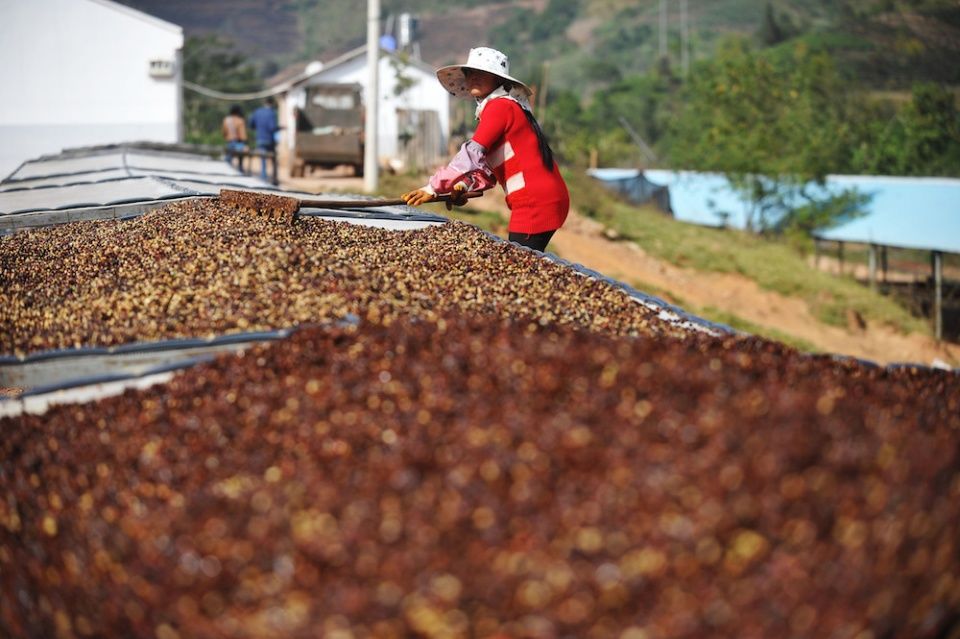
It was not until Nestlé took a fancy to Yunnan as a treasured land and distributed Catimor coffee trees with stronger resistance to leaf rust to local areas that people began planting again and supplied Nestlé for a long time. But Catimor carries Robusta genes, and its flavor performance is unsatisfactory. Drunk on its own, it is not very tasty, so the public's impression of Yunnan coffee has long remained at the instant coffee level.
In the past decade, Yunnan coffee cultivation has moved toward scientification, green bean processing techniques have continued to innovate, and the space for flavor improvement has consequently opened up. Domestic market demand for coffee has continued to grow, Yunnan coffee has developed rapidly, and its taste is refreshingly new.
Although processing methods can bring many changes to flavor, Front Street Coffee believes that to make Yunnan coffee truly accepted by the public, it is necessary to start from the root. The reason Yunnan beans do not taste good lies in the fact that the varieties contain Robusta genes. These genes bring extremely strong disease and pest resistance, but because of the presence of large amounts of chlorogenic acid, they also become a source of unpleasant bitterness.
If we want Yunnan coffee to taste better, we must start by changing the planted varieties. For this reason, since 2013, Front Street Coffee has leased a hilltop in Lincang, Yunnan, and established Front Street Coffee estate, mainly planting the most traditional Typica variety, along with a small amount of Bourbon. From the perspective of specialty coffee beans, choosing high-altitude areas, selecting and breeding excellent varieties, and adhering to green cultivation may be an attempt at the healthy and sustainable development of the Yunnan producing region.
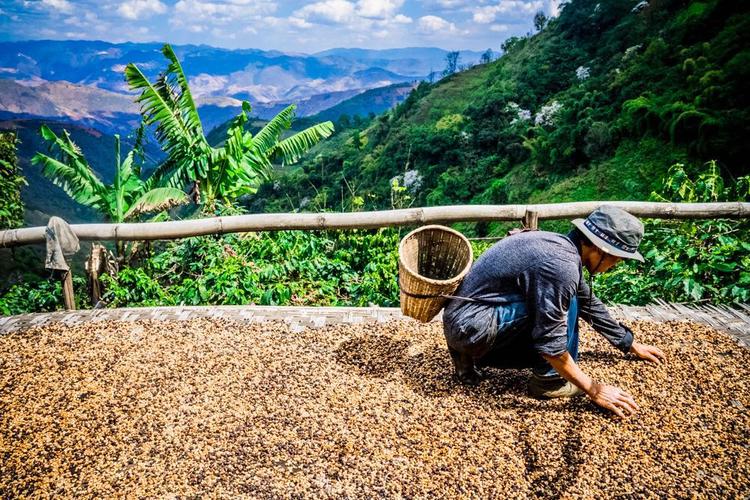
Front Street Coffee estate has harvested "Front Street 2013 Yunnan Typica Coffee Beans" successively since 2018. In the 2020/21 harvest season, Front Street harvested 200 kilograms of green beans and offered them as gifts for new and old customers to try, receiving considerable praise. By the 2021/22 new harvest season, the Typica harvest reached 600 kilograms. At present, Front Street Coffee's physical stores and Taobao store both offer this bean for purchase. Because of the change in variety, "Front Street 2013 Yunnan Typica Coffee Beans" uses traditional natural processing. The flavor is full and enticing, presenting notes of plum, berries, brown sugar, black tea, and nuts.
In order to preserve the sweet-and-sour sensation and tea-like characteristics of Yunnan coffee, Front Street Coffee uses a medium roast for this bean. For brewing, a V60 dripper can be used, with a coffee-to-water ratio of 1:15, medium grind (about the size of coarse granulated sugar / 75% passing through a China No. 20 standard sieve), and a water temperature of 88-89 degrees.
Specific brewing method: first pour 30g of water and bloom for 30 seconds; in the second stage, pour in a small stream in circles up to 125g, wait until the water level in the coffee bed drops by half before pouring again, continue pouring in a small stream in circles up to 225g, and after all dripping is complete, the total extraction time is about 2 minutes 10 seconds.
For professional coffee knowledge exchange and more coffee bean information, please follow Coffee Workshop (WeChat public account cafe_style)
For more specialty coffee beans, please add the private WeChat of Front Street Coffee, WeChat ID: qjcoffeex
The above content is compiled by CoffeeHunters, a coffee news website.


