







What Kind of Geisha Coffee Beans Are in Panama Butterfly?
Panama Butterfly is a blended single-origin coffee made of Geisha, Caturra, and Catuai, grown in Boquete in the Barú Volcano region and processed with a washed method. It carries the jasmine aroma and citrus acidity associated with Geisha, plus a fuller body and moderate bitterness, which makes it a common starting point for tasting Geisha coffee beans.
The blend is still single-origin because all three varieties come from the same estate and region. Historically, Geisha was planted mixed with Caturra and Catuai to boost yield, and farmers later separated the three for harvest before blending them at export. The same logic applies to Ethiopian beans, where many varieties grow together as a natural mix.
Panama Butterfly Coffee is a blended single-origin bean with Geisha lineage, composed of three varieties: Geisha, Caturra, and Catuai. It is produced in Boquete, in the Barú Volcano region, and is processed using a meticulous washed method. It has both the jasmine aroma and citrus acidity characteristic of Geisha, as well as a rich body and moderate bitterness, making it an introductory choice for many coffee lovers to experience Geisha flavors. This article, from the perspective of Front Street Coffee, systematically introduces Butterfly's definition and classification, variety composition, regional terroir, processing method, roasting curve, cupping performance, and brewing suggestions, helping readers fully understand this bean's unique charm and tasting points.
For more specialty coffee knowledge, please follow the WeChat public account: Front Street Coffee (FrontStreet Coffee)
When Front Street Coffee (FrontStreet Coffee) is approached by guests who want to try the taste of Geisha coffee beans, if the guest has never had Hacienda La Esmeralda Geisha from the start, Front Street Coffee (FrontStreet Coffee) will prioritize recommending Butterfly Coffee beans, which are also Panamanian coffee with Geisha flavor. Some people question whether Panama's Geisha blend Butterfly Coffee beans are single-origin coffee beans. Many believe that as long as it is blended, it is not a single-origin coffee bean. Front Street would like to clarify what the concept of single-origin coffee beans is.
Definition of Single-Origin Coffee Beans
Single-origin coffee refers to coffee produced from a specific origin, specific region, or specific estate, with a unique special flavor that reflects the local terroir.
According to information obtained by Front Street Coffee (FrontStreet Coffee), due to the estate's historical reasons, in order to pursue yield at the time, the early Geisha variety was planted mixed together with Caturra and Catuai coffee trees. For ease of harvesting, coffee farmers later separately distinguished the three varieties, and at export they directly blended the three varieties together to achieve the rich flavor they wanted to express. The three varieties in Butterfly are all from the same origin and same region, so it belongs to single-origin beans. For another example, Ethiopian beans are also not a single variety; the difference is that Ethiopia is natural harvest blending, while Butterfly is artificial post-blending.
Region: Boquete, Barú Volcano Region, Panama
Altitude: 1600m
Processing Method: Washed Processing
Varieties: Geisha, Caturra, Catuai
Boquete
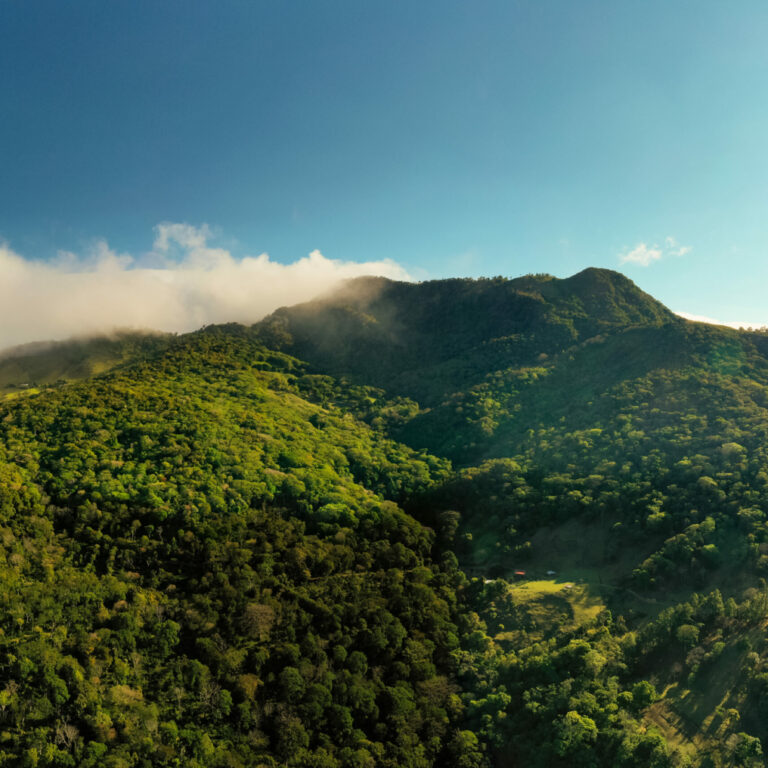
Panamanian coffee is mainly grown on the eastern and western slopes of the Barú Volcano in the west. Boquete is located on the eastern slope of the Barú Volcano. It is cool and foggy, and the mountainous geographical environment creates a unique microclimate. The cool climate and frequent fog help slow down the ripening process of coffee cherries, similar in effect to high altitude. Front Street believes that the coffee flavor of this region ranges from cocoa to fruity, with slight acidity.
Butterfly Coffee Bean Varieties
Panama Butterfly Coffee beans have 40%-50% high-quality Geisha lineage and are composed of three varieties: Geisha, Caturra, and Catuai. They are planted in the Barú Volcano region of Boquete. Panama's special local microclimate results in abundant rainfall in this area, along with large temperature differences between day and night. Combined with the unique volcanic rock soil of the volcanic region, as well as meticulous harvesting and fine processing, this coffee performs quite excellently in overall body, citrus acidity, and the jasmine aroma of Geisha coffee. However, Geisha coffee's bean shape and flavor are not like those of Central and South America, but more like flavors found only in Ethiopia. So what exactly is Geisha coffee?
Geisha: It was originally discovered in 1931 in the Geisha forest of Ethiopia. Afterward, Geisha was sent to the Coffee Research Institute in Kenya, introduced to Uganda and Tanzania in 1936, introduced to Costa Rica in 1953, and introduced to Panama around 1960. Although Geisha has strong disease resistance, its yield is low, so after people at the time used this quality as breeding stock for variety improvement, it faded into obscurity, until the owner of Hacienda La Esmeralda rediscovered them in a windbreak forest and separately entered them in the BOP cupping competition in 2004, winning first place, after which Geisha coffee became famous overnight. Since then, Geisha has been distributed to other regions of Colombia for planting. Although Geisha grown in other regions does not perform as amazingly as that grown in the windbreak forest, its floral aroma and acidity can still be excellently expressed.
Caturra: It is a natural mutation of the Arabica variety Bourbon, discovered in Brazil in 1937. Its tree is not as tall as Bourbon, but shorter. Because it inherits Bourbon lineage, its resistance is relatively weak, but its yield is higher than Bourbon. Although discovered in Brazil, Caturra is not suitable for growing in Brazil, so it was not planted on a large scale in Brazil, but became widely popular in Central and South America. For example, Colombia, Costa Rica, and Nicaragua all plant Caturra on a large scale.
Catuai: It is a coffee variety artificially hybridized from Caturra and Mondu Novo. Catuai has relatively good resistance to natural disasters, especially wind and rain. The Catuai tree is relatively short. Compared with other coffee trees, Catuai's fruit grows more firmly and is not easy to pick. The fruit can be either red or yellow. So far, it has not been found that yellow fruit tastes better than red fruit. On the contrary, some people have found in cupping that although coffee processed from some yellow fruit has good acidity, the cleanliness of the coffee's mouthfeel is worse than that of red fruit.

Butterfly Coffee Bean Processing Method
This Front Street Butterfly coffee uses meticulous washed processing. During washed processing, the skin and pulp are first removed, and it is allowed to ferment for 12-18 hours. Then the fermented beans are placed into a tank and pushed back and forth, using the friction of the beans and the force of flowing water to wash the coffee beans until smooth and clean. After washing, at this point the coffee beans are still wrapped in the parchment layer, with a moisture content of 50%, and must be dried to reduce the moisture content to 12-14%, otherwise they will continue to ferment and become moldy and spoiled. After that, the coffee beans are sorted and then stored in specialized warehouses.
Front Street Coffee (FrontStreet Coffee) Green Bean Analysis
Butterfly Coffee beans use washed processing. Washed coffee beans have cleanliness and clear floral aroma, and their moisture content is only 9.9%. Therefore, the Front Street Coffee (FrontStreet Coffee) roaster planned to charge at low temperature, then use high heat and a small airflow damper to speed up dehydration. After the dehydration stage ends, open the medium airflow damper and use medium heat so that the Maillard reaction time is not too rushed. Drop when first crack is at its densest.
Front Street Coffee (FrontStreet Coffee) Roasting Data
Yangjia 800N, roasting amount 550g: Preheat the drum to 200°C and charge, after 30 seconds adjust heat to 160, open airflow damper to 3, turning point 1'31", maintain heat; at 4'50" turn yellow, grassy smell disappears, entering the dehydration stage, at 165°C lower heat to 130°C, keep airflow damper at 4. At 7'50" dehydration is complete, the bean surface appears wrinkled and with dark streaks, the toasted bread smell turns into coffee aroma, which is the prelude to first crack. At this time, pay attention to listen for the sound of first crack. At 8'31" first crack begins, open airflow damper fully to 5, adjust heat to 70°C. Post-first-crack development time 1'28", drop at 193°C.
Front Street Coffee (FrontStreet Coffee) Cupping Report
Dry aroma: citrus, berries, floral
Wet aroma: citrus, jasmine
Flavor: peach, grape, caramel, honey
Front Street Coffee (FrontStreet Coffee) Brewing Tips
Dripper: V60 #01
Dose: 15g
Coffee-to-water ratio: 1:15
Grind size: 80% passing through a No. 20 sieve
Water temperature: 90-91°C
*Regarding grind size, Front Street determines it through the sieving method. Based on the grinding recommendations provided by the Specialty Coffee Association of America SCA for pour-over coffee, and combined with Front Street's actual operational verification, brewing with different grind sizes produces clearly different results, and the grind size for each coffee bean will differ. This is the significance of sieving. If there is no sieve at home, Front Street Coffee (FrontStreet Coffee) suggests judging by observing the flow rate: if the flow is too fast, the grind is coarse; if the flow is too slow, the grind is fine.
Front Street suggests everyone choose freshly roasted coffee beans when brewing coffee. Generally, from 4 days after the coffee bean roasting date, the coffee's flavor performance will be better. Therefore, Front Street Coffee (FrontStreet Coffee) insists on roasting fresh coffee beans. However, Front Street knows that some customers hope to brew immediately after receiving the beans (without waiting through the resting period), so when shipping, Front Street sends coffee beans roasted within 5 days. With 1-2 days of transportation, they arrive in the customer's hands at around 4-7 days, when the coffee beans have just finished resting and can be brewed immediately.
Front Street Coffee (FrontStreet Coffee) uses staged extraction, also called three-stage brewing: use 30g water for blooming for 30 seconds, pour in a small stream in circles until 125g for the stage break, and when the water level is about to expose the coffee bed, continue pouring until 225g and stop pouring. When the water level is about to expose the coffee bed, remove the dripper. (Start timing from the beginning of blooming.) Extraction time is 2'05".
Butterfly brewing flavor: jasmine floral aroma, black tea tea-like body, sweet and sour berry and citrus, finish with slight nuts, smooth mouthfeel, low bitterness, moderate acidity, medium aftertaste.
The above content is compiled by CoffeeHunters, a coffee news website.


