







Why does Ethiopian coffee taste so different across the coffee belt?
Ethiopia is the birthplace of coffee and its regions produce distinctly different cups. Yirgacheffe tends toward floral notes, Sidamo toward wild berry, and other areas such as Harar, Guji, Limu, Kaffa and Tepi each bring their own character. Compared with costly Panama Geisha, Ethiopian coffee stays affordable while still delivering bright fruit acidity, which is why it often becomes a first step into specialty coffee.
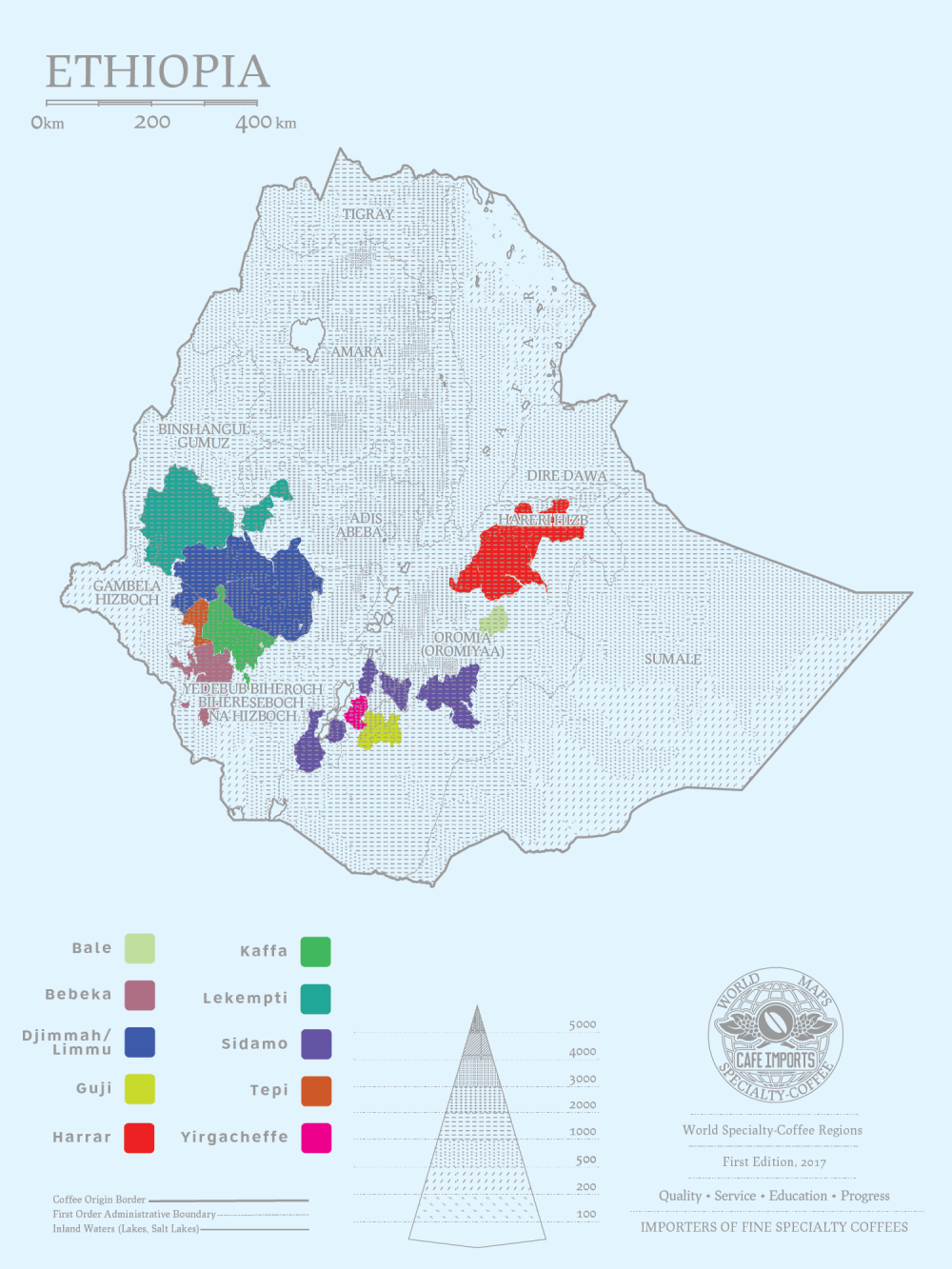
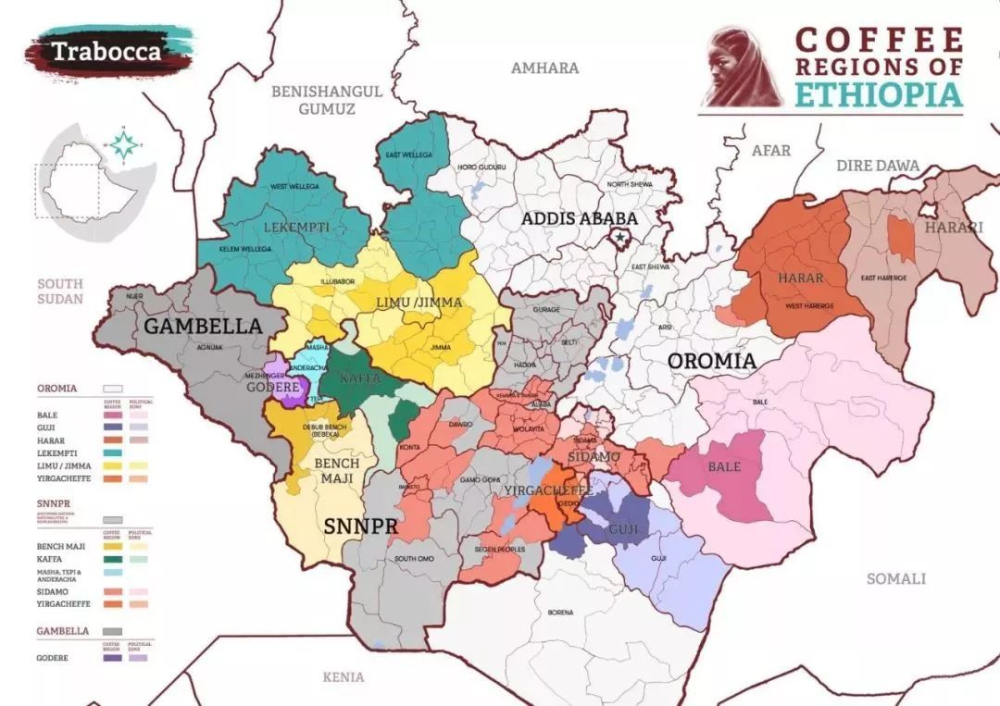
The country is divided into roughly ten producing regions, and maps drawn by different green bean traders vary slightly in how they draw the borders. Climate, soil, altitude and processing method all push flavor in different directions, so a washed Yirgacheffe and a natural Sidamo can taste unrelated. Ethiopia sits inside the coffee belt, and its lots make up about a third of the coffees on offer at many roasters.
Ethiopia is widely recognized as the birthplace of coffee, with numerous producing regions offering diverse flavors. Compared to the expensive Panama Geisha, Ethiopian coffee wins over many as their first step into the world of specialty coffee thanks to its affordable price and bright, excellent fruit acidity. From the delicate floral notes of Yirgacheffe to the wild berry flavors of Sidamo, different regions and processing methods give Ethiopian coffee a rich and varied character. Nearly one-third of the coffee beans on the shelves at Front Street Coffee come from Ethiopia, which speaks volumes about its standing in the hearts of coffee lovers. This article will systematically outline the regional divisions of Ethiopian coffee, the evolution of processing methods, and the flavor characteristics of representative coffee beans.

For more specialty coffee knowledge, please follow our WeChat public account: Front Street Coffee
Compared to Panama Geisha, which can cost over a hundred yuan per cup, Ethiopian coffee is more affordable yet still delivers a bright and outstanding fruit acidity. It is precisely this fruit-like acidity and aroma that has made Ethiopian coffee the starting point for many people's introduction to specialty coffee. As the world-recognized birthplace of coffee, Ethiopia is divided into multiple producing regions, each presenting its own unique flavor characteristics due to differences in climate, soil, altitude, and other growing conditions.
Nearly fifty coffee beans are listed on the blackboard at Front Street Coffee, covering countries across the entire coffee belt. Among them, coffee beans from Ethiopia occupy one-third of the board, showing just how high Ethiopia stands in the hearts of coffee lovers.
Ethiopia has a large number of coffee-producing regions, and their divisions are quite confusing. Maps of producing regions made by different people vary from one another. For example, the Ethiopian coffee region map made by Dutch green bean trader Trabocca and the one made by American green bean company Cafe Imports are largely the same in terms of regional divisions, but there are also subtle differences.
Ethiopia's coffee-producing regions can be roughly divided into: Yirgacheffe, Sidamo, Harar, Bale, Guji, Limu-Kimbi, Gimma-Limu, Bench Maji, Kaffa, and Tepi.
Among Ethiopia's many producing regions, Sidamo has long been famous, and the region's economic strength and status in Ethiopia are unique. On June 18, 2020, the people of the Sidamo region voted in a referendum to become independent from the Southern Nations, Nationalities, and Peoples' Region, becoming Ethiopia's tenth state, Sidama. However, the Sidamo producing region covers the entire Sidama state plus part of the Southern Nations, Nationalities, and Peoples' Region. Whether something like what happened with Sidamo will occur again remains unknown.
As the third wave of coffee has developed vigorously in China, Ethiopian coffee can be seen in cafes of all sizes across various regions. Those who pay close attention to producing regions often come across the two regions of Sidamo and Yirgacheffe. Coffee enthusiasts often introduce them to their friends like this: drink Yirgacheffe washed, and Sidamo natural. That is because it is precisely these two more traditional processing methods that give these two regions clear and recognizable flavors.
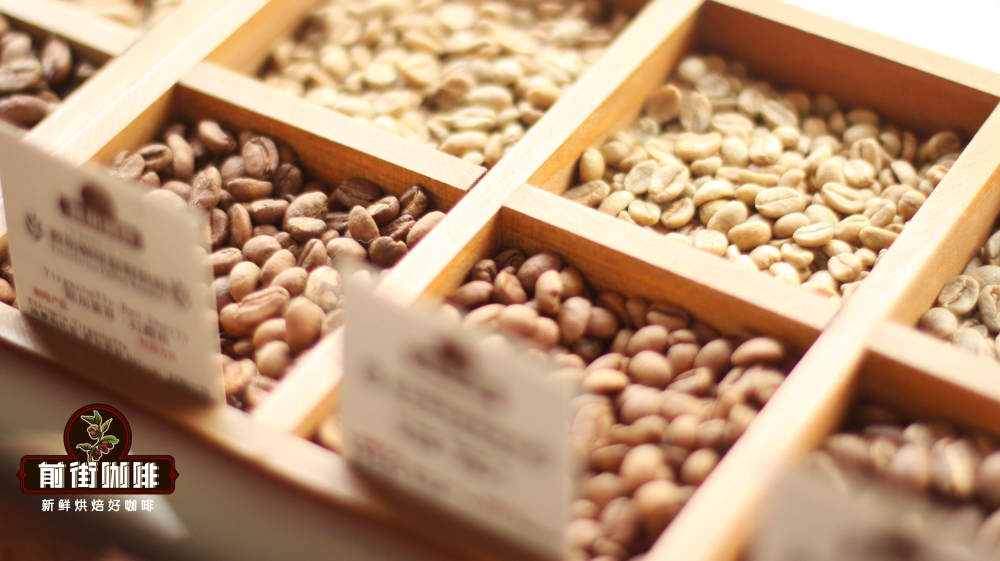
The natural processing method, as the most traditional and primitive post-harvest processing method for green coffee beans, is frequently used in various Ethiopian producing regions. However, the natural processing method also brings certain limitations, such as difficulty in controlling green bean quality. In the early grading of Ethiopian green coffee beans, the highest grade for natural beans was only G3. Later, the emergence of ECX broke this deadlock. Today, you can find G1-grade natural Ethiopian beans or washed Ethiopian beans on the shelves at Front Street Coffee.
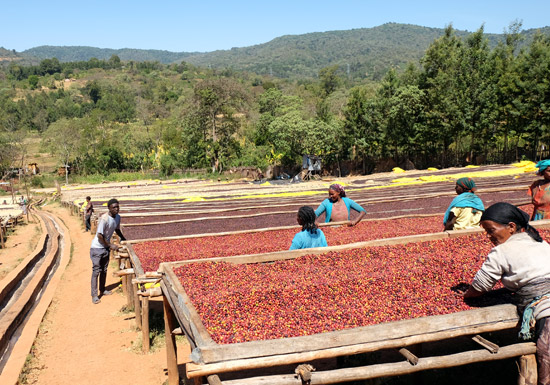
In the 1970s, in order to improve the quality of green coffee beans, the Ethiopian authorities introduced the washed processing method from Central and South America. In the washed processing method, selected coffee cherries need to have their skin and pulp removed, then the mucilage layer is completely washed off with clean water, and finally the beans are evenly spread on raised beds to dry.
The introduction of the washed processing method completely removes the pulp and mucilage that could add extra points to coffee flavor, exposing the most original flavor of the green coffee beans. It is precisely because of this that the delicate white floral notes and fine mouthfeel of Yirgacheffe coffee were discovered by the world.
It is also because of its unique floral aroma that Yirgacheffe coffee's value soared for a time, attracting many buyers in search of "Yirgacheffe." Some coffee growers from non-Yirgacheffe regions even falsely claimed that their coffee beans were Yirgacheffe beans. Because of Yirgacheffe coffee's unique flavor, and to end the confusion in the market regarding coffee-producing regions, the Yirgacheffe region became independent from the Sidamo region and declared itself a separate producing region.
Over the years, the Yirgacheffe region has often appeared on award lists in various green bean competitions. Coffee connoisseurs are even very familiar with certain villages and even cooperatives, such as the Gotiti Cooperative, Konga Cooperative, Worka Cooperative, and Kochere, shown on the Front Street Coffee menu. Although they are part of the same large producing region, each cooperative, relying on its unique geographical environment and processing techniques, brings Yirgacheffe flavors to their fullest.
For example, on the shelves at Front Street Coffee, although Gotiti and Kochere are both washed, there are still subtle differences in flavor. Gotiti has a pronounced citrus character upon entry, an extremely clean mouthfeel, and a green tea-like finish; while Kochere has more prominent sweetness, obvious citrus aroma, a sweet-and-sour sensation like orange juice, and a notable black tea character in the aftertaste.
Some people like Yirgacheffe, which represents freshness, while others like Sidamo, which represents wildness. Among the coffee friends at Front Street Coffee, many are Ethiopian coffee fans themselves, but after drinking too much washed Yirgacheffe in daily life, they naturally turn their attention to natural Sidamo.
Every coffee fan who relentlessly pursues Sidamo does so precisely because of its wild berry and cream flavors. With each new harvest season, everyone rushes to buy new beans to taste and search for the subtle differences between seasons. Among them, Huakui coffee beans are the Sidamo coffee beans most people ask about.
Since a natural coffee bean from the Buku Abel processing station in Hambela won the natural category in the Ethiopia division of the 2017 TOH green bean competition, the Huakui coffee IP has been carefully managed by Hongshun, and it is now in its sixth year. Many coffee beans are named after their place of origin or processing station. The term "Huakui" was actually coined domestically, meaning "chief of a hundred flowers," in the hope that this bean would one day surpass the status of Panama Geisha.
The Huakui coffee series also differs each year. Following the "Huakui X.0" format, X increases year by year. In 2022, the Huakui IP reached its sixth year, so it was naturally Huakui 6.0. On the road of pursuing refined and diverse Ethiopian flavors, Front Street Coffee has followed Huakui coffee beans for many years, and each year with the new harvest season it also launches the latest batch of that year.
However, coffee beans are a kind of agricultural product, and the final product is affected by conditions such as the climate of the growing area, so the flavor also shows correspondingly different expressions. Front Street Coffee often receives praise like this: Your beans are so beautiful, every single one is so plump! Therefore, Front Street Coffee felt that such a product was hard to accept. So Front Street looked through the Buku processing station in the Hambela region for another batch of natural coffee beans from the same harvest season that were not purchased by Hongshun. This new-season Huakui coffee bean has plump appearance, complete granules, and a low defect rate.
Through cupping these two new-season Huakui coffee beans, Front Street Coffee found that Hongshun's Huakui 6.0 flavor profile is berries, honey, and passion fruit, with prominent sweetness; the 2022 new-season Huakui coffee launched by Front Street has a flavor profile of citrus, honey, and orange blossom, with a strong juicy feel.
In order to express the bright, uplifting acidity of Ethiopian coffee, the roasters at Front Street Coffee generally use a medium-light roast level for Ethiopian coffee beans. As the roast level of coffee beans trends lighter, the rate at which flavor compounds in the beans are extracted slows down. In order to extract as much of the floral and fruity acidity of Ethiopian coffee as possible, Front Street Coffee recommends using the following parameters:
Dripper: Hario V60
Water temperature: 90°C
Dose: 15 grams
Coffee-to-water ratio: 1:15
Grind size: 80% passing through a Chinese standard No. 20 sieve
First pour 30 grams of hot water and bloom for 30 seconds, then pour from the center in a thin stream while slowly circling to 125 grams. When the water level in the dripper drops to the point where the coffee bed is about to be exposed, continue circling and pouring to 225 grams. The total extraction time is about 2 minutes.
The above content is compiled by CoffeeHunters, a coffee news website.


