







What Do the Red, Green and Blue Labels of Panama Geisha Coffee Mean?
Hacienda La Esmeralda in Panama grades its Geisha into Red, Green and Blue Labels. The labels differ by production area, altitude and flavor profile, which is why the same estate can offer several distinct Panama Geisha coffee beans. The estate rose to fame after the 2004 Panama cupping competition and has set auction records since.
The farm's modern chapter began in 1964, when Swedish-American financier Rudolph A. Peterson moved to Panama. For brewing, the article gives two methods: a siphon and a V60 dripper, each with its own parameters. Beginners may want to build a flavor framework from widely available origins first, because a very intense Geisha can make other coffees taste plain by comparison.
Panama's Hacienda La Esmeralda is a legend in the specialty coffee world, and its Geisha coffee is famous for its Red, Green, and Blue Label grading. From the perspective of Front Street Coffee, this article sorts out the history of Hacienda La Esmeralda and its grading system, explains in detail the definitions, production areas, altitudes, and flavor characteristics of the Red, Green, and Blue Labels, and introduces the corresponding Geisha products on Front Street Coffee's bean shelf. In addition, the article also shares two methods and parameters for brewing Geisha with a siphon and a V60 dripper, helping coffee lovers better appreciate the unique charm of Panama Geisha.
In the specialty coffee circle, the Geisha produced by Panama's Hacienda La Esmeralda can be said to be at the very top of the pyramid, and almost no coffee lover has never heard of it. Front Street Coffee believes that whether as the discoverer and promoter of Geisha's flavor or through its legendary experience of repeatedly breaking auction price records, these factors together have established Hacienda La Esmeralda's position today. However, although Hacienda La Esmeralda's Geisha is so outstanding, Front Street Coffee does not recommend that beginners try it immediately, precisely because it is too excellent—once you have tasted it, other coffees will seem bland by comparison, and Front Street Coffee believes this is not conducive to helping beginners build a systematic understanding of coffee flavors.
There are countless coffee varieties around the world, and starting from the most widely available production areas is by no means an ordinary choice. Front Street Coffee has always believed that the key is to first build your own flavor cognition framework, which will be of great benefit for gradually going deeper into the coffee world in the future. However, when faced with the many Geisha brands under Hacienda La Esmeralda, many people do indeed easily get confused. Front Street Coffee will now introduce the Green Label Geisha and, along the way, explain Hacienda La Esmeralda's grading system clearly.
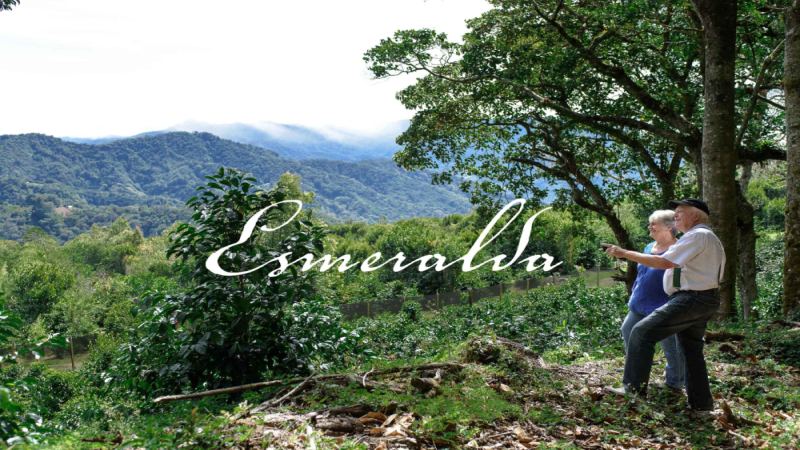
Panama Hacienda La Esmeralda
After participating in the Panama coffee bean cupping competition in 2004 and rising to fame in one stroke, it won the championship of that competition for many consecutive years.
In 1964, Swedish-American financier Rudolph A. Peterson moved to Panama after retiring and bought Hacienda La Esmeralda in Bouquete, initially focusing on dairy farming. He had once served as president of Bank of America and was quite influential in the financial world. Rudolph's original intention in purchasing Hacienda La Esmeralda was merely for vacation and retirement, and it is likely he never imagined that this estate would later become widely renowned and even become an iconic presence among Panama's specialty coffee estates.
In 1973, his son Price Peterson, after obtaining a doctorate in neurochemistry in the United States, chose to return to Bouquete to help his father manage the farm. After Price took over, based on altitude, microclimate, cupping performance, and planted varieties, he divided the market into three major brands for sale (Esmeralda Special, Diamond Mountain grows, Palmyra), and starting in 2012 he added Geisha, thus forming a four-brand structure.
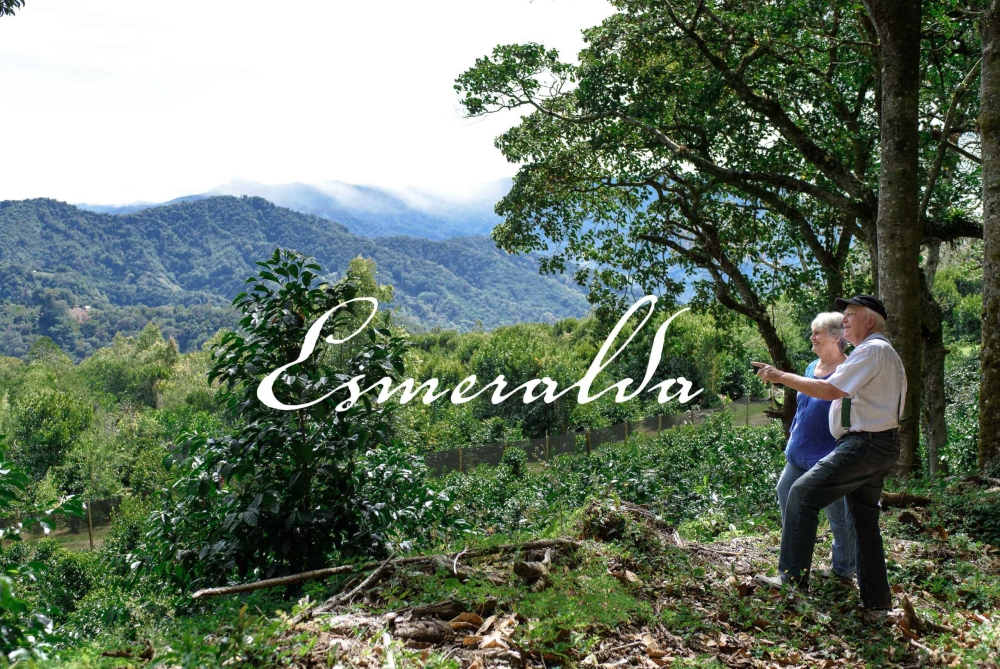
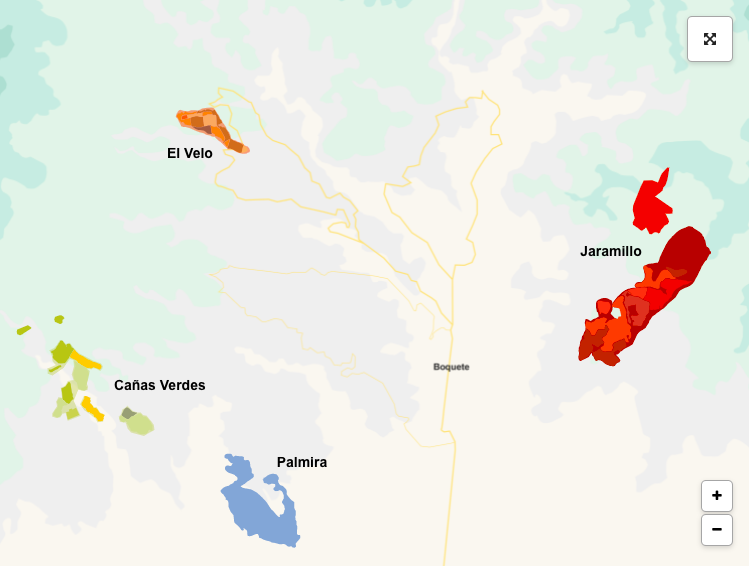
Hacienda La Esmeralda includes 4 farms: Canas Verdes, El Velo, Jaramillo, and Palmira, and all coffee beans are ultimately sent to these 4 farms for post-processing. The first farm purchased by the Peterson family, the estate owners, was Palmira. According to Front Street Coffee's latest information, Hacienda La Esmeralda acquired another new estate in 2022, named "Spring Estate," which is at a higher altitude and will be dedicated to growing Geisha coffee beans.
The differences between Hacienda La Esmeralda's Red Label, Green Label, and Blue Label
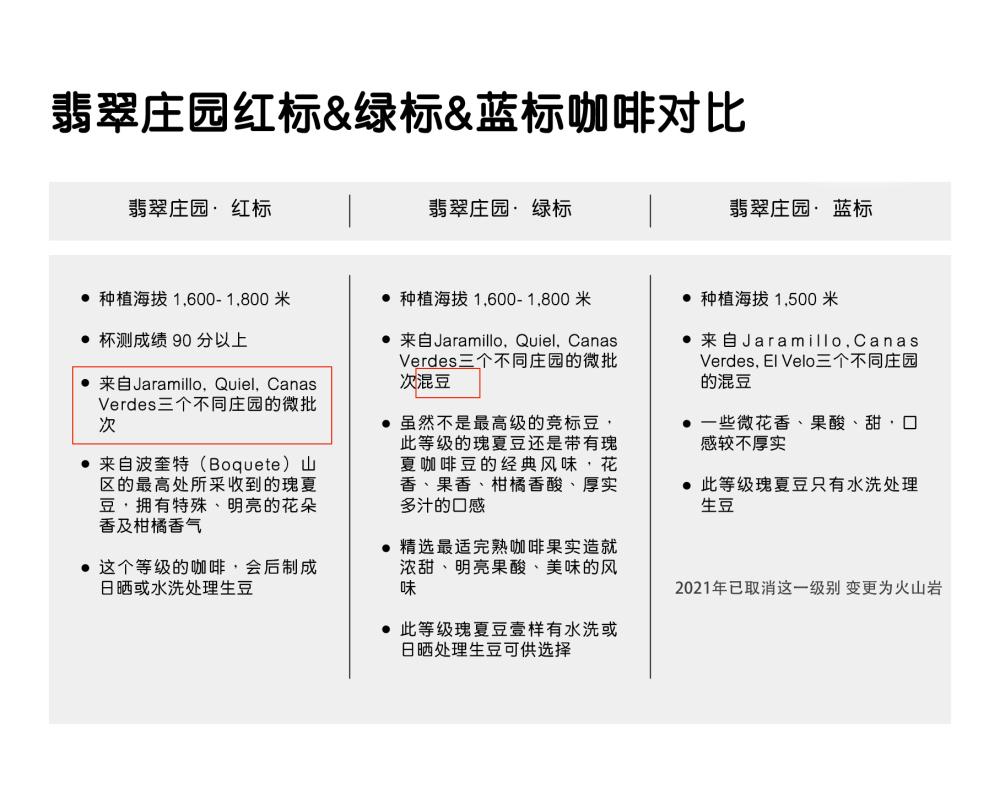
After years of experimentation, Hacienda La Esmeralda found that only Geisha beans produced by coffee trees growing above 1,400 meters above sea level can display the unique flavor that the Geisha variety should have. Therefore, the grading is mainly based on growing altitude, supplemented by actual cupping results, dividing Geisha beans into three grades: Red, Green, and Blue.
【Red Label】
The single-plot Geisha from Esmeralda Special, which is what we commonly call Red Label. It uses Geisha coffee beans grown at 1,600-1,800 meters above sea level, requires a cupping score of 90 or above, and comes from plots such as Jaramillo, Canas Verdess, and El Velo.
In the independent auction held by Hacienda La Esmeralda itself, only the Geisha lots selected from the divided plots to participate in the auction are auction Red Label. However, there are also non-auction Red Labels on the market. In fact, these are Geisha selected from the same plots that did not participate in the auction and then circulated to the market. There are only slight differences in variety quality, but it also cannot be guaranteed that auction lots will necessarily taste better than non-auction lots.
This is because some merchants will label non-auction Red Label as auction Red Label for sale, since auction prices are much higher than non-auction prices. Front Street has obtained exclusive information that Hacienda La Esmeralda has realized that the classification of auction Red Label and non-auction Red Label is indeed difficult for the public to distinguish, and will make a clearer distinction.
At present, Front Street Coffee's bean shelf has a non-auction Red Label Geisha coffee bean from Hacienda La Esmeralda, using a slow natural process. Front Street's Hacienda La Esmeralda Red Label Geisha comes from the Mario plot of the Jaramillo farm. Jaramillo is the "discovery site" of Geisha flavor, and the Geisha from the Mario plot has also performed outstandingly in many years of auctions.
Front Street Coffee: Panama Hacienda La Esmeralda Red Label Geisha Coffee Beans
Production area: Boquete, Panama
Estate: Hacienda La Esmeralda
Plot: Mario
Altitude: 1700+ meters
Variety: Geisha
Processing method: Slow natural
The slow natural process gives Front Street's Red Label Geisha from the Mario plot excellent acidity and prominent sweetness, with rich fruit flavors and white floral notes, a more intense flavor, and a fuller mouthfeel. After tasting this coffee bean, Front Street's baristas could not help but exclaim, "I've gone to heaven."
【Green Label】
Private Collection, commonly known as Green Label, does not belong to an independent competition lot. It is a Geisha variety that does not participate in auctions but still has excellent quality. It uses micro-lot blended beans grown at 1,600-1,800 meters above sea level from different plots such as Jaramillo and Cañas Verdess.
Because a blended-bean model is used, with no detailed plot labeling, there are sometimes cases where Green Label and Red Label have a very high flavor similarity, but the next offering may again be different.
Although Green Label is lower in grade than Red Label, it still carries Geisha's classic flavors—floral aroma, fruit aroma, citrus-like acidity, and a thick, juicy mouthfeel. On Front Street Coffee's bean shelf there is a washed Green Label Geisha. Because it is washed, it can express Hacienda La Esmeralda's most basic terroir characteristics. By comparing Hacienda La Esmeralda's natural and washed Green Labels, Front Street found that compared with the natural process, the washed Green Label is overall fresher and more natural, bright and refreshing, and can be described as never getting tiresome no matter how much you drink. Compared with the natural Red Label, it has a different charm. In terms of price, Front Street's washed Green Label Geisha has extremely high cost-effectiveness.
Front Street Coffee: Panama Hacienda La Esmeralda Green Label Geisha Coffee Beans
Production area: Bouquete
Estate: Hacienda La Esmeralda
Altitude: 1600 meters-1800 meters
Variety: Geisha
Processing method: Washed
【Blue Label】
The brand Geisha 1500 is what we commonly call Blue Label Geisha. It uses blended beans grown at 1,400-1,500 meters above sea level from three different plots: Jaramillo, Canas Verdess, and El Velo. Its flavor profile shows subtle floral aroma, fruity acidity, and sweetness, with a less full mouthfeel. Blue Label Geisha was initially only washed, and in 2020 a natural Blue Label Geisha was also launched. But in 2021, Hacienda La Esmeralda canceled the Blue Label brand.
In the second half of 2021, a Panama Geisha coffee bean named Las Rocas appeared. According to the information, this green coffee comes from the Boquete production area, and after verification by Front Street, it was found that this coffee bean indeed comes from Hacienda La Esmeralda's Blue Label Geisha lot.
After receiving this green coffee, Front Street Coffee immediately roasted it and cupped it within 8 to 24 hours after roasting. After cupping, Front Street Coffee's baristas found that the flavor of this Volcanic Rock Geisha coffee was highly similar to Blue Label Geisha. But by the 2022 crop year, this product was also canceled, and Hacienda La Esmeralda retained only Auction, Red Label, and Green Label.
Front Street Coffee: Panama Volcanic Rock Geisha Coffee Beans
Production area: Boquete, Panama
Estate: Hacienda La Esmeralda
Altitude: 1500+ meters
Variety: Geisha
Processing method: Washed
Friends who are craving it and want to try Panama Geisha coffee can start with this entry-level Geisha coffee bean and get a glimpse of Panama Geisha's style.
How should Panama Geisha coffee beans be brewed to taste good?
Every bean of Panama Geisha coffee is specialty, and in order to live up to the precious Panama Geisha you have purchased, you should of course also try your utmost to brew a delicious cup of Panama Geisha coffee. Therefore, many friends at Front Street Coffee's stores ask Front Street's baristas with the Geisha coffee they just bought, how does Front Street's store brew Geisha coffee?
Front Street recommends using freshly roasted coffee beans for brewing, as this allows you to experience the coffee's rich flavors to the greatest extent. The coffee beans shipped by Front Street Coffee are all within 5 days of the roasting date, because Front Street deeply understands that the freshness of coffee beans has a great impact on flavor. Front Street's roasting philosophy is "freshly roasted good coffee," so that every customer who places an order receives the freshest coffee when it arrives. Coffee's resting period is about 4-7 days, so when the customer receives it, it is exactly at its best flavor.
Here, Front Street will briefly introduce two methods for brewing Geisha coffee. One is extraction using a siphon, and the other is the extraction method commonly used for Front Street store offerings. Next, Front Street will use the washed Green Label Geisha as an example:
【Siphon】
The extraction principle of the siphon is achieved through pressure difference. First, heat the water in the lower chamber to boiling, then insert the upper chamber, causing the lower chamber to be in a high-pressure state. Due to the pressure difference between the lower and upper chambers, the hot water rises and mixes with the coffee grounds in the upper chamber for extraction.
After the extraction process ends, remove the heat source from the lower chamber, causing the pressure difference between the lower and upper chambers to decrease instantly. The siphon action between the upper and lower chambers will prompt the coffee extract to flow back into the lower chamber. If you want the coffee extract to flow back faster, you can wipe the lower chamber with a wet cloth, which can make the pressure difference between the upper and lower chambers smaller and the coffee extract flow back faster.
Parameters & technique
Water temperature: 90°C; Grind level: 80% passing through a Chinese standard No. 20 sieve; Coffee-to-water ratio 1:10; Pour 200 grams of water into the lower chamber. When the water temperature is 90°C, add the coffee grounds and stir ten times so the coffee grounds fully contact the water. At 30 seconds of soaking, stir five times to increase extraction of the coffee grounds. At 50 seconds, remove the heat source and stir. (Start timing when adding the grounds.) Extraction time is 1'12".
Flavor: Floral aroma, citrus, orange peel, peach, tea-like note, with tea fragrance in the finish; on the palate, the citrus acidity is relatively prominent and balanced.
【V60 Dripper】
The design of the V60 dripper focuses on the speed at which the water level drops, allowing the coffee grounds to achieve a relatively good extraction with a faster flow rate. The internal ribs adopt a curved spiral structure design to help speed up the water flow, extending from the bottom to the top, which indicates smooth venting. The curved ribs increase the water flow path to increase the contact time between coffee particles and water.
Parameters & technique
Water temperature: 91°C; Grind level: 80% passing through a Chinese standard No. 20 sieve; Coffee-to-water ratio 1:16; Use 30 grams of water to bloom for 30 seconds, pour to 130 grams in stages, and when the water level is about to expose the coffee bed, continue pouring to 240 grams. When the water level is about to expose the coffee bed, remove the dripper. (Start timing when blooming begins.) Extraction time is 2'00".
Friends who often read Front Street articles may raise a question: Front Street mostly chooses a 1:15 coffee-to-water ratio, so why is it 1:16 when brewing Panama Geisha? Because with a 1:15 ratio, the coffee's flavor becomes too concentrated, while a 1:16 ratio allows more flavors in the coffee to extend, making pleasant flavors such as floral aroma clearer and more distinguishable.

Flavor: Floral aroma, orange peel, almond, tea-like note, with creamy aroma in the tail end, and obvious sweet-acid balance.
Through experiments with two different brewing methods, Front Street Coffee believes that if you want a Green Label Geisha with rich flavor layers and a refreshing mouthfeel, you can try brewing with a V60 dripper; if you want a full-bodied Green Label Geisha, you can try brewing with a siphon.
As for describing coffee flavors, Front Street Coffee believes everyone will have their own interpretation, and what Front Street Coffee truly wants to do is guide friends who are new to specialty coffee to find a connection between coffee and their taste buds, and to develop our sense of taste. This process is like a kind of training, a kind of conscious development, and after our sensitivity improves, we can set aside this pursuit of clear flavors and instead use a more open attitude to feel coffee's richness and variation, and more purely feel the beauty of a cup of coffee.
For professional coffee knowledge exchange and more coffee bean information, please follow Coffee Workshop (WeChat public account: cafe_style)
For more specialty coffee beans, please add the private WeChat Front Street Coffee, WeChat ID: kaixinguoguo0925
The above content is compiled by CoffeeHunters, a coffee news website.


