







How are Colombian green coffee bean grades and regions organized?
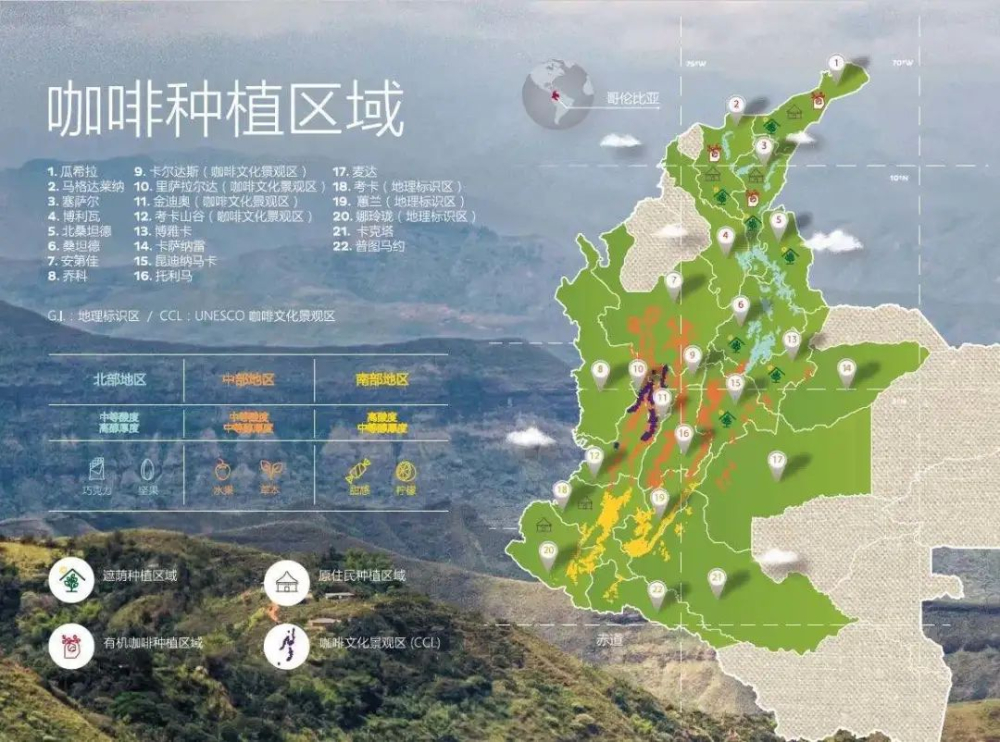
Colombia divides its coffee areas into northern, central, and southern blocks, with the north and south on clearly different harvest seasons. Coffee farms sit in the Andes between roughly 1,000 and 2,000 meters, where average temperatures run about 18°C to 22.5°C, giving the country both full-bodied and lively fruity profiles.
Huila Province is a leading southern origin, and its traditional washed processing feeds into export grading such as UGQ, EP, and Supremo under the Excelso standard. The country's image also rests on the MAM era and the Uncle Juan logo, while southern specialty origins have gained ground in recent decades. Roasting and brewing parameters for a huila coffee everyday bean round out the picture.
When people mention Colombian coffee, many picture that straw-hatted Uncle Juan. This article starts from the geography and climate of the producing regions, sorting out the three major Colombian production zones and the year-round harvest rhythm; it reviews the glory of the MAM era and the rise of southern specialty origins. At the same time, it explains in detail the terroir conditions of Huila Province, the traditional washed processing flow, and the Excelso export grading standards such as UGQ, EP, and Supremo. It also includes the roasting approach and complete brewing parameters for Front Street Coffee's Huila everyday bean, giving you a comprehensive understanding of this classic coffee from the South American Andes.
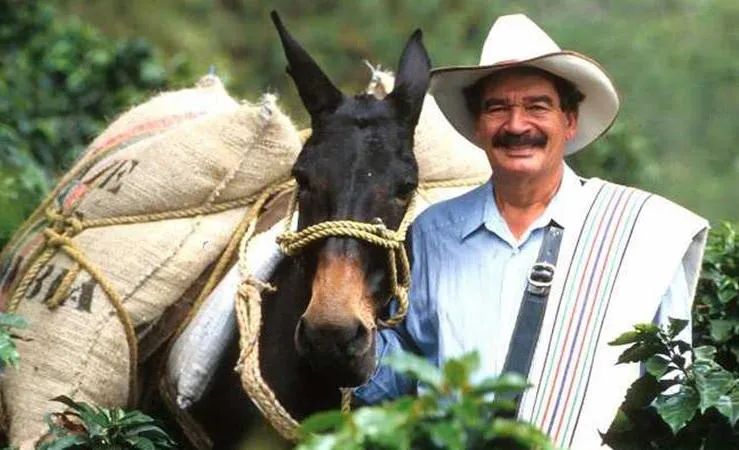
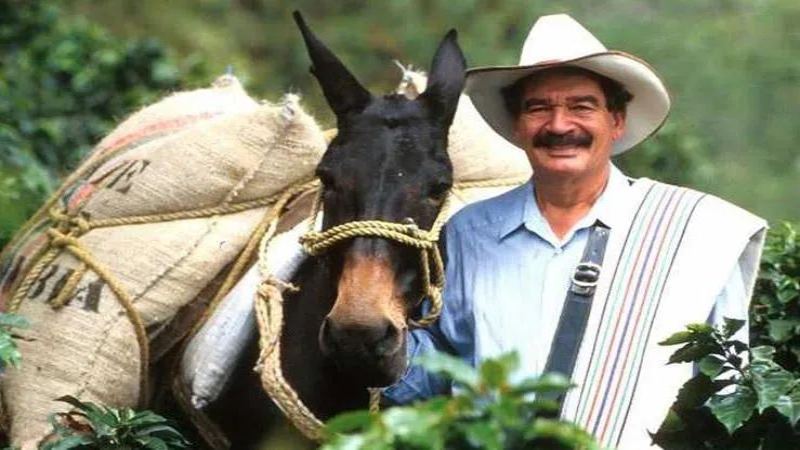
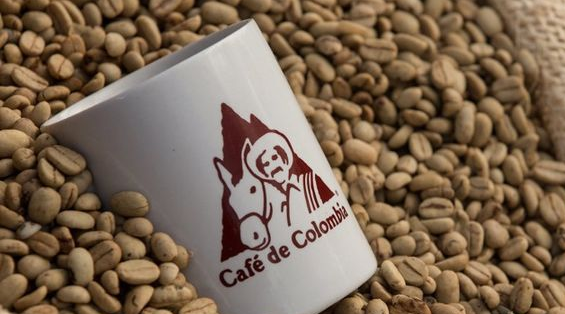
Whenever people look up brands related to Colombian coffee, they always encounter a familiar face: a simple, honest old farmer named Uncle Juan, wearing a white straw hat, an Andean wool poncho, a leather bag slung across his body, and canvas shoes, with his loyal mule companion by his side. This logo frequently appears in all kinds of advertisements and film and television scenes, and it has also brought Colombian coffee's brand image to the world in a classic form.
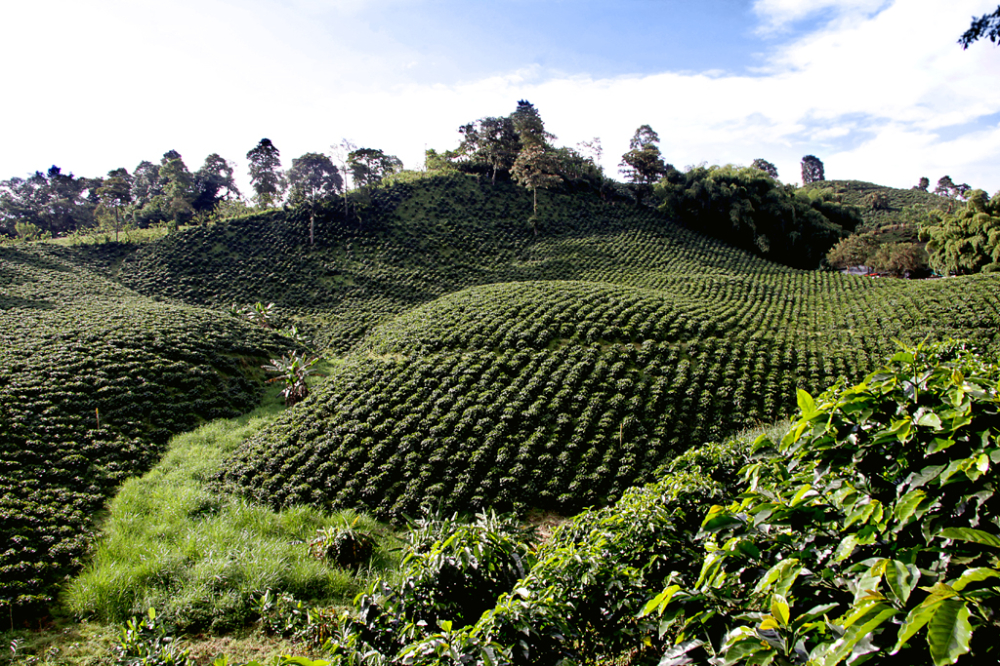
Colombian coffee trees grow in the valleys of the Andes mountain region
Colombia's coffee farms are distributed across the Andes mountain range within the country, and the climate varies with altitude from place to place: the southern end of the eastern plains and the Pacific coast show tropical rainforest climate characteristics, the mountainous areas between 1,000 and 2,000 meters above sea level have a subtropical climate, and the northwest has a tropical savanna climate. The average temperature in coffee-growing areas fluctuates roughly between 18°C and 22.5°C. Thanks to the diverse geographical and climatic conditions, whether you prefer a round, full-bodied coffee with a rich mouthfeel or a lively type with prominent fruity aromas, you can find something you like in Colombia.
The boundaries between Colombia's producing regions are quite clear. Affected by both the latitudinal span of the producing regions and the terrain of the Andes, the country can be divided from north to south into three major blocks: northern, central, and southern. The north and south have clearly distinct harvest seasons, while the central region, depending on whether it is located farther north or south, has a main and a secondary harvest period respectively, going through two harvests a year—the main production season runs from October to January of the following year, and the secondary season falls between April and July. The diverse climates among the mountain ranges make this land a year-round harvest area, with different periods and different types of coffee ripening one after another, so throughout the year you can see farmers busy harvesting among the trees.
Looking back at the last century, the most famous among Colombian coffees was the "MAM" combination made up of the three cities Medellín, Manizales, and Armenia. With the rise of the specialty coffee wave, a number of specialty origins emerged one after another in the south, such as San Agustín in Huila Province, Popayán in Cauca Province, Nariño Province, and Tolima Province. With outstanding altitude advantages and unique processing methods, the coffee produced here has delicate acidity and fruity notes, and has repeatedly achieved excellent results in Cup of Excellence competitions. After multiple rounds of cupping comparisons, Front Street Coffee finally selected washed coffee beans from Huila among these specialty origins, letting them carry the banner of Colombian coffee's classic image, and put them on the shelves in small-format packaging so that more people can taste the authentic classic Colombian flavor.
Huila Province is located at the southern end of the Central Cordillera in southern Colombia and is the country's most prestigious specialty coffee producing region. The terrain here is mainly hills surrounded by mountains, with growing altitudes exceeding 1,500 meters, possessing the high-altitude conditions and mild temperatures needed to cultivate high-quality Arabica beans. Fertile soil and exceptional growing geography complement each other—Colombia's most important rivers converge here, bringing extremely abundant water resources and moisture. The climate on the canyon slopes can block cold winds outside the mountains, while bursts of mountain breeze bring coolness without high heat, and rainfall is likewise abundant, making it a natural treasure for coffee cultivation.
Colombian coffee generally continues to use the traditional washed method for processing
Colombia's producing regions have abundant water, creating ideal conditions for washed processing. Local family farms generally have specialized green bean processing equipment (Ecomill or Eco-Pulper). Farmers pour the harvested coffee cherries into the machine, first removing the skin and pulp, then using a very small amount of water to remove most of the mucilage; the small amount of mucilage remaining on the parchment beans is then sent into a small water tank or container—sometimes just a tiled pool—and left to ferment overnight, allowing the remaining mucilage to loosen and fall off, then rinsed clean with water the next day, and finally spread out in the sun to dry to the target moisture content. The washed process both safeguards coffee quality and allows Huila coffee to show its most authentic and pure flavor. This also explains why Front Street Coffee prioritized washed lots when selecting its everyday bean.
Today Colombia's green coffee beans are graded according to screen size. Although bean size is not the core standard determining quality and flavor, many producing regions believe that plump, well-formed, and large beans tend to mature more fully, can develop richer aroma types, and are easier to heat evenly during roasting, thereby achieving consistent flavor performance.
Grading usually relies on screens with fixed specifications, with different models corresponding to holes of different sizes. Taking a 17-screen as an example, beans larger than this size cannot pass through the mesh holes, so the larger the screen number, the larger the beans retained on the screen. The three most common export grades are UGQ, EP, and Supremo.
Excelso UGQ 12*60 (1.5%): UGQ stands for Usual Good Quality. Green beans must reach 14 screen or above, with 1.5% of beans allowed to fall between 12 and 14 screen, but the lower limit must not be below 12 screen, and beans of 15 screen or above must account for more than half.
Excelso EP 12*60 (10%): EP stands for European Preparation. Green beans must be 15 screen or above, with 10% of beans allowed to be below 15 screen, but likewise not smaller than 14 screen.
Excelso Supremo 12*60 (5%): Green beans must reach 17 screen or above, with 5% of beans allowed to be smaller than 17 screen, but the minimum must still be above 14 screen.
No matter which specific screen-size range they fall into, as long as they are for export, green beans are all classified under the Excelso grade. In other words, Colombian green beans sold around the world today basically have to have the word Excelso printed on the burlap sacks. This export grade is currently the most widely applied standard grading by the FNC, and it also represents the highest specification for Colombian green bean exports.
In addition, Colombia has some other names: beans above 16 screen are called Extra, those larger than Supremo and reaching 18 screen or above are called Premium, and those almost uniformly 15 screen are called Minama, and so on. Colombia also has beans that do not meet the Excelso export threshold, which are locally classified as "Product of Colombia" and are generally used as raw material for commercial-grade instant coffee.
In Colombia, every farm must report a number and register green bean information, making it convenient for future green bean traceability. The naming of exported green beans generally follows the format of country, producing region, grade, plus other supplementary information. For example, Front Street Coffee's Huila everyday bean has the green bean name Colombia Huila Supremo SC17/18 FNC.
Front Street Coffee's brewing plan
This washed Huila everyday bean has both soft acidity and just the right body and sweet aftertaste. Front Street Coffee wanted to present Colombia's classic nutty base while retaining a certain acidity, so it chose a medium-dark roast. Before any coffee bean is launched, Front Street Coffee arranges at least one round of cupping evaluation, because cupping helps us understand a coffee's strengths and weaknesses more objectively.
Considering that this everyday bean follows a medium-dark roast profile, with flavors dominated by rich, full-bodied notes such as nuts and chocolate, and that after darker roasting the bean structure becomes looser and the coffee powder's water absorption capacity increases accordingly, Front Street Coffee uses a medium grind to avoid extracting too many off-flavors. The water temperature is lowered appropriately to prevent medium-dark roasted coffee from showing obvious burnt bitterness, and a KONO dripper is chosen to complete the extraction.
Dripper: KONO dripper Water temperature: 88°C Coffee-to-water ratio: 1:15 Coffee dose: 15g Grind size: EK43s setting 10.5 (75% passing a No. 20 standard sieve)
During brewing, first pour the coffee powder into the V60 dripper, add water equal to twice the coffee dose to wet the coffee bed, and after the bed swells into a dome, let it bloom for 30 seconds; then pour in a thin stream in circles from the inside out, pausing at 125g, wait for the coffee bed to fall back to half the height of the dripper, then complete the third pour with the same delicate stream to 225g, and finally wait until all the coffee liquid has drained, remove the dripper. The whole process takes about 2 minutes.
This everyday bean from Huila, Colombia, greets the palate with distinct roasted aromas of chocolate, nuts, and caramel, smooth and sweet, with moderate body and a clean, refreshing mouthfeel; as the temperature drops, you can also sense a pleasant, soft acidity.
To exchange more professional coffee knowledge and keep up with coffee bean information, welcome to follow Coffee Workshop (WeChat public account: cafe_style)
If you want to buy more specialty coffee beans, you can add Front Street Coffee's private WeChat: qjcoffeex.
The above content is compiled by CoffeeHunters, a coffee news website.


