







How does the natural process treat a green coffee bean?
Natural processing dries whole coffee cherries in the sun before the seed, or green coffee bean, is removed. It is the oldest method still in use. Ripe cherries are hand-sorted, spread on beds, tarps, or concrete, and dried for roughly three to four weeks until moisture falls to about 11 percent, then hulled.
The method suits dry, warm regions with strong sunlight and gives vivid fruity and wine-like aromas, but it carries cost and quality risks. Front Street Coffee points to Ethiopia Hambela Guji and Panama Elida Estate Sun-Dried Typica as representative natural coffees, both showing the layered fruit character that coffee bean processing of this kind produces.
Sun-drying is the oldest method of processing green coffee beans. With its vivid fruity notes and fermented wine-like aroma, it is now being rediscovered by more and more producing regions. This article provides a complete overview of the sun-drying process, including selective harvesting of ripe cherries, drying on beds, hulling and depulping, and storage for export. It also objectively analyzes the cost advantages and quality risks, and explains why sun-dried beans have such intense, layered flavors. At the end, Front Street Coffee has selected two representative sun-dried coffees—Ethiopia Hambela Guji and Panama Elida Estate Sun-Dried Typica—for your reference.
For more specialty coffee news, follow our WeChat official account: Front Street Coffee (FrontStreet Coffee)
When choosing coffee, many people first check its processing method. The processing method used, as well as the quality of that processing, directly determines the final flavor in the cup. In this article, Front Street Coffee will take a deep dive into this oldest traditional technique—the sun-drying method—and look at its advantages, shortcomings, and unique flavors.
Sun-drying has a long history and is one of the earliest techniques in green bean processing. It is mostly popular in regions with a dry, warm climate and abundant sunlight. Today, the intense fruity aroma this method gives coffee attracts coffee farmers around the world who are willing to take on the risks of trying sun-drying.
Sun-Drying Processing Flow
Harvesting and Sorting
After the ripe cherries are harvested, they are first hand-sorted one by one to remove defective fruits, such as overripe, underripe, or insect-damaged cherries, while also clearing out non-fruit impurities such as twigs and stones mixed in with them.
Drying
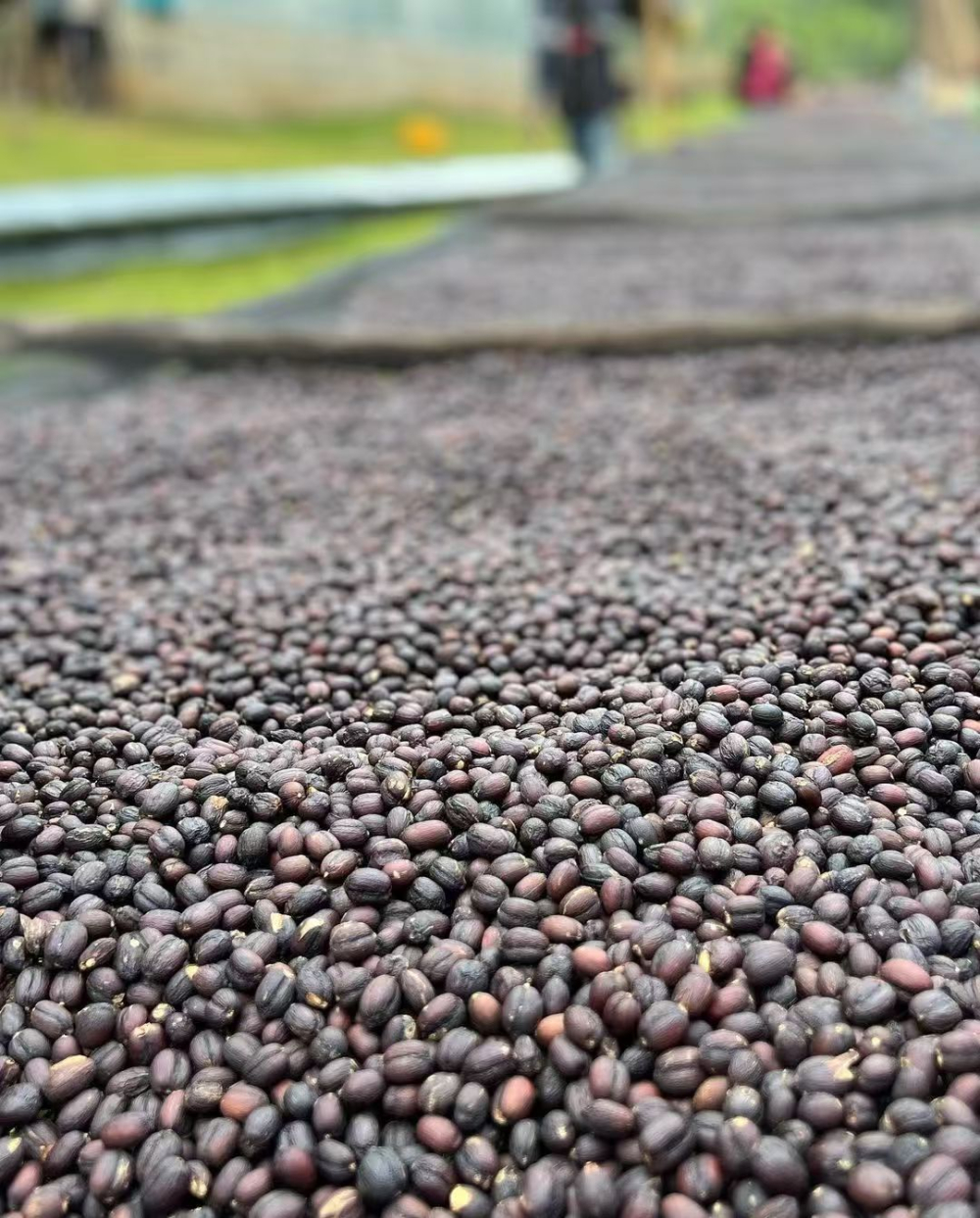
The sorted coffee cherries are then transferred to drying beds. The drying tools used vary from place to place; they may be tarps, raised beds, or directly on concrete ground. The entire drying period takes an average of three to four weeks, until the moisture content of the green beans drops to 11%, at which point the drying stage is considered complete.
Hulling and Depulping
After drying is complete, the parchment coffee is transported to the processing plant for depulping and hulling, and some is further polished. The outer layers such as skin and pulp are all removed at this stage.
Grading, Sorting, and Storage
After hulling, the green beans still need another round of sorting to eliminate beans with poor appearance. This step is also a check on drying quality: if dried too much, the beans become fragile and tend to shatter into fragments during hulling; if not dried enough, they retain high moisture and high water activity, making it easy for bacteria to multiply and leading to mold. Once sorting is complete, the green beans are immediately sent to storage to await export.
Advantages and Disadvantages of the Sun-Drying Method
Advantages: The sun-drying method costs far less to implement than other processing methods and uses very little water, making it especially suitable for producing regions with abundant sunlight but scarce water sources. In addition, because sun-dried beans have a unique flavor that is hard to replicate, many outstanding estates have begun to manage this type of product carefully, for example by switching to raised-bed drying to avoid secondary contamination and by carrying out strict, meticulous sorting. Because of this, many high-quality sun-dried coffees are now appearing on the market.
Disadvantages: Sun-drying is highly dependent on weather conditions, and controlling the degree of fruit drying is quite difficult. Once the drying yard is not sanitary enough, impurities can easily get mixed in, and the probability of defective beans rises accordingly. Because the pulp remains on the fruit throughout the sun-drying period, problems such as mold and rot also occur from time to time. Of course, in order to obtain higher-quality sun-dried flavor, some producers adopt refined sun-drying plans, using instruments and equipment plus labor-intensive monitoring of fermentation and drying progress, and promptly removing problematic beans once abnormalities are detected—however, the cost of this approach is a clear increase in expenses.
Flavor Characteristics of Sun-Dried Beans
Compared with washed beans, sun-dried coffee tastes more bold and intense, with a more three-dimensional layering, a fermented aroma resembling wine, and a full, prominent sweetness. Next, Front Street Coffee (FrontStreet Coffee) will recommend two quite representative sun-dried coffees.
1. Front Street Sun-Dried Huakui Coffee Beans
Region: Sidamo Guji Hambela
Processing Station: Buku Able
Altitude: 2,350 meters
Variety: Local heirloom varieties
Processing Method: Sun-dried
This new-crop Huakui is still processed using the sun-drying method. In Ethiopia, where sunlight conditions are uniquely favorable, coffee quality naturally stands up to the test. The cup is full of sweet aromas like berries and tropical fruit, accompanied by the typical sun-dried fermented flavor, so that the first sip feels like a glass of freshly squeezed juice.
2. Front Street Panama Elida Estate Sun-Dried Typica
Region: Boquete, Panama
Estate: Elida Estate
Altitude: 1,850 meters
Variety: Typica
Processing Method: Sun-dried
Although Panamanian coffee is famous for the floral notes and bright acidity shown by washed processing, it also hides sun-dried works that are unforgettable after just one try. This Typica from Elida Estate uses a refined sun-drying method, which both reliably controls quality and fully preserves the signature flavor of sun-dried beans—an intense, intoxicating fermented wine aroma, with fruity sweetness weaving together citrus and raisin notes.
The above content is compiled by CoffeeHunters, a coffee news website.


