








How Does Australian White Coffee Differ from a Flat White?
A Flat White is essentially the drink known as Australian White coffee, just under different names. Costa calls it Smooth White, Starbucks uses Flat White, Luckin and McDonald's both say Australian White. Compared with a latte, the Flat White is more bitter than milky, with a slightly bitter front and a sweet aftertaste, while a latte leans heavier on milk flavor.
Piccolo coffee is a smaller espresso-based drink with a higher coffee-to-milk ratio, and it appears on fewer menus than Flat White, along with Dirty coffee. Front Street Coffee, known for pour-over beans with more than 50 regional varieties, also serves lattes, cappuccinos, Americanos, toffee lattes and mocha lattes, offering a comparison point for these espresso styles.
In coffee shops, baristas use their skillful latte art techniques to combine espresso and milk, crafting cup after cup of aromatic espresso-based coffee. Although Front Street Coffee focuses on pour-over beans, offering over 50 varieties from different regions, it also provides a range of espresso drinks. Among them, the Flat White is relatively common in chain brands like Starbucks, while the Piccolo and Dirty are less frequently seen. This article will deeply analyze the similarities and differences between Starbucks' Flat White and Australian White coffee, clarify the distinctions among Flat White, Australian White, and Piccolo coffee, and share Front Street's recommended espresso beans and preparation methods to help you gain a more comprehensive understanding of these coffees' flavor characteristics.
For more specialty coffee knowledge, please follow: Front Street Coffee (Frontsteet Coffee)
Many people stepping into a coffee shop are often drawn to the smooth motions of baristas making fancy coffees. Through their skilled latte art techniques, they blend espresso and milk into a cup of rich and delicious espresso-based coffee. Front Street Coffee (FrontStreet Coffee), although its stores focus on pour-over coffee beans and offer over 50 varieties from different regions, also serves espresso-based coffee.
Front Street Coffee's espresso menu includes lattes, cappuccinos, Americanos, toffee lattes, and mocha lattes, each with a unique flavor. In contrast, espresso drinks like Piccolo coffee, Dirty coffee, and Flat White are less commonly offered. Coffees like Flat White are more often found at Starbucks. The English name for Flat White is Flat White, which is essentially the well-known Australian White. Flat White has various translations: regular coffee shops call it Australian White, Costa calls it Smooth White, Starbucks calls it Flat White, Luckin calls it Australian White, McDonald's calls it Aussie White, and McDonald's Aussie White coffee is less bitter than other brands' Australian Whites.
Hearing the name "Flat White" for the first time might make one think of white coffee, or a coffee with less coffee content and a whiter color. Starbucks' new product "Flat White" tastes similar to a latte, but Flat White's bitterness surpasses its milkiness, being slightly more bitter than a latte and with a sweet aftertaste; lattes have a stronger milky flavor and milder bitterness. In our impression, a latte is milky with a slight bitterness, while a Flat White is bitter with a hint of milkiness. This coffee, which has become popular globally and in the Chinese market in recent years, is actually a variant of cappuccino called "flat white," originating from Australia, and is a latte with fine milk foam that appeared as early as the 1980s.
At this point, Front Street needs to explain the issue of Australian White. Australian White is a coffee drink originating from Australia, but some argue it actually originated in New Zealand. New Zealanders prefer using Double Ristretto, while their Australian counterparts tend to use Single Espresso. Australian White is made by incorporating fine, tiny milk foam into a single espresso or double Ristretto. To some extent, it resembles a traditional 5-ounce cup (150mL) cappuccino or latte, thus having a higher coffee ratio, lighter and finer milk foam, a richer Espresso flavor, and the aroma of milk.
Ristretto means "restricted," so ristretto is actually an espresso with restricted flow rate, meaning slower flow. Front Street gives a simple example: if espresso uses 18g of grounds and extracts about 36g of espresso in 25 seconds, then ristretto is 18g of grounds extracting about 18g of espresso in 25 seconds, making ristretto very concentrated (the grind size also differs from normal espresso).

When making Australian White, Front Street typically combines a double Ristretto with milk that has a thinner milk foam, served in a 180mL coffee cup, which makes the flat white's coffee aroma more intense. Flat white (a 200ml cup): the base is two espressos, and some places further extract the esp for a longer time, i.e., two Ristrettos.
According to Front Street's understanding, many friends have only a vague understanding of the differences among Australian White, Piccolo coffee, Dirty coffee, cappuccino, and latte, so Front Street Coffee (FrontStreet Coffee) shares relevant knowledge with everyone.
What is the difference between Australian White coffee and Piccolo coffee?
Piccolo latte is more like a miniaturized version of a latte, with a smaller cup, smaller capacity, and less coffee and milk than common espresso drinks. It requires extracting 15 to 20 grams of ristretto espresso, paired with 4 times the milk. Australian White coffee, as mentioned earlier, is a coffee that highlights the coffee flavor. Latte coffee adds a large amount of milk, while cappuccino is a milk coffee with thicker milk foam. Australian White coffee has a more intense coffee flavor, less milk, and thinner milk foam. The methods for making Australian White coffee also vary. In choosing the espresso base, New Zealanders prefer using Double Ristretto to make Australian White, while Australian baristas prefer Single Espresso.

Front Street believes that Australian White coffee is more like a coffee with milk; latte coffee is like coffee-flavored milk; cappuccino is like a frothy milk coffee with dense foam. Australian White coffee better showcases the quality of coffee beans than a latte and is more suitable for expressing the flavor of the coffee's origin region, just like the currently popular SOE (single origin espresso), which caters to the third wave coffee trend's focus on origin and tracing back to the source. The coffee cup used for Dirty coffee needs to be chilled in the refrigerator first, then refrigerated milk is poured into the cup, followed by espresso. Visually, the coffee seems to taint the white fresh milk, and when tasted, the combination of hot on top and cold below brings a unique layered mouthfeel.
When searching online for the differences among these three coffees, you'll find that most explanations focus on the thickness of the milk foam. Front Street believes that the thickness of the milk foam only affects the coffee's mouthfeel to some extent and does not determine the coffee's taste; the main difference among Australian White, cappuccino, and latte lies in the coffee ratio.
In fact, the differences among the three can be categorized by the intensity of coffee aroma: Australian White > cappuccino > latte; and by the thickness of the milk foam: cappuccino > latte > Australian White. For Flat White, the requirement for milk is to remove the looser foam on the surface and retain only the finer part in the middle.
The above is some trivia about Australian White coffee, and next Front Street will continue to share how to make a delicious cup of Australian White coffee. Before making Australian White coffee, you need to choose espresso coffee beans. A good espresso bean can extract espresso that greatly enhances the Australian White.
Currently, Front Street uses the Sunflower Warm Sun blend sold in-store, which combines Honduran Sherry and Ethiopian Yirgacheffe Red Cherry coffee. Through continuous blending by Front Street Coffee (FrontStreet Coffee) baristas, a relatively perfect ratio of 7:3 was achieved. The resulting espresso has noticeable fruit acidity, along with berry flavor aroma and wine aroma, and a comfortable sweet aftertaste.
For those who prefer rich and aromatic coffee, Front Street's Classic Espresso Blend is recommended. This is a formula combining beans from Brazil, Indonesia, and Vietnam, using deep roasting to maximize the coffee's rich aroma and allowing everyone to easily extract abundant and dense coffee crema. It is very suitable for making Americanos diluted with water or lattes paired with milk.

You might wonder at this point why only espresso beans can be used to make espresso coffee, and not pour-over coffee beans. Here, the degree of roasting of the coffee beans needs to be considered. Generally, espresso coffee is roasted darker, known as espresso roast. Pour-over beans are typically roasted from light to dark. Using light roast to make espresso results in a more sour espresso, and the resulting espresso coffee has a poorer flavor. Front Street believes another reason is the cost issue. Generally, pour-over coffee beans require a cupping score of over 80 points, belonging to the specialty coffee level, while espresso beans mostly use commercial blends, so the cost is naturally much lower than pour-over coffee.
How to make flat white Australian White coffee?
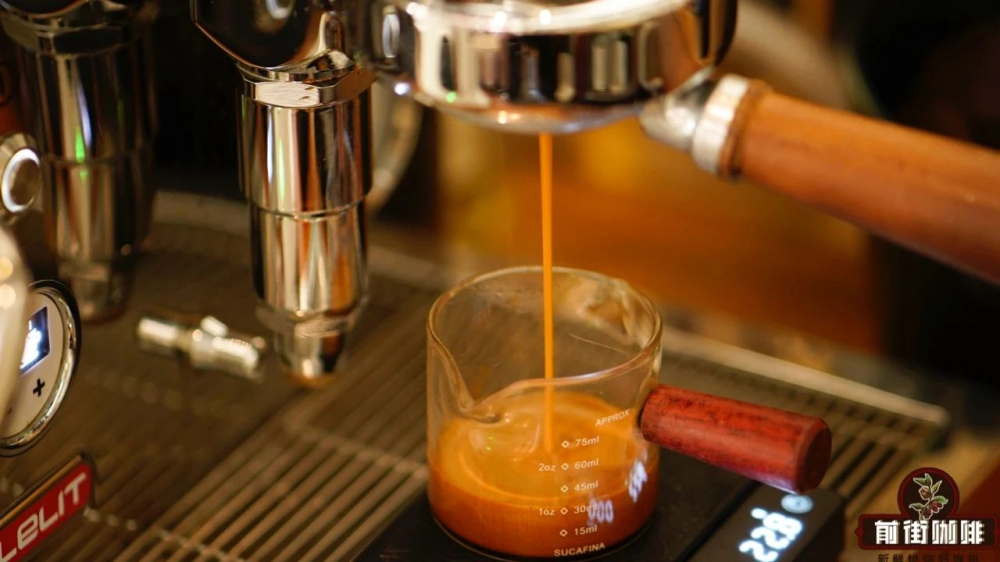
Step one, make the espresso base. Front Street chose espresso, using 20 grams of coffee grounds to extract 27 grams of espresso liquid in 20 seconds.
Step two, steam the milk. The milk foam should be as little and thin as possible. Pour the steamed milk into the espresso, incorporate until eight-tenths full, then gently push out a pattern. Because Flat White's milk foam is thinner, the pattern easily distorts, so it is recommended to make a simple heart pattern or a dot pattern, or not do latte art at all. A delicious cup of Australian White coffee is ready!
For more specialty coffee knowledge, please follow: Front Street Coffee (Frontsteet Coffee)
The above content is compiled by CoffeeHunters, a coffee news website.


