








What Is Australian White Coffee and Is It Strong?
Australian white coffee, better known as flat white, combines the silkiness of a latte with the richness of a cappuccino, and its coffee flavor is more pronounced than a latte's. Starbucks traces it to Australia in the 1980s and started serving it in its Australian stores in 2009, reaching the UK and US in 2010 and China in 2012.
New Zealand disputes that origin, with Wellington credited as where the drink reaches its form. Starbucks preparation uses a smaller cup and thinner milk foam than a latte. Iced versions work but dilute the milk texture, so the coffee flavor stays noticeable only if the milk and espresso ratio is adjusted.
Flat White is an extremely popular drink in Starbucks' milk coffee lineup. Its Chinese name is a transliteration of the English term, and it is also widely known as Australian White Coffee. It combines the silkiness of a latte with the richness of a cappuccino, with a more pronounced coffee flavor than a latte. Regarding this coffee, there has long been a dispute over its place of origin between Australia and New Zealand. Starbucks officially traces it back to Australia in the 1980s, while New Zealand insists that Wellington is where it reaches perfection. Beyond the origin debate, this article will also analyze Starbucks' preparation parameters, whether an authentic Flat White is suitable for iced drinks, the coffee beans and extraction methods needed for home brewing, and provide a detailed comparison with lattes in terms of cup size, milk foam thickness, and flavor focus.
For more specialty coffee knowledge, please follow: Front Street Coffee (Frontsteet Coffee)
Flat White—this Chinese name comes from the transliteration of the English "Flat White," and people also habitually call it Australian White Coffee. It consistently ranks in the top three among Starbucks' best-selling milk coffees. Compared with lattes and cappuccinos, a Flat White has both the velvety smoothness of a latte and the richness of a cappuccino. At Front Street Coffee, all three of these coffees are available.
The Origin of Flat White Coffee
According to Starbucks, the Flat White is an Australian creation, born in the 1980s, and later favored by coffee consumers in Australia and beyond. Starbucks stores in Australia began serving this drink in 2009, while customers in the UK and the US got to try it starting in 2010. It wasn't until 2012 that it officially entered the Chinese market.
However, New Zealanders are not convinced. The New Zealand Herald called the Flat White "a quintessential New Zealand coffee." The newspaper acknowledged that Sydney cafes may have first introduced the drink in the 1980s, but insisted that Wellington is where the Flat White reaches perfection.
Australian food historian Michael Symons once conducted in-depth research into the origins of the Flat White. His conclusion was: the Flat White may have originated in Sydney and Melbourne, but its best form appeared in Wellington. He noted that from the late 1980s to the 1990s, some cafes already claimed to have contributed to perfecting this coffee, but such claims remain inconclusive to this day.
Although the origin of the Flat White is difficult to definitively settle, one thing is certain: compared with a latte, a Flat White has a stronger coffee flavor and thinner milk foam, making it fuller in both texture and flavor.
How Starbucks Makes Flat White Coffee
When making a Flat White, Starbucks uses 2, 3, or 4 shots of ristretto espresso depending on cup size. The hot version adds steamed milk frothed to 0.5 cm of foam, while the iced version starts with ice cubes and milk, with the ristretto espresso poured over the top last.
Can Flat White Be Drunk Iced?
In fact, an authentic Flat White only comes in a hot version. Starbucks introduced a cold version to cater to consumers' various coffee customization needs. So if you want to more fully experience the richness of a Flat White, Front Street Coffee (FrontStreet Coffee) recommends choosing the hot version.
How to Make Flat White Coffee at Home?
Making a Flat White requires a more concentrated ristretto espresso. To extract this kind of espresso, you need a pressurized espresso machine paired with medium-dark roasted espresso beans. This time, we used Front Street's classic espresso blend coffee beans to make the Flat White. The blend consists of beans from three origins—Brazil, Indonesia, and Vietnam—and uses a dark roast, which maximizes the coffee's rich aroma and allows everyone to easily extract abundant, dense crema. Whether making an Americano diluted with water or a latte paired with milk, it's very suitable.
When Front Street Coffee (FrontStreet Coffee) makes a Flat White, the espresso portion uses ristretto: 20 grams of coffee grounds extracted to yield 30 grams of coffee liquid, with extraction time controlled at 23 to 28 seconds.

Next, pour 150 ml of chilled fresh milk into a milk pitcher, and use the espresso machine's steam wand to aerate and heat it, creating about 0.5 cm of milk foam. Then combine the milk with the coffee, and it's done.
What's the Difference Between a Flat White and a Latte?
Both consist only of milk and espresso, but a Flat White and a latte differ significantly in preparation method and tasting experience. Caffe Latte means "milk" in Italian. It pursues a balance between coffee and milk—you can taste the coffee flavor as well as the sweet, rich milk, with the two complementing each other without either overpowering the other. A Flat White, on the other hand, uses milk to enhance the coffee flavor. Coffee is the star, and milk plays only a supporting role. That's why a Flat White tastes more coffee-forward and richer.
Although the Flat White has its own character, there is no fixed preparation ratio in the industry. Each cafe's barista has a different understanding of it, and combined with the different espresso beans used at each shop, the Flat Whites produced vary from one another.
When New Zealand baristas make a Flat White, they serve it in a smaller cup than a latte (about 150 ml), with a double shot of espresso as the base. With less milk, the coffee ratio increases, and the coffee flavor is naturally stronger. That's why the Flat White is also called a "small latte."
As baristas' extraction techniques continue to improve, in order to better showcase the aroma of the coffee beans in an Australian White, Melbourne cafes will even switch the base to a double Ristretto, incorporating milk foam of a thickness comparable to a latte into a 150 ml cup. Ristretto refers to extracting a smaller liquid yield from the same dose of coffee grounds. It can be understood as a reduced version of espresso, with extraction more concentrated in the early and middle stages, giving it a richer taste—and therefore placing higher demands on coffee bean quality.
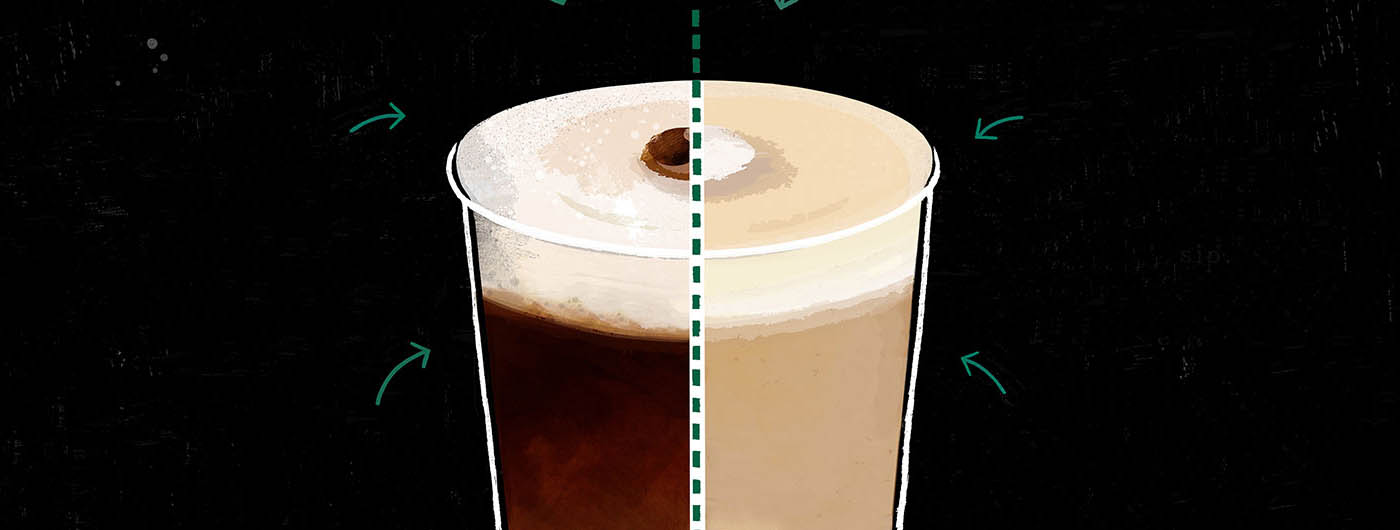
In Australia, however, baristas believe that as long as the milk foam is thinner than a latte's, it's fine. When they serve an Australian White, they use the same cup size as a latte, focusing more on the thickness of the milk foam. Compared with lattes, cappuccinos, and other milk coffees, the Flat White has the thinnest milk foam, typically between 0.3 and 0.5 cm.

The "Flat" in Flat White means flat—the milk foam must be thin enough to be level with the rim of the cup, without a domed foam layer, so that every sip of rich coffee liquid carries a layer of dense foam. That's why the Flat White is also called "Flat White Coffee." Latte coffee's milk foam mostly domes up 0.5 to 0.7 cm, while Australian White Coffee's milk foam can only be kept under 0.5 cm, otherwise it's hard to achieve the "flat" liquid surface effect. Front Street wants guests to enjoy a Flat White that is creamy and smooth, yet not too "watery," so it retains a 0.3 cm layer of milk foam.
The above content is compiled by CoffeeHunters, a coffee news website.


