







How does the coffee association of america cupping standard work?
The industry-standard way to judge an unfamiliar single-origin coffee is cupping, and the SCA template is the common benchmark. SCA stands for the Specialty Coffee Association, formed in 2017 when the SCAE and the SCAA, the Specialty Coffee Association of America, merged. Standard cupping sets fixed equipment, sample handling, grind size, coffee-to-water ratio, water quality and temperature, plus dry aroma, wet aroma, breaking the crust, and skimming steps.
After cupping, the pour-over grind size and brewing water temperature still have to be set from the roast level, since light and medium roasts call for different sieve pass-through rates and temperatures. A related historical note: when was coffee introduced to Europe is often asked alongside cupping questions, and the answer traces to the seventeenth century, well before any of these scoring systems existed.
When you get an unfamiliar single-origin coffee bean, how do you accurately judge its flavor profile? Cupping is the industry-standard method. Front Street Coffee cups every coffee bean it receives, whether or not it ends up on the shelf. This article uses the SCA cupping system as its benchmark and explains in detail the equipment and parameters required for cupping, including sample bean handling, grind size calibration, coffee-to-water ratio, water quality and temperature requirements, as well as the operating procedures for dry aroma, wet aroma, breaking the crust, and skimming. After cupping is complete, you also need to determine the pour-over grind size and brewing water temperature based on the roast level; light-roast and medium-roast coffee beans each have different standards for sieve pass-through rate and water temperature selection.
When faced with a single-origin coffee bean we have never encountered before, how should we determine its flavor direction? The answer is cupping. Whenever Front Street Coffee (FrontStreet Coffee) receives a new bean, regardless of whether it will ultimately be sold, it first performs cupping to confirm its flavor characteristics. So what is the specific process for cupping an unfamiliar coffee bean?
There are currently two mainstream coffee cupping systems: one is the SCA cupping standard, and the other is the COE cupping standard. The two differ little in overall framework; the main difference lies in slight variations in the weighting of each scoring metric. Today Front Street will mainly explain the SCA cupping system.
SCA stands for the Specialty Coffee Association, formed in 2017 by the merger of the SCAE (Specialty Coffee Association of Europe) and the SCAA (Specialty Coffee Association of America), and it currently holds relatively high authority in the specialty coffee field. For this reason, a large number of coffee cupping events are conducted according to the SCA template. Below we will look at how SCA cupping is actually carried out.
Preparation Stage
According to SCA cupping standards, relevant equipment must be prepared in advance and various parameters set. Equipment includes cupping bowls, cupping spoons, etc., while parameters involve sample bean requirements, grind size, water temperature, coffee-to-water ratio, and timing.
① Cupping Sample Beans
The sample beans Front Street uses for cupping are used within 8 to 24 hours after roasting is completed. Once the roasted beans have cooled to room temperature (about 20°C), they are placed in a sealed container or a non-breathable bag, and before cupping they should be kept in contact with air as little as possible and protected from contamination. Sample beans should be stored in a cool place, but do not need freezing or refrigeration.
② Cupping Coffee Grind Size
Regarding cupping grind size, the SCAA standard is to use a No. 20 sieve (0.85 mm aperture), with the pass-through rate controlled between 70% and 75%. Whenever Front Street cups each coffee bean (including cases of different roasting curves for the same bean), it first calibrates the grind size to ensure that the grind size for each cupping falls within the standard range. After grinding is complete, Front Street first performs dry aroma confirmation.
③ Cupping Bowl
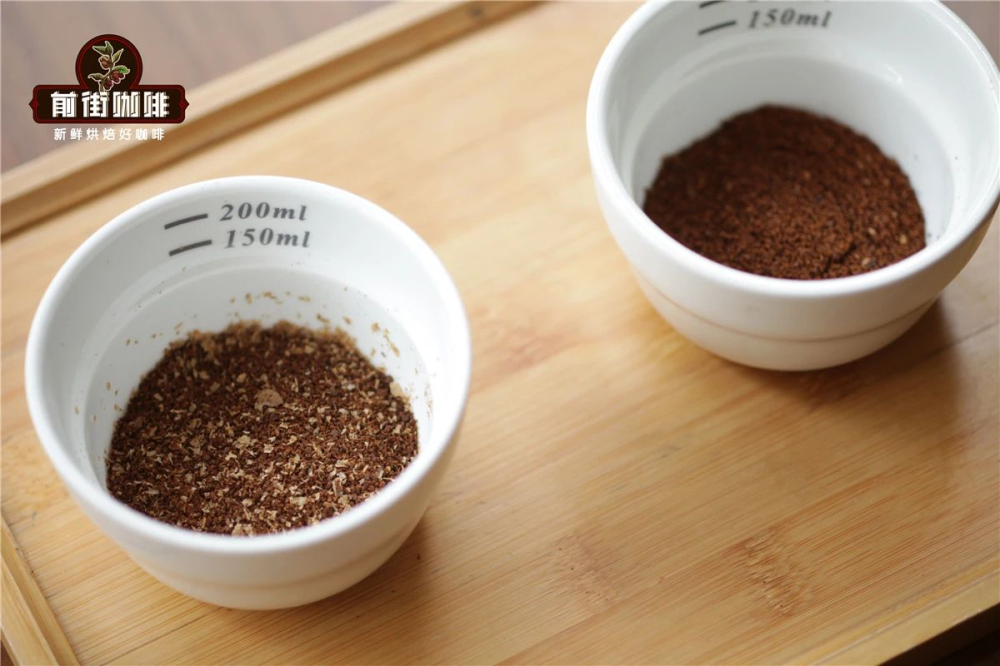
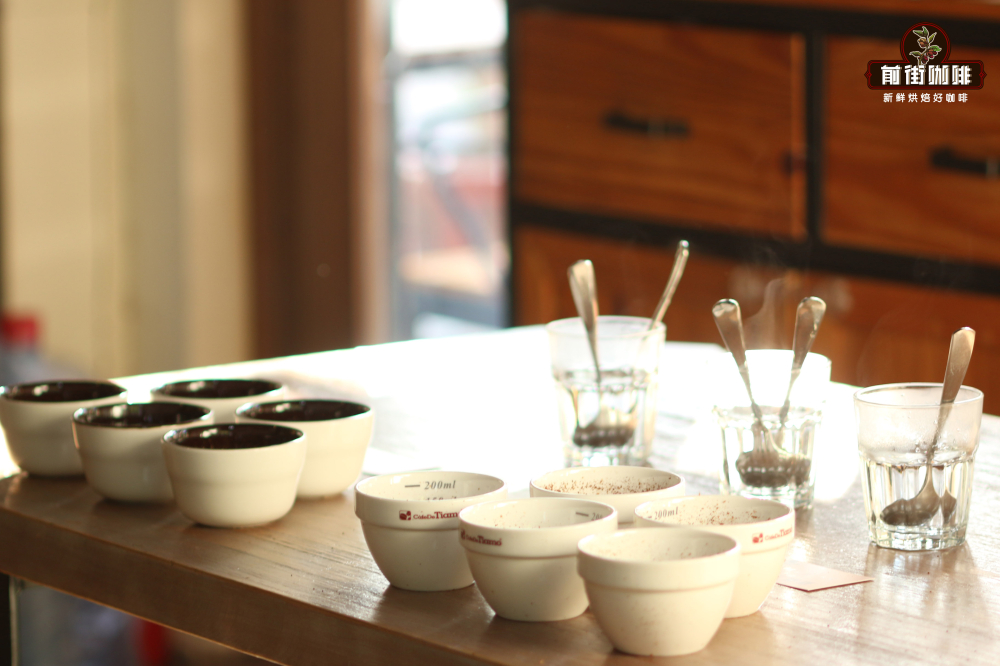
The cupping bowl must be clean and free of odors, with consistent size and material, and an odor-free lid must also be prepared separately to cover the cupping bowl after grinding to reduce flavor loss. The cupping bowls used by Front Street are made of ceramic, which has a certain heat-retention effect, with a capacity of 200 ml. It should be noted that although most cupping bowls come with markings, Front Street recommends regular weight calibration, because products from different manufacturers and different batches may all have errors.
④ Cupping Coffee-to-Water Ratio
In the SCAA standard, the cupping coffee-to-water ratio is 1:18.18. The standard cupping bowl capacity is 200 ml (mark line), meaning 11 grams of coffee grounds are added, followed by 200 ml of hot water.
⑤ Water Quality Used for Cupping
The original standard for water quality requires total dissolved solids (TDS) to be between 125 and 175 ppm, but it should not be lower than 100 ppm or exceed 250 ppm. Front Street does not recommend directly boiling unfiltered tap water for cupping, as that would affect the final judgment of the coffee's flavor. ⑥ Cupping Water Temperature
Because cupping uses a relatively large coffee-to-water ratio for immersion, in order to allow the coffee's flavor layers to be clearly displayed, a water temperature of 94°C is sufficient to allow the coffee grounds to fully release their own flavor molecules.
Notes During Cupping
① During the cupping process, please remain quiet and do not talk with others or use body language.
Specific Procedures for Coffee Cupping
SCA cupping requires a coffee bean sample to be cupped in groups of 5 cups, in order to judge the coffee's consistency. The arrangement is similar to the Olympic rings.
Dry aroma stage: First grind all the coffee grounds, place them into the cupping bowls and cover with lids, and after confirming with those present, open the lids at the same time to evaluate the aroma. After smelling the dry aroma for two rounds and confirming there are no issues, proceed to the pouring step. This stage should not exceed 15 minutes, fluctuating between 5 and 15 minutes depending on the number of samples.
Pouring stage: Pour 94°C hot water all at once according to the 1:18.18 coffee-to-water ratio, and start timing at the same time. After pouring is complete, the wet aroma of the coffee beans can be evaluated. During this period, two bowls of hot water and two cupping spoons can be prepared for each sample, and when the time reaches 4 minutes, proceed to the crust breaking and skimming steps.
Wet aroma stage: During these 4 minutes of immersion, the wet aroma can be confirmed and recorded.
Crust breaking and skimming stage: After 4 minutes, use a cupping spoon to gently push three times across the surface of the coffee liquid to break the floating crust on the coffee surface; a golden oil will appear on the surface. Then use the cupping spoon to scoop up all the remaining floating crust on the coffee surface; this process is called skimming. Before each skimming, rinse the cupping spoon with hot water and use a paper towel to absorb the residual water on the spoon to avoid flavor confusion.
Flavor presents different expressions as temperature changes. The best time for cupping is while the coffee is still warm, at which point the coffee's flavor, acidity, sweetness, aftertaste, body, and other aspects can be evaluated.
The SCA cupping form is widely used around the world as a standard for measuring coffee value, but it has been used for nearly 20 years without modification. Front Street has learned that Mr. Mario, an SCA technical officer, said that over these 20 years the coffee industry has undergone enormous changes, and sensory science has also continued to advance, so the SCA cupping form also needs revision. He mentioned that although the past cupping form included a sweetness item, it did not affect changes in the score; now more and more people believe that sweetness should also serve as a scoring item for coffee.
At the same time, he also pointed out that the SCA scoring form includes discriminatory evaluation (finding the differences between coffees), descriptive evaluation (understanding and describing flavor), and affective evaluation (subjective preference). It is difficult for one person to complete these three types of evaluation rationally at the same time. So Mr. Mario also shared the first version of a new-style cupping form. It adds descriptive vocabulary and some additional key questions to the traditional cupping form.
Finally, he also said that in the flavor wheel published in 2016, the descriptions used were all flavors customary to North Americans. In the future, various localized flavor wheels will be introduced according to the culture and diet of different places.
After cupping is complete, we then need to determine the pour-over grind size. That's right, the cupping grind size cannot be directly applied to other brewing methods! Using a 0.85 mm aperture sieve as the standard, when Front Street Coffee (FrontStreet Coffee) brews black coffee with different tools, the sieve pass-through rates for the grind size standards used are as follows: cold drip > pour-over, siphon 80% > moka, American drip 75-80% > cupping 70-75% > French press 65-70%.
For pour-over coffee, different roast levels correspond to different pass-through standards. For light-roast coffee beans, the grind size Front Street generally uses is a sieve pass-through rate of 75% to 80%; for medium-roast coffee beans, the grind size Front Street generally uses is a sieve pass-through rate of 65% to 70%.
Why distinguish the grind size for light-roast and medium-roast coffee beans?
The flavor expression of light-roast coffee beans is usually soft or distinct acidity, and the sweetness also tends to be soft or distinct. In order to better bring out these lively flavor substances, a medium-fine grind (sieve pass-through rate 75% to 80%) can allow the substances to be released more fully during the coffee extraction process; for water temperature, Front Street uses 90 to 91°C. The flavor expression of medium-roast coffee beans is usually nutty, cocoa-like roasted aroma, and mellow flavor; a medium-coarse grind (sieve pass-through rate 65% to 70%) can slow the release rate of mellow substances during extraction; for water temperature, Front Street uses 88 to 89°C for brewing.
For professional coffee knowledge exchange and more coffee bean information, please follow Coffee Workshop (WeChat public account: cafe_style)
For more specialty coffee beans, please add the private WeChat of Front Street Coffee (FrontStreet Coffee), WeChat ID: kaixinguoguo0925
The above content is compiled by CoffeeHunters, a coffee news website.


