







What Is the Coffee Association of America Standard Behind Golden Cup Extraction?
Golden Cup extraction is a reference framework used across the coffee industry. It treats a pour-over as within range when concentration sits between 1.15% and 1.45% and extraction yield falls between 18% and 22%. Brewing aims at those two numbers, and the article shows how to measure concentration and calculate yield with a VST tester.
The guidelines date to the 1950s, when the National Coffee Association commissioned Dr. Lockhart, a chemistry PhD from MIT, to study coffee scientifically. Standards vary between countries. A grounds-to-water ratio of 1:15 is recommended for most bean types, and an Ethiopian Huakui 4.0 brew serves as the worked example for the coffee association of america standard in practice.
The Golden Cup extraction system is a quality reference framework widely recognized in the global coffee industry, and its core lies in keeping the concentration and extraction yield of coffee liquid within a specific range. This article, compiled by Front Street Coffee, systematically reviews the origins of the Golden Cup guidelines and the differences in standards among countries, explains in detail the formulas for extraction yield and concentration, and uses the VST concentration tester and an Ethiopian Huakui 4.0 brewing example to demonstrate how to measure concentration and calculate extraction yield. At the same time, the article also discusses the effect of the pour-over coffee grounds-to-water ratio on flavor, gives a recommended ratio of 1:15 suitable for most bean types, and helps coffee enthusiasts establish a quantifiable approach to brewing adjustment.
To get more professional coffee knowledge, welcome to follow Front Street Coffee.
Golden Cup extraction is a coffee extraction reference system widely adopted internationally, and Front Street Coffee has always believed that it has benchmark guiding significance in the coffee industry. So what exactly does Golden Cup extraction refer to? What theoretical calculation formulas are involved behind it? Next, Front Street Coffee will use this article to give everyone a systematic overview.
What is Golden Cup extraction?
According to Front Street Coffee's understanding, the Golden Cup guidelines originated in the 1950s, when the National Coffee Association (NCA) commissioned Dr. Lockhart, a chemistry PhD from MIT, to conduct scientific research related to coffee. In simple terms, Golden Cup extraction means that when making pour-over coffee, keeping "concentration" between 1.15% and 1.45% while also keeping "extraction yield" within the range of 18% to 22% is regarded as falling within the Golden Cup extraction range. When producing coffee, Front Street Coffee also completes delivery only after both concentration and extraction yield meet the standards. Front Street Coffee believes that countless upstream factors shape a good cup of coffee, and what we can do is use professional skill to extract as much of the excellent flavor of this coffee bean at its current best as possible.
So what exactly is the formula for coffee extraction yield ?
Generally speaking, extraction yield = coffee liquid volume × coffee concentration / coffee grounds weight. However, countries do not have a unified definition of Golden Cup extraction. Below are the coffee bean extraction standards from various places compiled by Front Street Coffee:
Specialty Coffee Association of America (SCAA):
Extraction yield [18%-22%] Concentration [1.15%-1.35%]
Specialty Coffee Association of Europe (SCAE):
Extraction yield [18%-22%] Concentration [1.2%-1.45%]
Norwegian Coffee Association (NCA):
Extraction yield [18%-22%] Concentration [1.3%-1.55%]
Brazilian Coffee Association (ABIC):
Extraction yield [18%-22%] Concentration [2%-2.4%]
From the table above, it is not difficult to see that countries differ in their definitions of the Golden Cup guidelines and also have different requirements for coffee concentration. But what can be certain is that the industry generally agrees that when the extraction yield falls between 18% and 22%, the flavor performance of the substances extracted from the coffee is relatively ideal.
The most widely known part of the Golden Cup extraction guidelines is undoubtedly the Golden Cup extraction chart. In the chart, the horizontal axis represents the extraction yield of the coffee grounds, the vertical axis represents the concentration of the coffee liquid, and the diagonal lines correspond to the grounds-to-water ratio (coffee grounds/water).
[Concentration] refers to the proportion of "extracted coffee substances" in the entire cup of coffee liquid. [Extraction yield] refers to the proportion of "extracted coffee substances" relative to the weight of the coffee beans used.
An extraction yield below 18% is underextraction, while above 22% is overextraction.
Front Street Coffee regulates brewing parameters precisely according to this range. Whenever a new bean is launched, it undergoes repeated adjustments through roasting, cupping, pour-over brewing, and other stages, among which the adjustment direction for pour-over is mainly based on TDS concentration. Of course, if you are just drinking coffee at home daily, there is no need to specially purchase professional instruments; judging strength by taste is enough.
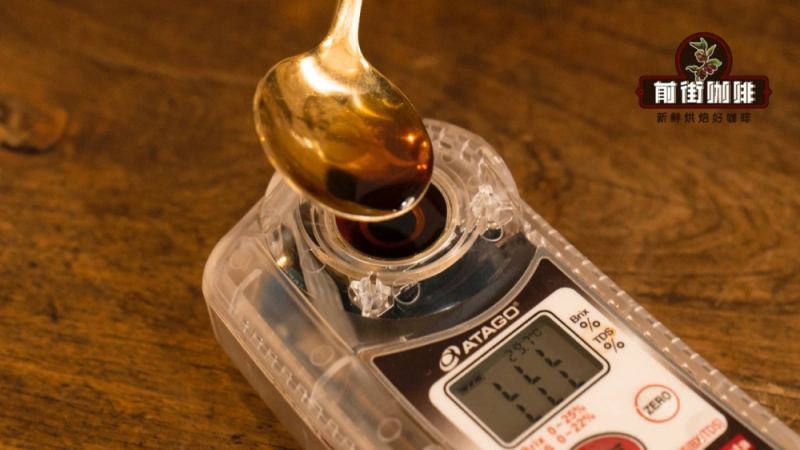
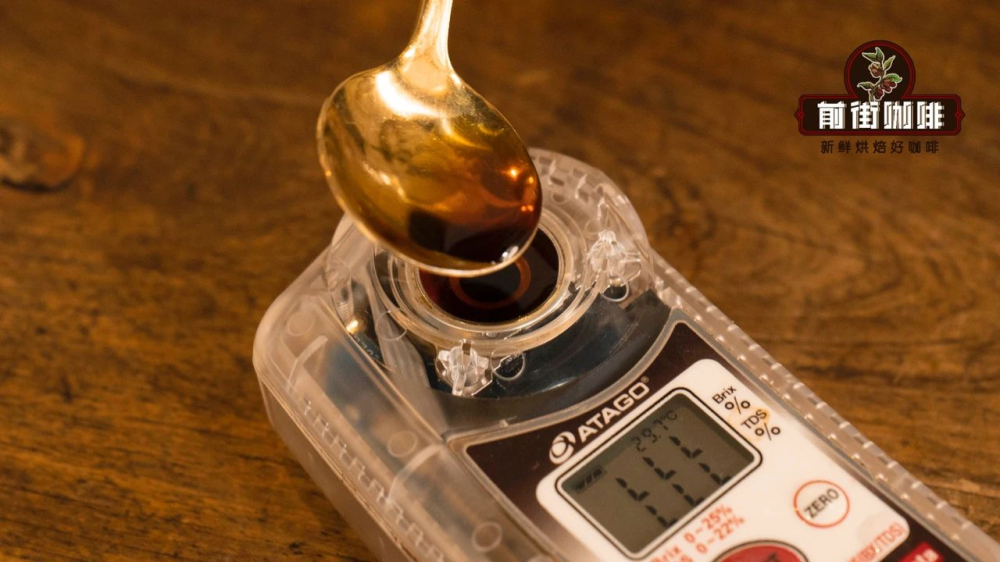
However, coffee enthusiasts who pursue precision and rigor may consider getting a dedicated measuring device. This device was invented in 2008 by Vince Fedele, president of the U.S. company VST. Simply drip 2 to 3 milliliters of cooled coffee liquid onto the optical instrument, and the coffee concentration value can be read accurately. It is very convenient to operate, and there is no longer any need to dry coffee liquid or coffee grounds in an oven as in the past, eliminating the cumbersome concentration calculation process. (The device is shown in the figure below.)
Without the aid of a VST for measurement, calculating extraction yield is considerably more troublesome. Initially, Dr. Lockhart used the simplest rough method: brew coffee with an American coffee machine, record the milliliter volume of the black coffee, then pour it into a metal container and put it in an oven to thoroughly dry off the water. In the end, only solid powder remains in the container—that is, the extracted solid flavor substances of coffee (hot-water-soluble substances). Divide the weight of the soluble substances by the weight of the coffee grounds used to obtain the extraction yield.
The above is the Golden Cup theoretical calculation formula and related knowledge compiled by Front Street Coffee. This extraction yield calculation is also applicable to pour-over coffee . Below, Front Street Coffee will use Ethiopian Huakui 4.0 as an example for demonstration. Preparation in advance is needed: make a cup of pour-over coffee, a coffee concentration tester (ExtractMojo), a titration test tube, and clean water.
Front Street Ethiopian sun-dried Huakui coffee beans
Country: Ethiopia
Region: Sidamo
Altitude: 2250-2350m
Variety: local heirloom varieties
Processing method: sun-dried processing
Flavor: rose, cream strawberry, citrus, passion fruit, oolong tea
Brewing plan:
Dose: 15g
Grounds-to-water ratio: 1:15
Grind size: fine grind (80% pass rate on No. 20 standard sieve)
Water temperature: 91°C
Dripper: V60
The brewing process is as follows:
For the first pour, add 30 grams of water and bloom for 30 seconds.
For the second pour, add 95 grams (the electronic scale shows about 125 grams), finish pouring in about 1 minute, then wait ten seconds.
For the third pour, add the remaining 100 grams (the electronic scale shows about 225 grams), finish pouring in about 1 minute 40 seconds.
Dripping is completed in about 2 minutes. Remove the dripper and finish extraction.
How do you measure coffee concentration?
First, calibrate the concentration tester and use pure water to zero the standard. Then stir the completed pour-over coffee, use a titration test tube to extract coffee liquid, place it into the coffee concentration tester, press the measurement button, and try measuring several times until the value stabilizes.
How do you calculate coffee extraction yield?
From the definition of concentration, it can be known that concentration equals the ratio of the weight of extracted substances to the coffee liquid, and extraction yield equals the ratio of the weight of extracted substances to the weight of the coffee beans.
After conversion, it can be obtained: extraction yield equals the product of concentration and the weight of coffee liquid, divided by the weight of the coffee beans.
Here Front Street Coffee generally assumes that the water absorption rate of coffee grounds is 1:2, so the coffee liquid volume is roughly 225 - (15×2) = 195 grams. If the measured concentration is 1.45%, then the extraction yield is 1.45%×195÷15=18.85%.
From this, Front Street Coffee can conclude that this cup is a pour-over coffee with a concentration of 1.45% and an extraction yield of 18.85%. Based on this, it can be judged that this is a pour-over coffee with relatively high concentration and moderate extraction yield, and this data along with factors such as ratio can then be used to adjust the extraction concentration of the coffee.
Of course, the Golden Cup is only a reference system. After all, everyone's taste preferences differ, and coffee that fits Golden Cup data is not necessarily equivalent to coffee that tastes good. Therefore, Front Street Coffee suggests that everyone should still try more and drink more—that is the more recommended approach.
In addition, the grounds-to-water ratio of pour-over coffee also greatly affects the extraction of coffee concentration. If the water ratio is too high, the extraction concentration will be insufficient and it will taste lacking in atmosphere; conversely, if there is too little water, it will overextract and the coffee will become bitter and unpleasant. Therefore, Front Street Coffee also determines the grounds-to-water ratio of pour-over coffee through pour-over practice, and will share it with everyone below.
Pour-over coffee grounds-to-water ratio
As stated above by Front Street Coffee, the pour-over coffee water-to-grounds ratios derived from the SCA Golden Cup extraction theory, along with their extraction parameters and taste differences, are as follows:
[Bold taste] 1:10~1:11, i.e. 1:12.5~1:13.5 under the Golden Cup guidelines [Moderate taste] 1:12~1:13 (i.e. 1:14.5~1:15.5 under the Golden Cup guidelines) [Light and refreshing] 1:14~1:16 (i.e. 1:16.5~1:18.5 under the Golden Cup guidelines)
When the ratio of coffee bean grams to brewing water volume is between 1:14.5 and 1:15.5, it is easiest to reach the golden range of 18% to 22% Golden Cup extraction yield and 1.15% to 1.35% concentration. This is also why Front Street Coffee has always recommended brewing at 1:15.
This parameter was determined because it had already been verified many times before. Although 1:12-1:15 is only a suggested range, Front Street Coffee still tested several parameters outside this range. Drip coffee with a 1:20 grounds-to-water ratio tastes very light, while 1:10 is quite strong. Through adjustment experiments, 1:15 is the brewing ratio that Front Street Coffee considers relatively suitable for most coffee beans. Of course, some people use 1:14 or 1:17, and none of that matters; the key is whether you can accept it yourself. What Front Street Coffee provides is only a generally acceptable parameter for everyone's reference.
Then, after determining the grounds-to-water ratio, determine the dose. Front Street Coffee's single serving is 15g of grounds, so the water amount is 225g, just right for one serving.
The above is the relevant content compiled by Front Street Coffee about the standard water-to-grounds ratio for pour-over coffee Golden Cup extraction. It is hoped that it can help coffee enthusiasts understand the related knowledge more deeply, so that in future pour-over brewing they will have more theoretical support for practice.
For more specialty coffee beans, please add the private WeChat of Front Street Coffee, WeChat ID: kaixinguoguo0925
The above content is compiled by CoffeeHunters, a coffee news website.


