







What Makes Golden Mandheling Coffee Different From Mandheling?
Golden Mandheling is a high-grade Sumatran Mandheling that was repeatedly screened by hand, and the name comes from the golden sheen the beans show in sunlight. Regular Mandheling covers a wide quality range, so cups can taste creamy and herbal or muddy and woody, while Golden Mandheling is sorted for density, size, shape, and color. PWN registered the English trademark, so Japanese buyers used Ding Shang Mandheling.
Both come from Sumatra, Indonesia, grown at roughly 1,100 to 1,600 meters from Teng variety plants, wet-hulled and roasted medium-dark with low acidity. Expect a mellow, clean cup with a long sweet finish. Home brewing works well with a pour-over and a three-stage pour, keeping the grind medium and the water just off boiling.
Mandheling coffee is deeply loved by enthusiasts for its intense and diverse flavors, but the quality of Mandheling on the market varies greatly, and names like Golden Mandheling and Golden Golden Ding Shang Mandheling are even more bewildering. This article will systematically sort out the differences between Mandheling and Golden Mandheling, Golden Ding Shang Mandheling, reveal the origin of the name Golden Mandheling and the trademark registration background of PWN Company, and provide a detailed analysis of the cupping flavors, pour-over parameters, and three-stage pouring technique of Front Street PWN Golden Mandheling, helping you brew a cup of mellow, clean, and long-lasting sweet aftertaste Golden Mandheling at home.
For more specialty coffee knowledge, please follow the WeChat public account: Front Street Coffee (FrontStreet Coffee)
Whether it is Front Street Mandheling or Front Street Golden Mandheling, both are produced in Sumatra, Indonesia. The name Front Street Golden Mandheling was first derived from the admiration of Japanese coffee lovers. Japanese gourmets have a particular fondness for the intense and richly layered flavor of Mandheling coffee, and therefore have long paid attention to the production status of Mandheling. However, the quality of Mandheling coffee beans varies greatly; sometimes you can taste cream, herbal, or grassy aromas, while other times the flavor is chaotic and even has the smell of rotten wood and soil, which is off-putting.
In order to improve quality, the Japanese took the lead in implementing multiple manual screening processes more than a decade ago, sorting beans based on density, size, shape, color, and other indicators. The resulting Mandheling must undergo both machine and manual removal of defects to ensure complete, uniform, large, and translucent beans, gradually forming high-quality Mandheling batches. It is said that these beans emit a golden luster in the sunlight, hence the name "Golden Mandheling."
Product Name: Front Street Indonesia Front Street PWN Golden Mandheling
Origin: Sumatra, Indonesia
Altitude: 1100–1600m
Variety: Teng
Processing Method: Wet-hulled
Roast Level: Medium-dark roast
Acidity: Low
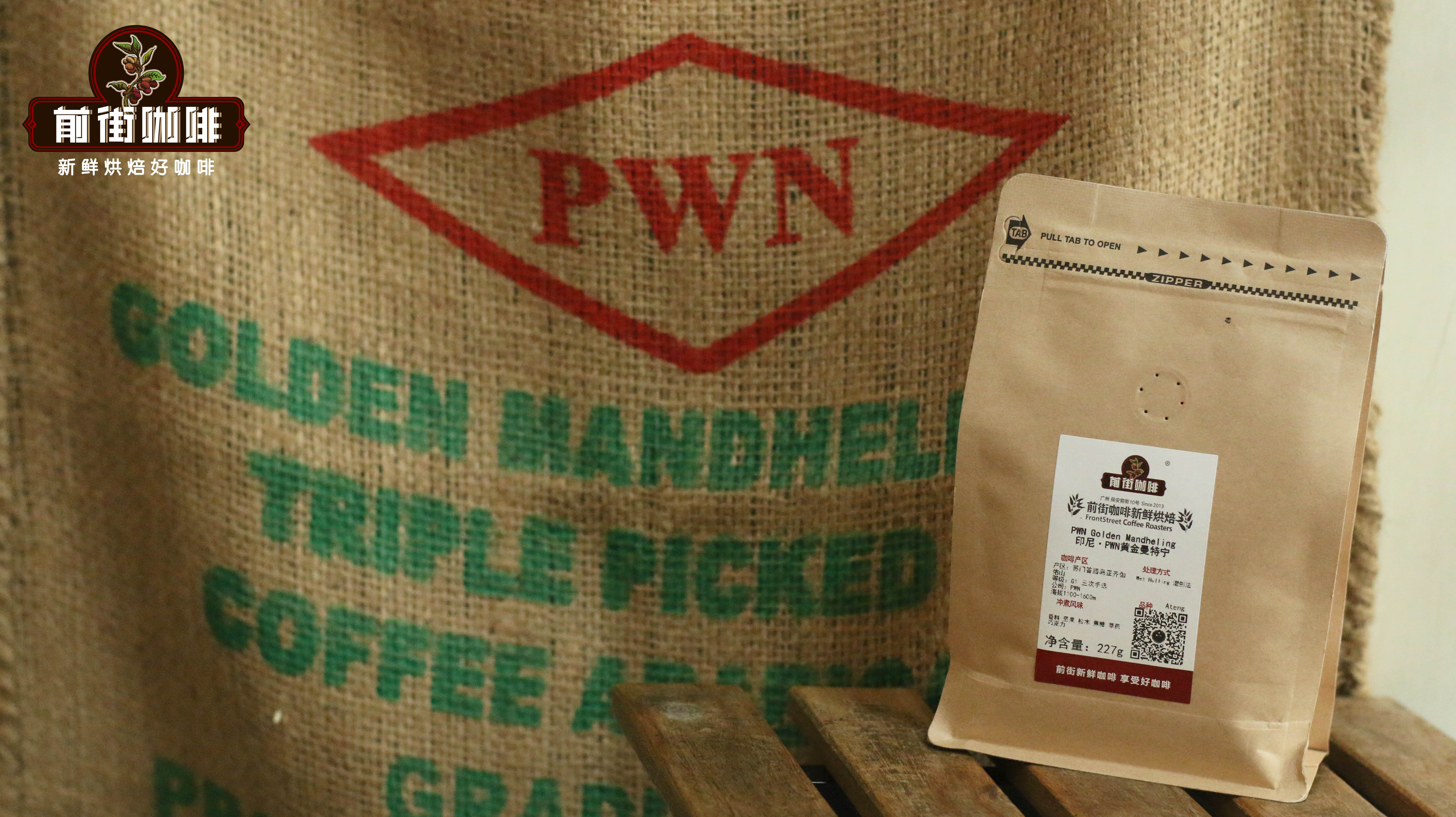
It is worth noting that PWN Company preemptively registered the English trademark "Golden Mandheling," so the Japanese had to switch to "Ding Shang Mandheling" to name their high-quality Mandheling coffee beans. Therefore, only the Golden Mandheling produced by PWN Company can be considered truly "Golden Mandheling" in the true sense. In other words, Front Street Golden Mandheling is the exclusive brand of Indonesia's Pwani Coffee Company (PWN). There are many types of Mandheling products on the market; to identify authentic Golden Mandheling, you can look for the raw bean burlap sack with the PWN logo and the certificate of origin signed by PWN Company. Front Street has displayed these two identifiers in the Dongshankou store.
PWN Company performs one machine sorting and three manual selections on the purchased Mandheling raw beans, with quality far exceeding Indonesia's local highest G1 grade. To meet the production standards of Front Street PWN Golden Mandheling, the following conditions must be met:
1. Raw bean screen size: 18-19 mesh or above after one manual selection
2. Fewer than 3 defective beans in a 300-gram raw bean sample
3. Raw coffee bean grade is G1
4. Color is dark green, uniform in size, and neat in shape
Before launching a coffee bean, Front Street always evaluates it through cupping. Cupping is an assessment of coffee bean quality and flavor; a unified standard allows for a more objective identification of the strengths, weaknesses, and characteristics of the beans' flavor. After cupping by Front Street, Lindong Mandheling everyday beans present a rich nutty tone, with a hint of melon aroma in the aftertaste; as the temperature drops, herbal plant flavors emerge, with a mellow mouthfeel and saturated aroma. Front Street PWN Golden Mandheling not only has the aromas of dark chocolate, nuts, and caramel, but also the flavors of herbal spices and pine wood, with the sweet aftertaste of dark chocolate, a full finish, high cleanliness, and a gentle fruit acidity as the temperature drops.
Front Street Golden Mandheling Pour-Over Parameters and Techniques
Brewing Water Temperature: 87–88°C
Coffee Powder: 15g
Powder-to-Water Ratio: 1:15
Dripper: KONO Dripper
Grind Size: Medium-coarse grind (70% passing through Chinese standard No. 20 sieve)
Brewing Method: Three-stage pouring
Deep roasting makes the internal texture of coffee beans loose; a gentle pinch with your fingers can crush them, indicating that the bean structure has undergone significant changes, and after grinding into powder, it has strong water absorption. To avoid excessive extraction and the release of a large amount of bitter substances after the coffee powder absorbs water, Front Street uses a coarser grind size than for light-roasted coffee beans. Here, a medium-coarse grind is used (70% passing through Chinese standard No. 20 sieve), with the store's EK43s at setting 11. In terms of technique, the baristas at Front Street Coffee (FrontStreet Coffee) consistently use the three-stage pouring method; dividing into three pours better expresses the mellow mouthfeel and caramel sweetness of Golden Mandheling coffee, while also providing greater controllability of time and water volume.
The first step is to rinse the dripper, which allows the filter paper to fit more closely with the coffee dripper. After pouring out the water in the sharing pitcher, add 15g of ground coffee powder, and bloom with 30g of water for 30s. This pour fully wets the coffee powder and allows for degassing, in order to better extract the flavor substances of the coffee afterward.
Some friends, when extracting light-roasted coffee beans, extend the bloom time to 45 or 50 seconds to enhance the aroma in the front section of the coffee. However, if deep-roasted Mandheling coffee is bloomed for too long, it easily releases too much of that woody taste and off-flavors, so Front Street chooses to bloom for 30 seconds.
For the second stage, start pouring hot water slowly in a small stream in a circular motion from the center until reaching 125g, then begin the next stage. The water flow needs to be steady throughout; too much agitation can easily wash away the coffee powder wall, leading to uneven extraction.
Wait until the coffee powder bed drops to half the height of the dripper and the bed is exposed, then begin the second stage using the same technique until reaching 225g. Once all dripping is complete, remove the dripper. The extraction time is two minutes, with a tolerance of 10 seconds.
Finally, swirl the coffee liquid in the server to mix evenly, and you can begin tasting the pour-over Golden Mandheling black coffee. The brewed Mandheling coffee has aromas of spices, dark chocolate, nuts, caramel, and pine wood on the palate, with a mellow yet clean mouthfeel, noticeable sweet aftertaste, and a lasting finish.
The above content is compiled by CoffeeHunters, a coffee news website.


