







How Do Coffee Bean Grades and Regions Differ in Colombia?
Colombia is the second-largest Arabica producer after Brazil, and its beans are tied to a chocolatey profile. The MAM label seen in supermarkets stands for Medellin, Armenia and Manizales, three commercial growing regions, while specialty production concentrates in the south, including Antioquia, Boyaca, Cauca, Huila, Narino, Santander and Tolima.
Coffee reached Colombia in the early 18th century and moved into commercial trade in the 19th century, with exports reaching roughly half of total exports by the early 20th. Huila's route to certified origin status and a pour-over recipe using a specific dripper, water temperature and three-stage pour round out the picture.
Colombia is the world's second-largest producer of Arabica coffee, and its coffee is deeply associated with chocolatey notes. This article starts from the history of cultivation, outlines the commercialization process and the establishment of the export logistics system, and then analyzes the three major commercial production regions behind the MAM label commonly seen in supermarkets, as well as the terroir characteristics of southern specialty production regions such as Antioquia, Boyaca, Cauca, Huila, Narino, Santander, and Tolima. The article especially focuses on the Huila region, explaining its journey to becoming a certified region of origin, and shares Front Street Coffee's brewing recipe for Colombian Huila coffee beans, including dripper selection, water temperature, coffee-to-water ratio, and the three-stage pouring method.
Colombia's Arabica coffee production ranks second in the world, after only Brazil. When people mention Colombian coffee beans, they always think of that signature chocolate flavor. Coffee originated in Ethiopia, and if no one had introduced seeds or seedlings to Colombia, today's scene would naturally not exist. However, there is no unified account of the starting point of coffee cultivation in Colombia. One view holds that Jesuit monks brought it in 1723, after which it gradually spread to various places and developed into a cash crop.
It was not until the 19th century that Colombian coffee entered the commercialization stage, and by the late 19th century it already occupied an important position, with coffee becoming one of the key sources of government fiscal revenue. In the early 20th century, Colombia built a logistics system that enabled smallholder coffee farmers in remote areas to export their beans more smoothly, and coffee exports thus accounted for about 50% of total exports.
If you go to a supermarket to choose Colombian coffee beans, you are very likely to see the "MAM" label. Some people may think that "MAM" represents a certain production region. Front Street explains here that, strictly speaking, "MAM" is made up of three major production regions: Medellin, Armenia, and Manizales. These three major regions are the most widely known among commercial coffee beans.
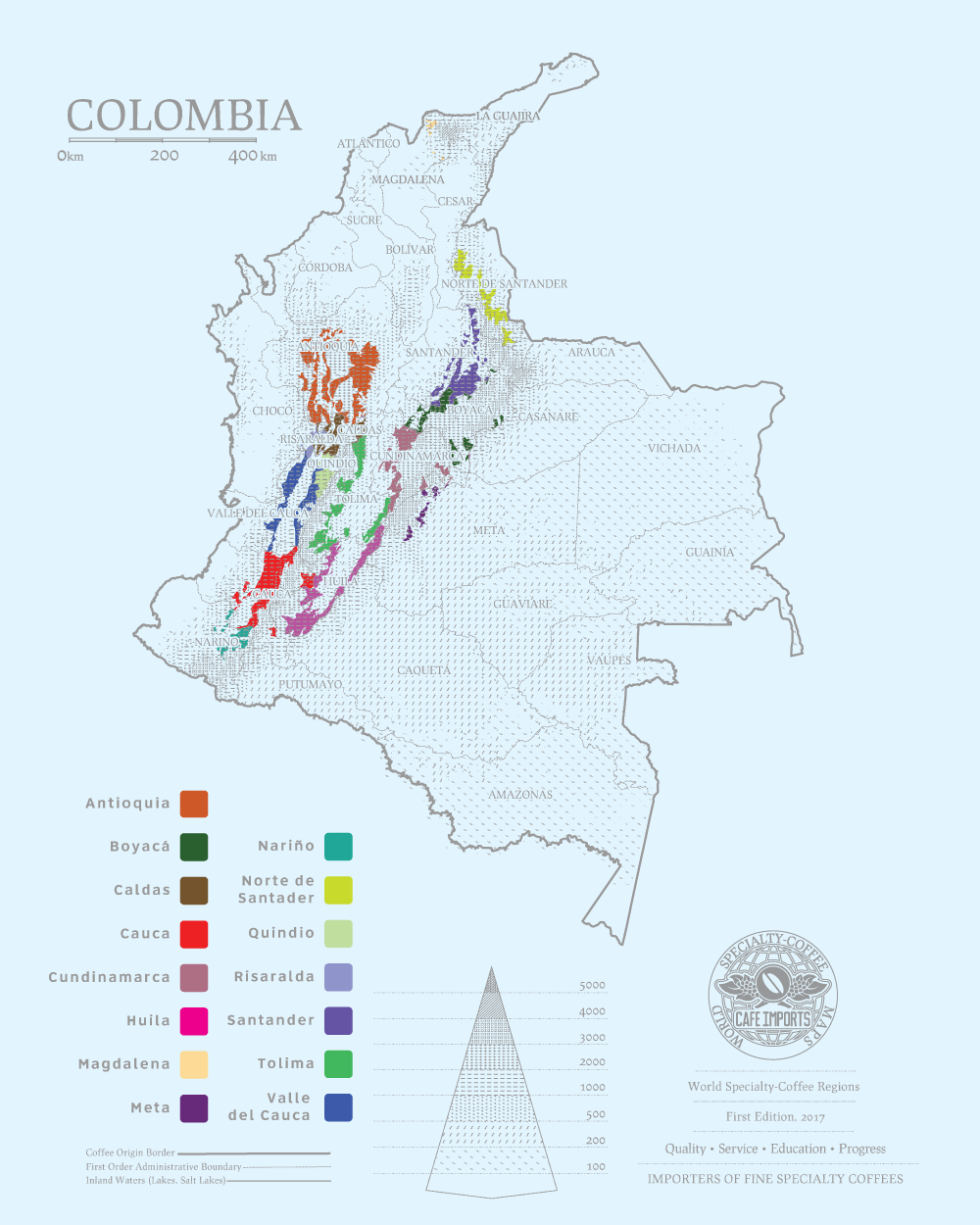
Colombia's specialty coffee production regions are mostly concentrated in the south. Below, Front Street introduces them one by one:
[Antioquia]
Antioquia is the region where coffee first took root in Colombia. Most of the area is at high altitude, located near the high mountains of the Andes, and it is a critically important coffee-producing region in Colombia.
[Boyaca]
Boyaca is one of the earliest regions in Colombia to grow coffee. Today this region has more than 10,000 smallholder coffee farmers, each carefully processing carefully selected coffee cherries at their own managed processing stations. This region has a long history of cooperation with FNC.
[Cauca]
The Cauca region borders Tolima and Huila and is a certified Colombian coffee region of origin, with an average altitude of about 1,700 meters. About 80% of its terrain is mountainous, and two major volcanoes, Sotara and Petacas, are nearby, providing fertile volcanic soil for coffee cultivation.
[Huila]
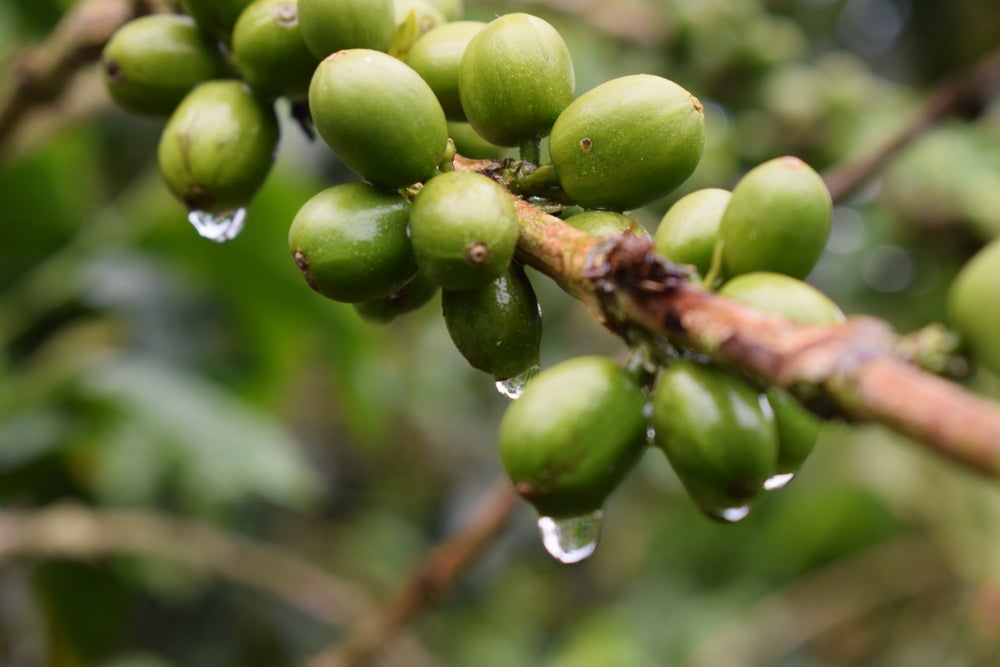
Huila is the most renowned specialty coffee region in Colombia, located on one side of the Andes and close to Colombia's second-highest peak, the Nevado del Huila volcano. The fertile soil, dense forests, and humid climate here are extremely favorable for coffee cultivation. Several important rivers in Colombia converge in the Huila region, bringing abundant water resources and moisture.
[Narino]
Narino was the first region to obtain certified Colombian coffee region-of-origin status. The terrain in this region is steep and includes active volcanoes. The Galeras volcano has brought large amounts of fertile volcanic soil to Narino.
[Santander]
Santander is a well-known specialty coffee region in northern Colombia. Its lower altitude and higher temperatures make the coffee taste stronger and the mouthfeel rounder. As of 2020, Santander had 32,000 coffee-growing households and 37,000 coffee farms. After cupping coffee beans from the Santander region, Front Street found that the flavor is intense, the aftertaste is long, and it has a unique fresh herbal note.
[Tolima]
Tolima is Colombia's third-largest coffee-producing region, producing 12% of the country's coffee beans. It is completely surrounded by the Andes and the Magdalena River basin, making it a remote environment.
Friends who follow Front Street's everyday coffee bean series will notice that Front Street's everyday beans are all made up of representative production regions. Among them is this Colombian Huila coffee bean.
Huila is Colombia's largest specialty coffee region. It is not only the region with the highest output, but its coffee quality is also astonishing, and it finally became a certified Colombian coffee region of origin in 2013.
If you walk into a Front Street store and ask the barista which region they would choose to represent Colombia, Front Street's baristas will all answer the Huila region. Colombian Huila coffee is characterized by slight fruity acidity, rich nutty and chocolate flavors, and a balanced profile.
It is often said that the best ingredients often need only the simplest cooking methods. The same is true for coffee. The washed processing method can present the most basic flavor of a production region, with the cleanest and brightest cup; natural processing has a more intense aroma, more obvious sweetness, and a thicker mouthfeel.
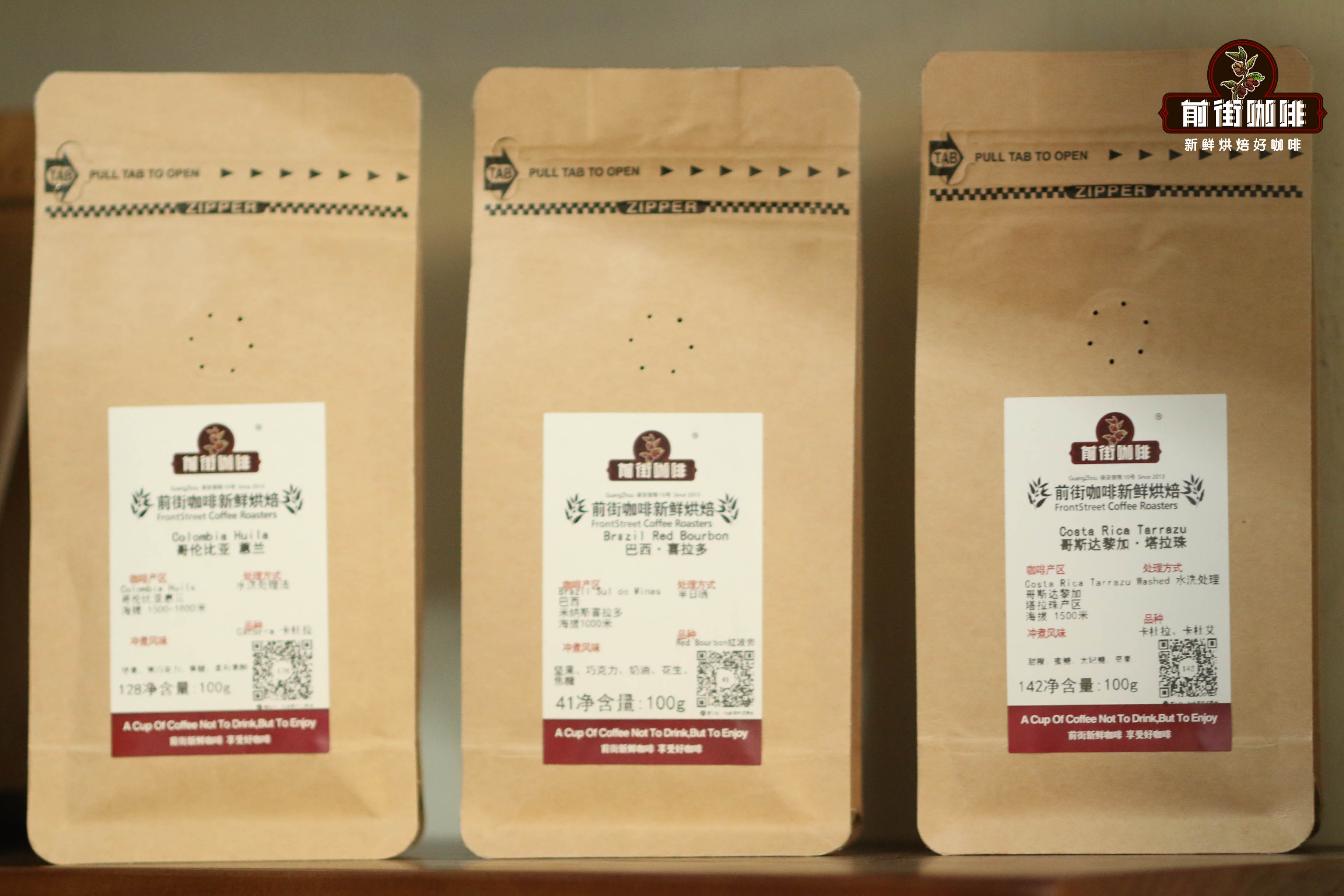
Front Street Colombian Huila coffee beans
Region: Huila, Colombia
Altitude: 1,500 meters—1,800 meters
Variety: Caturra
Processing method: washed processing
African coffee beans mostly use light roasting to highlight acidity, Asian coffee beans mostly use dark roasting to highlight body, while American coffee beans mostly use medium roasting to highlight aroma. Front Street's roaster, considering the need to highlight the nutty, chocolatey, and other notes of Colombian Huila coffee and to enhance caramel-like sweetness, used a medium roast.
When brewing this Colombian Huila coffee bean, Front Street Coffee's baristas, combining its basic flavor and roast level, use hot water at 90 degrees Celsius to extract as much aroma as possible. However, to avoid over-extraction and bitterness caused by water that is too hot, they choose the faster-flowing Hario V60 dripper. At the same time, to give the final cup a richer layered feel, Front Street recommends using the three-stage pouring method.
Dripper: Hario V60
Water temperature: 90 degrees Celsius
Dose: 15 grams
Coffee-to-water ratio: 1:15
Grind size: 80% passing a No. 20 sieve
First pour 30 grams of water for a 30-second bloom, then slowly pour the second stage in a circular motion with a small stream until 125 grams. When the water level in the dripper drops to 1/2, continue pouring the third stage until 225 grams. Finally, wait for the water to completely pass through into the container below, then remove the dripper. The total extraction time is about 2 minutes.
For more coffee bean information, please follow Coffee Workshop (WeChat public account: cafe_style). For professional coffee knowledge exchange, please add WeChat ID: kaixinguoguo0925
The above content is compiled by CoffeeHunters, a coffee news website.


