







What defines the Sidama coffee region and its Huakui lots?
Sidama is a renowned Ethiopian specialty coffee region in the south, sitting at 1,400 to 2,200 meters near Kenya. Unlike Yirgacheffe, known for bright citric acidity and jasmine, Sidama offers a fuller mouthfeel with rich fruity and floral aromas. Its sun-dried lots, including Hambela Geisha from Guji sold as Huakui, have placed well in COE and TOH competitions.
The region's terroir, altitude, soil, and microclimate, works together with natural coffee bean processing to build that depth. Washed Sidama green coffee bean lots tend to be light green and elongated oval. Hambela Geisha is tracked through numbered vintage versions, 3.0 through 6.0, and the name Huakui refers to the lot from the Guji-area Hambela station rather than a separate variety.
Sidamo and Yirgacheffe both belong to Ethiopia's famous specialty coffee regions, yet they present completely different flavor profiles. Yirgacheffe is known for its bright citric acidity and jasmine floral notes, while Sidamo delivers a fuller, heavier mouthfeel with rich fruity and floral aromas. This article provides a comprehensive overview of Sidamo's terroir conditions—altitude, soil, microclimate—explains the sun-dried processing method in detail, and focuses on the Hambela Geisha coffee from the Guji region: from the TOH championship batch to the origin of the name "Huakui," and the logic behind distinguishing the 3.0 through 6.0 vintage versions. It also includes Front Street Coffee's brewing parameter recommendations and freshness management insights to help coffee enthusiasts gain a more complete understanding of this region's unique charm.
Both Sidamo coffee and Yirgacheffe coffee come from Africa and are both Ethiopian coffee beans, yet their flavor directions are vastly different. Yirgacheffe's clear, transparent citric acidity and jasmine-like aroma leave a deep impression; while coffee from the Sidamo region showcases abundant juiciness and rich floral-fruity aromas, giving an overall impression of depth and substance—seemingly a step further in mouthfeel complexity than Yirgacheffe. Of course, these are simply two distinct stylistic preferences, each excellent in its own right, each with its own merits.
Perhaps we've habitually been confined by the perception of washed Yirgacheffe, but we should know that Sidamo, like Yirgacheffe, is a renowned Ethiopian specialty coffee region. Yirgacheffe has its washed representative, while Sidamo has its sun-dried Huakui holding the fort—and Front Street's sun-dried Huakui 5.0 is the most popular!
Now Front Street will take you into the Sidamo coffee region.
Like Yirgacheffe, Sidamo has long been internationally renowned. In many international coffee competitions, the name of the Sidamo region frequently appears at the top of award lists. In recent years, in green bean competitions such as COE and TOH, the Sidamo region has appeared on the lists even more frequently.
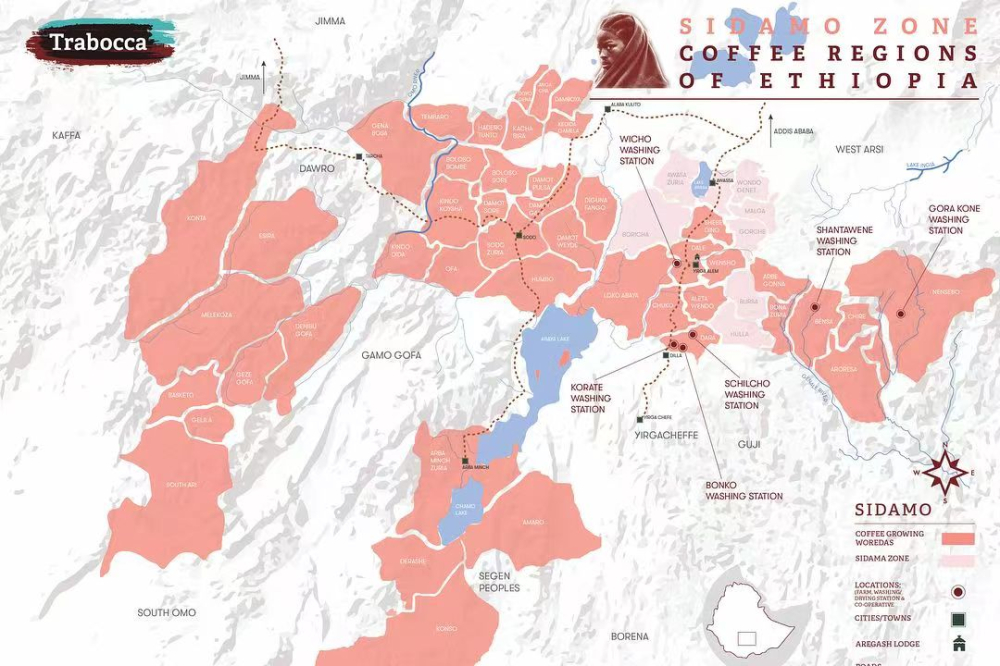
The Sidamo region has an altitude between 1,400 and 2,200 meters, located in southern Ethiopia, adjacent to Kenya, and is a well-known specialty coffee area. Washed Sidamo green beans are light green, relatively small in size, elongated oval in shape, plump, with balanced overall quality, a fragrant and mellow aroma, and a long-lasting finish that carries a sense of wild beauty. Front Street believes: Sidamo's coffee flavors are extremely diverse—different soil types, microclimates, and countless native coffee varieties result in significant differences and distinctive characteristics among coffees produced in various towns.
According to Front Street's understanding: from 2010 to 2012, this region consecutively scored 92 to 94 points on CR, the authoritative American coffee evaluation website, demonstrating that the green bean quality here is extraordinary. Sidamo's coffee flavors are very diverse. Different soil types, microclimates, and countless native coffee varieties, combined with the towering mountains, highlands, plateaus, valleys, and plains within its borders, create rich topographical variation. The geology here consists of nutrient-rich, well-draining volcanic soil, with soil depth approaching two meters, and surface soil that is dark brown or brown. The greatest advantage here is that soil fertility is maintained through organic matter cycling—fallen leaves from surrounding trees or decaying plant roots naturally become fertilizer. What sets Sidamo apart from typical African coffees is its clear fruity acidity, smooth mouthfeel, and delicate floral and herbal aromas.
When mentioning Sidamo, one must bring up Huakui coffee, with the most representative being the sun-dried Huakui. Huakui coffee comes from Hambela in the Guji region of Sidamo. The Guji region originally belonged to Sidamo, but in 2010 it was separated by the Ethiopia Commodity Exchange (ECX) and became an independent new region. The Guji region is located southeast of Yirgacheffe, with complex terrain featuring towering mountains, valleys, and plains interwoven. The geology of this area is fertile black soil (Vertisol), with soil depth of nearly two meters and an average altitude exceeding 1,800 meters. The significant day-night temperature difference brought by geographical characteristics gives the area all the terroir conditions needed to produce high-quality specialty coffee.
What exactly is Huakui coffee?
Huakui coffee beans were originally named Hambela; the name "Huakui" was given by a domestic green bean trader. This bean is produced in Hambela, located in Guji, Ethiopia's largest coffee region, administratively under Oromia State. Hambela's western side faces Yirgacheffe's Kochere across the mountains, with the two regions separated by a highland 3,200 meters high and about 30 kilometers wide; to the southeast and north it borders Guji's Shakiso, Uraga, and Kercha sub-regions respectively, making it Ethiopia's highest-altitude coffee sub-region.
Currently, the Hambela region has approximately 20 processing plants of various scales. In 2017, Ethiopian DW Green Bean Company submitted its coffee beans to the TOH (the Taste Of Harvest) green bean competition hosted by the African Coffee Association, and a sun-dried batch from the "Buku Abel" processing plant won the TOH Ethiopia championship with its intense strawberry and cream aromas. That year, this batch of green beans was introduced to China by Beijing green bean trader Hongshun, and in the same year Li Jianfei used this bean to win second place in the 2017 World Brewers Cup China region. This Ethiopian bean stood out remarkably among many Geisha competition beans, and was therefore given the name "Huakui." (Geisha in Japanese means geisha, and Huakui means the top geisha, used to indicate this bean's outstanding quality.)
In other words: only sun-dried coffee beans produced and processed by Buku Abel can be called "Huakui." The Huakui is grown at altitudes above 2,000 meters, with sugarcane, bananas, and other tropical plants growing around the coffee trees, providing appropriate shade. Under such growing conditions, Huakui coffee's sweet-and-tart, smooth characteristics are created, and the sun-dried processing method further enhances this coffee bean's sweetness.
Huakui coffee variety
Some may ask: the variety labeled on the Huakui 5.0 packaging is "local native species"—what variety is that exactly? Front Street tells you: Ethiopia, as the birthplace of coffee, possesses an enormous number of coffee varieties—whether unknown or known, Ethiopia can be called a treasure trove of varieties. Many varieties have yet to be discovered, and since the Ethiopian government takes confidentiality measures regarding species genetic information, they are collectively called local native species. Therefore, Huakui 5.0's variety is labeled as local native species.
Sidamo coffee bean processing methods
Yirgacheffe coffee's processing method is washed, but in fact Yirgacheffe originally used the traditional sun-dried processing method; currently, sun-dried processed coffee beans account for over seventy percent of Ethiopia's output. Coffee beans from the Sidamo region are likewise primarily sun-dried.
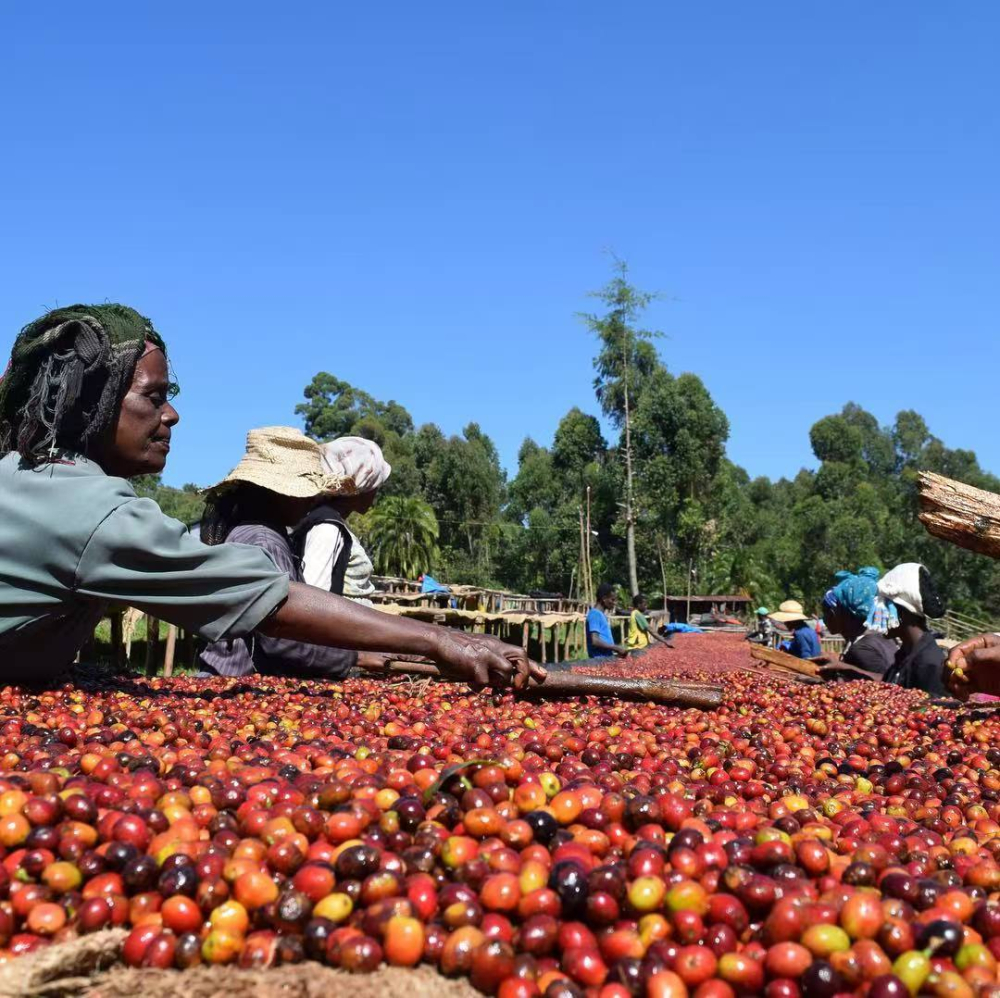
The sun-dried processing method is one of the oldest and most classic processing methods. The steps of sun-dried processing are simpler compared to other methods: the coffee cherries are sun-dried for several weeks until the moisture content drops to around 11%, then the skin and pulp are removed together by machine, after which they are stored in warehouses awaiting export.
Sidamo green coffee beans have a slightly grayish hue, with some being coarse and others fine in size. The acidity ranges from soft to intense, the body from light to full, with sweet and spicy notes—it is one of the garden coffees of the southern Ethiopian highlands. What sets it apart from typical African coffees is Sidamo's clear fruity acidity, smooth mouthfeel, and delicate floral and herbal aromas.
Sun-dried Sidamo's flavor leans toward floral notes but with a slight earthy taste. Washed Sidamo carries a nutty fruit aroma and a mild cocoa note, but both share the common traits of a smooth, slightly viscous mouthfeel with comfortable, pleasant acidity and aroma. Light or medium roast is suitable for single-origin, while medium or dark roast is suitable for blends and as a good Espresso base.
There's another question: why does Huakui have 3.0, 4.0, 5.0, 6.0, etc.? What do these mean? Let's take a look together.
Huakui coffee beans are also a type of agricultural product, naturally related to climate, so each year's flavor will still have some differences. The naming convention of Huakui X.0 is based on the year: Huakui 2.0 was released in 2018, Huakui 3.0 and 3.1 in 2019, Huakui 4.0 in 2020, Huakui 5.0 in 2021, and Huakui 6.0 in 2022. In other words, this is how each year's coffee beans are distinguished.
Front Street brewing recommendations:
To enjoy a delicious cup of coffee, Front Street believes that the freshness of coffee beans is a crucial factor—only fresh coffee beans can allow you to experience coffee's rich flavors to the fullest. The coffee beans shipped by Front Street Coffee (FrontStreet Coffee) are all within 5 days of roasting, because Front Street deeply understands the significant impact of coffee bean freshness on flavor. Front Street's roasting philosophy is "Freshly roasted good coffee," ensuring every customer who places an order receives the freshest coffee. Coffee beans need a resting period of about 4-7 days, so when customers receive them, they are at their optimal flavor.
Of course, some customers need Front Street to grind the beans for them, and that's fine too, but Front Street must remind you: once coffee beans are pre-ground, they no longer need resting, because during transportation, the pressure from carbon dioxide inside the packaging also rounds out the coffee's flavor, so you can brew a cup immediately upon receiving the ground coffee. However, ground coffee needs to be brewed promptly, because ground coffee oxidizes relatively quickly upon contact with air—meaning the coffee's flavors will dissipate faster, and the flavor won't be as good. Therefore, Front Street recommends purchasing whole beans and grinding fresh for each brew, so you can better taste the coffee's flavors.
Front Street's brewing parameters for sun-dried Huakui coffee:
As a light-roasted Yirgacheffe, Front Street chose: V60 dripper, water temperature 90°C, water-to-coffee ratio 1:15, coffee dose 15g, grind size (80% passing through China's No. 20 standard sieve)
Using a staged extraction approach, bloom with 2 times the coffee dose in water, i.e., 30 grams of water for a 30-second bloom. The reason a blooming process is needed is to allow the coffee grounds to release their internal carbon dioxide gas, thereby making the subsequent extraction more stable. Pour in a slow circular motion until reaching 125 grams, then pause; continue pouring until 225 grams and stop. After the water in the dripper has fully drained, remove the dripper. Timing starts from the beginning of pouring, with an extraction time of 2'00". Next, pick up the entire cup of coffee and swirl it to mix evenly, then pour it into a cup for tasting.
[Sun-dried Huakui 5.0 Coffee Flavor] Floral and fruity aromas are very pronounced—citrus, passion fruit, strawberry, oolong tea—with high sweetness.
At Front Street Coffee (FrontStreet Coffee), there are quite a few Ethiopian single-origin beans, mostly from the Yirgacheffe and Sidamo regions. Among them, washed Yirgacheffe coffee is Front Street's most popular daily bean and also the top choice for beginners, offering excellent value for money! Front Street Huakui is the most popular single-origin, and both can be ordered from the Tmall flagship store. Of course, Front Street Coffee (FrontStreet Coffee) also has dozens of single-origin coffees from different countries and regions—coffee lovers are in for a treat!
The above content is compiled by CoffeeHunters, a coffee news website.


